Rafael Yglesias - Hot Properties
Здесь есть возможность читать онлайн «Rafael Yglesias - Hot Properties» весь текст электронной книги совершенно бесплатно (целиком полную версию без сокращений). В некоторых случаях можно слушать аудио, скачать через торрент в формате fb2 и присутствует краткое содержание. Город: New York, Год выпуска: 2010, ISBN: 2010, Издательство: Open Road Integrated Media LLC, Жанр: Современная проза, Юмористическая проза, на английском языке. Описание произведения, (предисловие) а так же отзывы посетителей доступны на портале библиотеки ЛибКат.
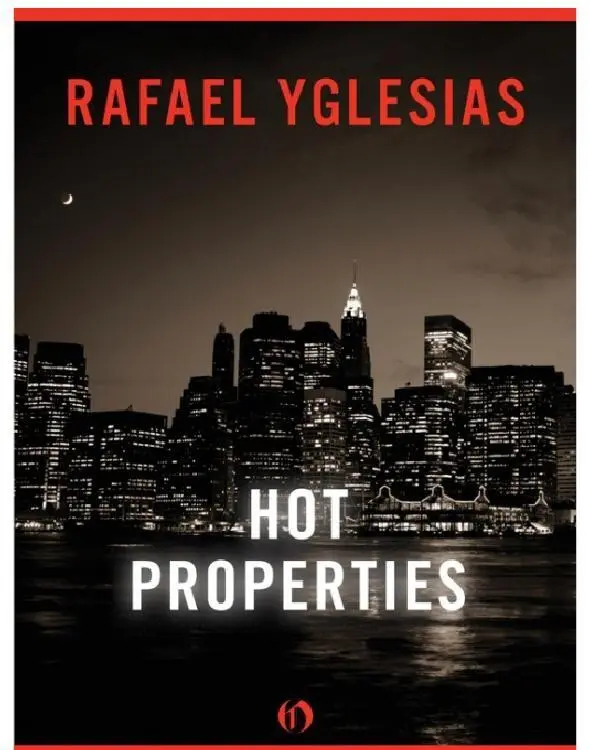
- Название:Hot Properties
- Автор:
- Издательство:Open Road Integrated Media LLC
- Жанр:
- Год:2010
- Город:New York
- ISBN:9781453205082
- Рейтинг книги:3 / 5. Голосов: 1
-
Избранное:Добавить в избранное
- Отзывы:
-
Ваша оценка:
Hot Properties: краткое содержание, описание и аннотация
Предлагаем к чтению аннотацию, описание, краткое содержание или предисловие (зависит от того, что написал сам автор книги «Hot Properties»). Если вы не нашли необходимую информацию о книге — напишите в комментариях, мы постараемся отыскать её.
Rafael Yglesias’s most sharp-tongued satire,
exposes the greed, envy, and backbiting in a media world bloated with money and power.
This ebook features a new illustrated biography of Rafael Yglesias, including rare photos and never-before-seen documents from the author’s personal collection.
Touted by the gossip columns as a roman a clef about the publishing world, Yglesias's fourth novel has definite commercial potential, since there are always people who like to read sordid tales about the media. Focusing on a group of ambitious, opportunistic New York yuppies, each desperate for success, power, fame, money and glamorous sexual partners, Yglesias follows his characters as their aspirations flourish or fade. And even for the one person who comes up with a smashing bestseller, happiness is an elusive emotion, banished by inner fear and self-loathing. The leading players in this fermenting brew are introduced in the book's opening scene, a dinner party so exquisitely awkward that even the reader is embarrassed. Thereafter we watch an aspiring playwright sell out to Hollywood; a sexy blonde discover she can really write, but must use her body to assure publication; a blocked novelist lose his scruples, professional and personal; a journalist at a leading newsmagazine realize that his way to the top has been sabotaged by office intrigue. Yglesias views his characters with cynicism, but he knows how to create the dramatic momentum that will have readers turning the pages. And if his book does become a bestseller, he will have the ironic last laugh.
Copyright 1986 Reed Business Information, Inc.
“
[is] the novel you want in the Hamptons. It lambastes the pretensions of the people you’ve been glaring at on the beach all day, and excoriates the city you’ve left behind.”
— “Sharp, funny, and fresh insight into the American literary world…”
—
From Publishers Weekly
Review
Hot Properties — читать онлайн бесплатно полную книгу (весь текст) целиком
Ниже представлен текст книги, разбитый по страницам. Система сохранения места последней прочитанной страницы, позволяет с удобством читать онлайн бесплатно книгу «Hot Properties», без необходимости каждый раз заново искать на чём Вы остановились. Поставьте закладку, и сможете в любой момент перейти на страницу, на которой закончили чтение.
Интервал:
Закладка:
Betty, embarrassed, tried to head her off. “I thought you said—”
“—David can try to write seriously. I can only write about these airheads who—”
“Stop! I thought from what you said that this was David’s. Of course you can try to write a novel.”
“Try?” Patty had never yelled at Betty and she had little reason to. But keen resentment suddenly ballooned in her mind. She felt overwhelmed by everyone’s attitude toward her: the silly little blond who wasn’t even permitted the delusions everyone else has. Betty can think of herself as another Maxwell Perkins, but Patty can’t hope to be Fitzgerald. “I’m doing it!” she shouted at Betty, leaning over the table and shooting the words at her.
Betty held up her hands, surrendering. “Okay. That’s great.” She looked down at the package.
Patty, her anger spent, sat back and stared off, an exhausted shopper whose buying impulse is satisfied but now wonders if poverty will be the consequence. Had she bankrupted the friendship, or, more to the point, Betty’s willingness to be a sympathetic reader?
Betty looked up. “When did you do this?”
Patty couldn’t bring herself to return the glance. “Last two months,” she said, sulking.
“It’s the whole book?”
“No, just half. I don’t know! That’s why I wanted you to read it. I think it’s … well, I just don’t know where it’s going.” Patty had straightened and looked at Betty once again, apologizing with her tone and her wide-open pleading eyes.
“I’m really impressed,” Betty said with feeling. “And not because I didn’t think you could!”
“I’m sorry.”
“I can’t believe you said that.”
“I’m awful, aren’t I?”
“Yes,” Betty said, exaggerating a frown of disapproval for a moment, before she relaxed into a smile. “I’ll read it tonight.”
“Call me when you’re done. I don’t care how late.”
Betty smiled, confidently back to her role of the calm, mature elder sister. “I’ll call you tomorrow. I might be on the phone with Tony late and have to fall asleep. So don’t wait up worrying.”
“You mean you’re going to sleep tonight instead of reading my manuscript? You care more about talking to your husband than my work?” Patty said, making it a great joke, but keeping enough of a glint in her eye to tell Betty that in fact it was the way things should be.
“No, I don’t,” Betty said, playing along. “But I have to keep up appearances or you’d gossip about me.”
And they laughed like girls again, playing at adulthood and giggling at the naughtiness of it. But something of Patty’s angry outburst — a faint echo of distant artillery — still rang in their ears and worried their happy tones.
CHAPTER 10
Fred’s life caught excitement. Fate tossed him a series of slow glamorous pitches right into a large infallible mitt. Tom Lear befriended him with a vengeance. He took Fred to see a rough cut of the movie that had been made of his screenplay, which meant that Fred got to sit with Tom. the famous director Jay Forsch, and Sam Billings, the producer, while they discussed what changes could be made in the editing. Tom solicited Fred’s opinion and he babbled away, inspired by Tom’s easy manner, feeling no pressure or self-consciousness. To his astonishment, Forsch and Billings listened and — agreed! Later that night, when he told Marion that the world-famous director and producer were going to cut two scenes at his suggestion, she nodded at Fred as if he were speaking in a foreign language and she had to fight in order to understand him.
Lear, Forsch, and Billings took him to Elaine’s afterward. All the important people in the restaurant — with the exception of Woody Allen — came over to their table to chat. Fred was introduced to each of them. Names that before then existed only on film credits, book jackets, magazine covers. Fred shook their actual hands and enjoyed considerable success. He frankly told the famous that he loved their work (didn’t have to lie once, he told Marion), and they not only didn’t despise his compliments, but seemed to enjoy them. The whole thing was unbelievable. It was as though he had merged into celluloid: after a lifetime of watching, he was up there playing the scene!
Lear took him along to a series of exclusive screenings for the movie-business crowd in New York. They usually ended up joining a variety of glamorous people for dinner afterward at Wally’s, or Cafe Central, or Orso’s, or Texarcana, a changing series of “hot” restaurants with subtle distinctions made over who merited what kind of table. In some, sitting in the back room was everything — in others, it was death. A few were presumably secret (like Raos, located on a Mafia-protected block in the midst of a devastated and scary section of Spanish Harlem), though in fact the chic crowd all seemed to know of those. Others, such as Elaine’s, were landmarks, sacred sites that demanded pilgrimage. Because of the people he accompanied, Fred experienced service he had never heard of — entrees cooked that didn’t exist on menus, complimentary drinks, waiters standing asleep on their feet at two in the morning waiting patiently for them to go home, even though they had finished eating hours before. He marveled at it. Like an astronaut viewing the surface of an alien world, he found every detail stunning.
Once he was known by these restaurants as part of the crowd, he found himself welcomed as though he were a celebrity. Sometimes he was even seated ahead of other famous people. The first time that happened he replayed the moment over and over in his mind, recalling it to memory blissfully, the way one might cherish an ecstatic night of love with an ideal mate, staring off in happy reverie for minutes on end. The way those famous faces watched him get in before them, their brows furrowing, attempting to place him. Who the hell is that fat little Jew? he imagined them thinking. I’d better smile at him, he must be important.
Only I’m not important, he would be forced to remind himself. But even that hardly depressed his elation. At least he was there. And he could talk to these people. They actually listened to him.
There was a price he had to pay for this happiness, however. Marion provided the bill. Since Tom’s invitations involved screenings, permitting him only one guest, she couldn’t come. She could have joined them for dinner after the movie, but she had refused on the basis of how late that would make the evening, too late for her to then get a good night’s sleep. Of course once she heard the stories of whom they were meeting, she changed. Asked to come along. By then Fred didn’t want her to. He didn’t know why, but her switch in attitude angered him. Maybe it was that having spent a few nights without her, he realized how much more relaxed he was. He seemed to be more intelligent when she wasn’t around. People liked him better. She wasn’t there to forever burst his balloon.
Keeping her away was hard.
“Where are you going tonight?” she asked.
“I don’t know,” he said. “We’re going to the Paramount screening room — you know, the one where it’s all Eames chairs.”
“Yeah, you told me. Where are you going later?”
“I don’t know.” A lie. They were going to Elaine’s. “We’re meeting Sam Billings, Tom’s producer—”
“I know who he is. When will you know where?”
“I guess, uh … not until we get there. Billings is meeting us at the screening room.” A lie. Billings wasn’t going to the screening. Fred realized only now that if he failed to dissuade her from coming, he had just told a falsehood that might be easily exposed. “I’ll call you from the restaurant.”
“I’m supposed to sit at home starving until you call?”
Читать дальшеИнтервал:
Закладка:
Похожие книги на «Hot Properties»
Представляем Вашему вниманию похожие книги на «Hot Properties» списком для выбора. Мы отобрали схожую по названию и смыслу литературу в надежде предоставить читателям больше вариантов отыскать новые, интересные, ещё непрочитанные произведения.








Обсуждение, отзывы о книге «Hot Properties» и просто собственные мнения читателей. Оставьте ваши комментарии, напишите, что Вы думаете о произведении, его смысле или главных героях. Укажите что конкретно понравилось, а что нет, и почему Вы так считаете.