Rafael Yglesias - Hot Properties
Здесь есть возможность читать онлайн «Rafael Yglesias - Hot Properties» весь текст электронной книги совершенно бесплатно (целиком полную версию без сокращений). В некоторых случаях можно слушать аудио, скачать через торрент в формате fb2 и присутствует краткое содержание. Город: New York, Год выпуска: 2010, ISBN: 2010, Издательство: Open Road Integrated Media LLC, Жанр: Современная проза, Юмористическая проза, на английском языке. Описание произведения, (предисловие) а так же отзывы посетителей доступны на портале библиотеки ЛибКат.
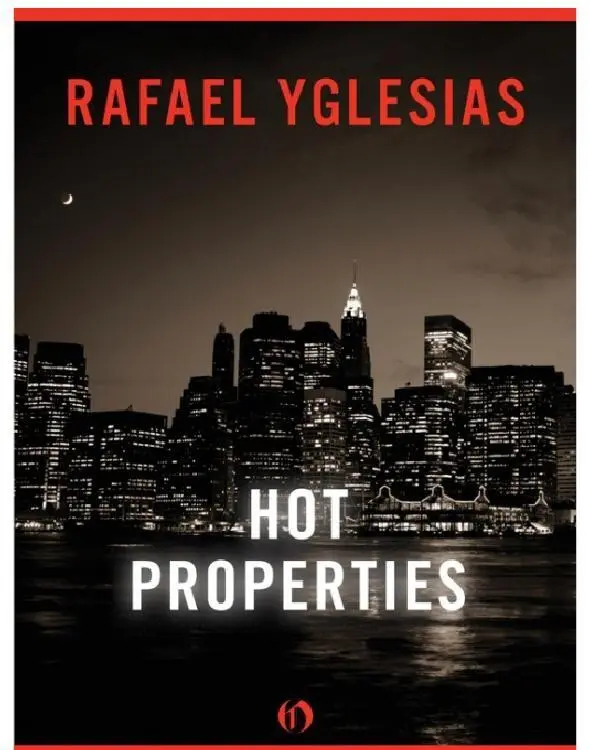
- Название:Hot Properties
- Автор:
- Издательство:Open Road Integrated Media LLC
- Жанр:
- Год:2010
- Город:New York
- ISBN:9781453205082
- Рейтинг книги:3 / 5. Голосов: 1
-
Избранное:Добавить в избранное
- Отзывы:
-
Ваша оценка:
Hot Properties: краткое содержание, описание и аннотация
Предлагаем к чтению аннотацию, описание, краткое содержание или предисловие (зависит от того, что написал сам автор книги «Hot Properties»). Если вы не нашли необходимую информацию о книге — напишите в комментариях, мы постараемся отыскать её.
Rafael Yglesias’s most sharp-tongued satire,
exposes the greed, envy, and backbiting in a media world bloated with money and power.
This ebook features a new illustrated biography of Rafael Yglesias, including rare photos and never-before-seen documents from the author’s personal collection.
Touted by the gossip columns as a roman a clef about the publishing world, Yglesias's fourth novel has definite commercial potential, since there are always people who like to read sordid tales about the media. Focusing on a group of ambitious, opportunistic New York yuppies, each desperate for success, power, fame, money and glamorous sexual partners, Yglesias follows his characters as their aspirations flourish or fade. And even for the one person who comes up with a smashing bestseller, happiness is an elusive emotion, banished by inner fear and self-loathing. The leading players in this fermenting brew are introduced in the book's opening scene, a dinner party so exquisitely awkward that even the reader is embarrassed. Thereafter we watch an aspiring playwright sell out to Hollywood; a sexy blonde discover she can really write, but must use her body to assure publication; a blocked novelist lose his scruples, professional and personal; a journalist at a leading newsmagazine realize that his way to the top has been sabotaged by office intrigue. Yglesias views his characters with cynicism, but he knows how to create the dramatic momentum that will have readers turning the pages. And if his book does become a bestseller, he will have the ironic last laugh.
Copyright 1986 Reed Business Information, Inc.
“
[is] the novel you want in the Hamptons. It lambastes the pretensions of the people you’ve been glaring at on the beach all day, and excoriates the city you’ve left behind.”
— “Sharp, funny, and fresh insight into the American literary world…”
—
From Publishers Weekly
Review
Hot Properties — читать онлайн бесплатно полную книгу (весь текст) целиком
Ниже представлен текст книги, разбитый по страницам. Система сохранения места последней прочитанной страницы, позволяет с удобством читать онлайн бесплатно книгу «Hot Properties», без необходимости каждый раз заново искать на чём Вы остановились. Поставьте закладку, и сможете в любой момент перейти на страницу, на которой закончили чтение.
Интервал:
Закладка:
“Has he been keeping you from me?” Tom Lear asked with mock outrage. “He knew it would be magic between us. That’s why.”
Marion laughed and winked at Tom. Fred knew she meant to be flirtatious, but that subtle art was beyond Marion— she made it seem dirty somehow. Can’t she tell he’s making fun of her? he asked himself.
He found himself spending much of the evening listening to Marion with disapproval. She talked a lot. Asked briefly about Indiana Jones and then launched into a pompous lecture saying that scary movies damaged kids. Tom pretended to take her seriously. Fred thought, indeed he probably did consider her point well-taken, but Fred also saw the bored look in his eyes. Marion’s not pretty enough to be dull. Fred could hear him think. Tom’s eyes drifted to the door, probably hoping someone interesting would come in. Fred could feel, like a sympathetic itch, the restlessness in Lear’s body, the desire to be free of them.
Marion was oblivious, tipsy from her two glasses of wine, asking (too loudly) who was who at the other table, and puzzled by Fred’s morose air. “What’s with you?” she asked Fred when another (one of many) lulls in the conversation had caused Tom to stare off toward the bar.
“Nothing,” Fred said, afraid she was about to say something intimate and embarrassing.
She smiled, her eyes unfocused. “The food here sucks,” she said. Loud.
Tom’s eyes went to her instantly. The sentence shot through Fred like a current, startling every nerve. “Shhh,” he said, his head whipping one way and the other to check whether Elaine or one of the waiters had overheard. Tom, however, was laughing.
Marion looked at him. “Right? She’s got a great racket going. Lousy food, horrible decor, the worst tables made into the chicest. The woman’s brilliant.”
Fred spotted the owner seated only two tables away. Marion’s speech, in his mind, was as loud as a PA broadcast in a public school. “Shut up,” he said. “She’s right over there.”
Marion smiled at Tom about Fred and put a hand on his head, patting it. “Poor boy. He lives in fear of everybody.”
Tom’s eyes went to Fred, as though the proof of her observation was visible on Fred. The look burned through Fred. He imagined he could see Marion’s statement click into place for Tom, characterizing Fred for him, belittling him.
“That’s bullshit!” Fred said, desperate to discredit Marion’s remark. “It’s rude, that’s all.”
Marion looked triumphant. “See?” she said to Lear, who was watching with greater interest than he had shown all night.
“See what?” Fred said. “What the fuck does that mean?”
“Fred.” She said this like a command, a confident dog owner announcing: Heel. “Come on. I was teasing.”
“Fred,” Tom Lear said gently. “We’re all afraid.”
“It was rude.” Fred stared at the table. He felt hot in the face, unable to meet their eyes. Somehow he had been made into a jerk. “It was rude,” he heard himself repeat petulantly. He didn’t look up. He knew the shame and hurt would show too clearly on his face. There was a heavy silence before Tom said something — obviously to distract the conversation — about an article in that morning’s Times. Lear kept that going for a while, long enough so that the suggestion they get a check wasn’t placed too close to the angry exchange between Fred and Marion. It was smoothly done. The departure had no more than a trace of the embarrassment of that silence.
But during that silence, during the long moment of peering at the blue-and-white-checked tablecloth, while Lear and Marion said and did nothing to ease his wounded feelings, Fred had felt his bright new world collapse around him.
David, the faithful spy, tattled effortlessly to Chico about the senior editors’ reactions to the cover-meeting argument. David had no worry that by repeating everything said he might harm anyone’s reputation with Chico, because the comments had been universally disparaging about Rounder, even the remarks made by two people whom Rounder had hired. A few joked about Chico’s childish manner but there was admiration for him as well for having called Rounder on his foolish naiveté. Thank God I didn’t volunteer to do this for Rounder, he told himself, watching the pleased expression on Chico’s face. They were having dinner together at an Italian restaurant near Newstime on a Thursday night that looked to be a virtual all-nighter for David. A major Midwestern bank had suddenly appeared near to collapse in midweek and they were scrambling to get a story together. David had put his best writer on it, but his early draft had been awful — the explanation of how it happened was muddled, and there was a complete absence of drama.
“But there is no drama,” the writer complained. “The computers showed up with bad numbers.”
“Somebody punched the numbers up on a terminal, didn’t they? That person had a reaction, didn’t he?” David asked. He wanted to grab the bureau reports and write the story himself. But he had done that early in his tenure as senior editor (doing a total rewrite on one of the aging hacks under him), and Harpo, figuring it out when David submitted the story — he could recognize David’s touch — told him that was not being an editor. “You’re supposed to help the writers write, not make it clear they don’t know how.” Since then he had left them to do the writing, even if that meant five or six revisions to get it right. But the frustration of standing by while someone floundered in waters he himself could easily swim never lessened. Tonight would be one of those late nights that, as a writer, he could have ended early.
Why complain? It had its advantages. He could go to dinner with Chico and do himself some good. And he could drink! He sipped his third gin and tonic (when the thermometer reached seventy-five degrees that afternoon, he decided to inaugurate his summer beverage) and enjoyed Chico’s rapacious pleasure at hearing Rounder criticized. “That’s all,” David finished to the eager face.
“Well,” Chico said. He looked off. “I wish Mrs. Thorn could have been there.”
“She must know.”
“Know what? How the staff feels?”
“No. What a bad job he’s doing. She reads the magazine,” David said, and then laughed at the thought that maybe she didn’t read it.
“Presumably. But she’s happy no matter what’s in Newstime, unless her Washington friends complain.”
David vividly pictured Henry Kissinger, in a tuxedo, at a fashionable Washington dinner party, holding up a copy of Newstime over his (what? lobster newburg?) and making faces, holding his nose maybe and saying, “Yecch,” like a kid rejecting spinach. But no matter how silly he made the image, it still impressed him, as it had years ago when he joined the magazine straight out of college, just how important every word, every decision, every action that a writer or an editor of a national newsmagazine could be. Nobody notices you until you fuck up, he thought with masochistic pride. After all, it takes a pretty tough and remarkable person to withstand that pressure.
“I got to get him off my back,” Chico said.
David nodded. “He’s a disaster.” Is Rounder a disaster? he wondered the moment he had said so. David always retreated from absolute statements once he had made the initial advance. An uncertain general, he preferred to marshal the troops of judgment and seek higher ground rather than commit them to the mess and chaos of battle.
Chico added to his regret by staring at him. His small eyes fixed on David. “Do you think he can last long?”
“I don’t know,” David said. He had no idea. The truth was he found the firing and hiring of Grouchos hard to imagine or understand. Hiring Rounder had been so obviously wrongheaded. An inexperienced outsider was sure to create ill feelings among the veterans — and, predictably, he had. “Maybe she’d be too embarrassed.”
Читать дальшеИнтервал:
Закладка:
Похожие книги на «Hot Properties»
Представляем Вашему вниманию похожие книги на «Hot Properties» списком для выбора. Мы отобрали схожую по названию и смыслу литературу в надежде предоставить читателям больше вариантов отыскать новые, интересные, ещё непрочитанные произведения.








Обсуждение, отзывы о книге «Hot Properties» и просто собственные мнения читателей. Оставьте ваши комментарии, напишите, что Вы думаете о произведении, его смысле или главных героях. Укажите что конкретно понравилось, а что нет, и почему Вы так считаете.