Rafael Yglesias - Hot Properties
Здесь есть возможность читать онлайн «Rafael Yglesias - Hot Properties» весь текст электронной книги совершенно бесплатно (целиком полную версию без сокращений). В некоторых случаях можно слушать аудио, скачать через торрент в формате fb2 и присутствует краткое содержание. Город: New York, Год выпуска: 2010, ISBN: 2010, Издательство: Open Road Integrated Media LLC, Жанр: Современная проза, Юмористическая проза, на английском языке. Описание произведения, (предисловие) а так же отзывы посетителей доступны на портале библиотеки ЛибКат.
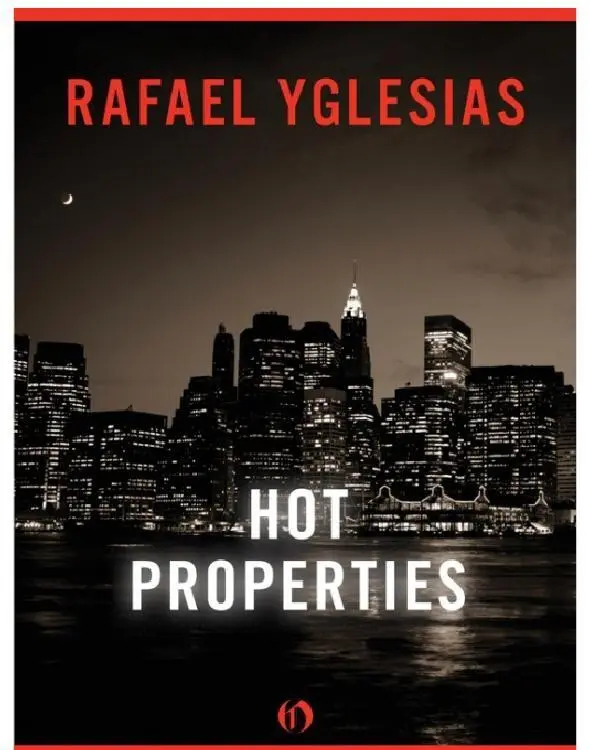
- Название:Hot Properties
- Автор:
- Издательство:Open Road Integrated Media LLC
- Жанр:
- Год:2010
- Город:New York
- ISBN:9781453205082
- Рейтинг книги:3 / 5. Голосов: 1
-
Избранное:Добавить в избранное
- Отзывы:
-
Ваша оценка:
Hot Properties: краткое содержание, описание и аннотация
Предлагаем к чтению аннотацию, описание, краткое содержание или предисловие (зависит от того, что написал сам автор книги «Hot Properties»). Если вы не нашли необходимую информацию о книге — напишите в комментариях, мы постараемся отыскать её.
Rafael Yglesias’s most sharp-tongued satire,
exposes the greed, envy, and backbiting in a media world bloated with money and power.
This ebook features a new illustrated biography of Rafael Yglesias, including rare photos and never-before-seen documents from the author’s personal collection.
Touted by the gossip columns as a roman a clef about the publishing world, Yglesias's fourth novel has definite commercial potential, since there are always people who like to read sordid tales about the media. Focusing on a group of ambitious, opportunistic New York yuppies, each desperate for success, power, fame, money and glamorous sexual partners, Yglesias follows his characters as their aspirations flourish or fade. And even for the one person who comes up with a smashing bestseller, happiness is an elusive emotion, banished by inner fear and self-loathing. The leading players in this fermenting brew are introduced in the book's opening scene, a dinner party so exquisitely awkward that even the reader is embarrassed. Thereafter we watch an aspiring playwright sell out to Hollywood; a sexy blonde discover she can really write, but must use her body to assure publication; a blocked novelist lose his scruples, professional and personal; a journalist at a leading newsmagazine realize that his way to the top has been sabotaged by office intrigue. Yglesias views his characters with cynicism, but he knows how to create the dramatic momentum that will have readers turning the pages. And if his book does become a bestseller, he will have the ironic last laugh.
Copyright 1986 Reed Business Information, Inc.
“
[is] the novel you want in the Hamptons. It lambastes the pretensions of the people you’ve been glaring at on the beach all day, and excoriates the city you’ve left behind.”
— “Sharp, funny, and fresh insight into the American literary world…”
—
From Publishers Weekly
Review
Hot Properties — читать онлайн бесплатно полную книгу (весь текст) целиком
Ниже представлен текст книги, разбитый по страницам. Система сохранения места последней прочитанной страницы, позволяет с удобством читать онлайн бесплатно книгу «Hot Properties», без необходимости каждый раз заново искать на чём Вы остановились. Поставьте закладку, и сможете в любой момент перейти на страницу, на которой закончили чтение.
Интервал:
Закладка:
“Mrs. Thorn? Embarrassed?” Chico smiled. Apparently that was impossible, a naive remark.
“I guess not,” David said.
“She has the selective memory of the rich.” Chico went on. “When she fires Rounder, she’ll probably also fire the president of Newstime, thinking, by then, that it was his fault she picked Rounder.”
“We should let him sink,” David said thoughtlessly. He heard himself almost slur the last word. He stared at the water glasses, and they quavered in his vision. I must be drunk, he thought, wondering if his capacity was diminishing.
“What do you mean?”
“Stop protecting his ass!” David said, aggrieved, as though he, not Chico, were the main victim of Rounder’s presence. “He wants to ignore the Russian boycott and put Redford on, let him! He’s the editor in chief. Let him run it.”
Chico shook his head. “I can’t. When she made the decision, she spoke to me privately, saying that eventually she wanted Rounder to become sort of the spokesman for the magazine, help the company formulate new projects, that I would be the editor in chief within a few years. She expects me to watch him. If he doesn’t keep his nose clean. I might be blamed for not having wiped it.”
“Bullshit,” David said. He felt at ease with Chico: his equal. A sudden elevation of status that Chico’s manner— curious, interested, even slightly abashed — confirmed. “She’s suckered you. She knows she needs you to run the magazine. But if you run it for free, there’s no reason to promote you. She can’t ask you to do the work of Groucho without giving you the mustache.”
Chico’s eyes widened, and for a second David wasn’t sure if he would take the use of the lower echelon’s jargon in good humor. Presumably Chico had once been a lowly employee, chipping away at the awesome statuary of his bosses with like chisels, but ascending the pedestal might have made him as humorless and cold as marble. Instead, he laughed. “I haven’t heard that for years!” he said, delighted. “That’s still the lingo?”
“Nothing changes at Newstime,” David said in a mock announcer’s voice, “not even the childish nicknames.”
But Chico had already lost his enjoyment of the slang, and was back to fretting over David’s advice. “You know, you’re right. I should let the fucking guy sink. Him and Ray.”
Ray? That was Harpo, who, when Chico had fallen into his sullen fit at the cover meeting, had continued to explain why ignoring the Olympics would be a mistake. Rounder had humiliated Chico by finally giving the cover to Harpo to top-edit, but that wasn’t Harpo’s fault.
“Ray thinks he’s going to kiss ass all the way to being number two,” Chico went on with surprising nakedness, his big head scrunched low on his shoulders like a football player’s. He looked ready to charge a running back, prepared to take a jolt and give an even worse one. “He thinks I can’t take it. That I’ll leave and he’ll inherit.”
God, David thought, I’m so naive. He’s probably right. That’s why Harpo kept on arguing it out with Rounder. Not to support Chico, but to appear like a responsible number two, disagreeing but not pressing the point too far.
“And he’s slipped, you know that?” Chico also seemed to be slurring words. How many drinks had they had? Maybe it was four. Their glasses were suddenly full again, magically, though David remembered sucking the last drops from the ice only moments ago. “He used to be a terrific editor. The kind of editor you are now. Bold, decisive. In control of the writers. On top of the section. Now he’s focused on dominating the meetings. Getting more pages for his sections whether they deserve ’em or not.”
“Yeah!” David said, wanting to encourage more talk, not to agree. None of it seemed true, but it was working out well for him. However, his “Yeah” had come out too enthusiastically. He sounded like a bloodthirsty fan. Yeah! Get ’em!
Chico shut his eyes and rubbed his forehead. “You and I could do great stuff with the magazine …” He let it hang for a moment, opening his eyes before adding, “… if we were given a free hand.”
David remembered from his college days, from the antiwar era, a favorite comeback used when someone would try to include another in a decision or action without actually asking for his agreement: “What do you mean, ‘we’, white man?” He smiled at the thought of saying this to Chico. But even with four (was it five now?) drinks in him, he didn’t have the nerve.
But Chico did it for him. “You’d be perfect for Ray’s job,” he said.
David, surprised and delighted, said without thinking. “I agree!”
They talked around this subject for quite a while, drinking steadily. The booze seemed to hit David hard. He bumped into a table on his way out of the restaurant. Out in the night air, passing well-dressed couples walking back to their hotels from theater and dinner, he felt woozy. The faces loomed past him — big, frozen in his mind for a moment in the smiles or the pensive or laughing looks they happened to have. Chico walked with his head down, shuffling his feet on the pavement, as though he were a bored schoolboy reluctantly going back to his unhappy home. There were curious silences from the traffic, moments when the sound of David’s breathing seemed to be the loudest noise in the city. He felt empty. Not depressed or sad or lonely or abandoned. He felt absent. Expected back, but not there.
Later, David sat in his office waiting for the writer to finish more changes he had felt were needed on the bank collapse. He replayed that moment when Chico offered him Harpo’s job. David knew it was no trick to give someone a promotion that you’re not in a position to grant. Still he felt flattered and excited. If Chico could somehow unseat Rounder and if he could dispose of Harpo and if he could fulfill his promise to David (incredible, impossible ifs, all of them), then David would become the youngest Marx Brother in the magazine’s history, a surefire successor to Chico. He might even make Groucho by the age of forty. His heart didn’t beat eagerly. The alcohol gave him a dispassionate eye. He regarded the prospect with quiet satisfaction. And somehow, he felt a reasonable certainty that the incredible just might happen.
“But that makes no sense!” Tony whined. Garth leaned back in his chair, staring coldly. Foxx looked in Tony’s direction as though he were a weary tourist checking off a sight he was supposed to have seen because of its great reputation, but in fact found boring. Neither spoke, despite Tony’s urgent voice. “I mean,” Tony continued quietly, hoping to bury the tone of injury in his voice, “how could he have belonged to the movement and then become right-wing without some explanation?”
“Can’t have political speeches.” Foxx said, a coffee-shop waitress informing a customer that an item on the menu was unavailable.
“You don’t want me to be right-wing,” Garth said. “I’m turned off to politics. Not right-wing.”
“That’s not enough of a conflict!” Tony complained. Again, impatience showed through the veil of modesty and reasonableness he had drawn over his true nature. Lois had told him, over and over, “Writers don’t have power in this town. They expect you to do the rewrites they want. No arguing. The only way you can get them to do what you want is to make it seem like it’s what they want.” Last night they had screwed three times and talked out this meeting. He had actually lain inside her with his sore and numbed penis while they planned strategy.
It had all been for naught. He had, at the start, mollified them by announcing he’d do what they wanted, but as they went through the script, beginning with the very first line, picking away at his stage directions, his dialogue (my dialogue! my God, I’m famous for my dialogue!), his character choices, and even, incredibly, the names he had given to one of them, rage, incredulous fury, threatened to erode his submissive mask.
Читать дальшеИнтервал:
Закладка:
Похожие книги на «Hot Properties»
Представляем Вашему вниманию похожие книги на «Hot Properties» списком для выбора. Мы отобрали схожую по названию и смыслу литературу в надежде предоставить читателям больше вариантов отыскать новые, интересные, ещё непрочитанные произведения.






Обсуждение, отзывы о книге «Hot Properties» и просто собственные мнения читателей. Оставьте ваши комментарии, напишите, что Вы думаете о произведении, его смысле или главных героях. Укажите что конкретно понравилось, а что нет, и почему Вы так считаете.