Rafael Yglesias - Hot Properties
Здесь есть возможность читать онлайн «Rafael Yglesias - Hot Properties» весь текст электронной книги совершенно бесплатно (целиком полную версию без сокращений). В некоторых случаях можно слушать аудио, скачать через торрент в формате fb2 и присутствует краткое содержание. Город: New York, Год выпуска: 2010, ISBN: 2010, Издательство: Open Road Integrated Media LLC, Жанр: Современная проза, Юмористическая проза, на английском языке. Описание произведения, (предисловие) а так же отзывы посетителей доступны на портале библиотеки ЛибКат.
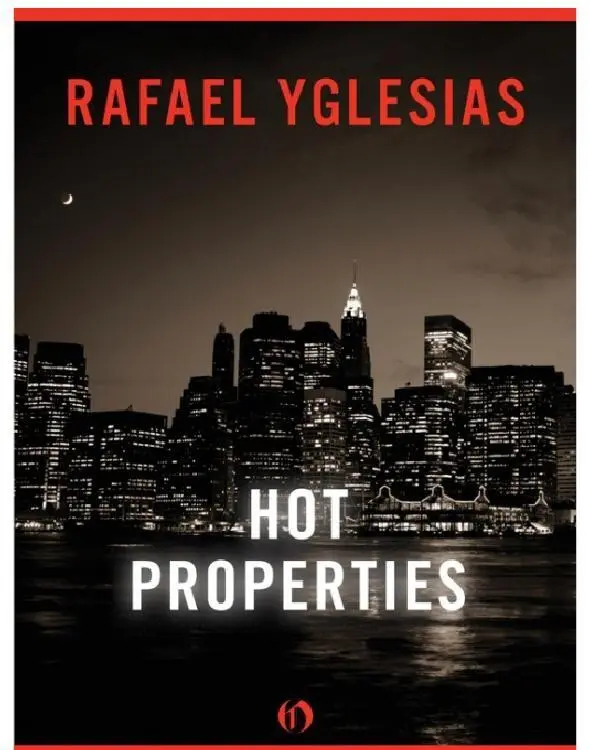
- Название:Hot Properties
- Автор:
- Издательство:Open Road Integrated Media LLC
- Жанр:
- Год:2010
- Город:New York
- ISBN:9781453205082
- Рейтинг книги:3 / 5. Голосов: 1
-
Избранное:Добавить в избранное
- Отзывы:
-
Ваша оценка:
Hot Properties: краткое содержание, описание и аннотация
Предлагаем к чтению аннотацию, описание, краткое содержание или предисловие (зависит от того, что написал сам автор книги «Hot Properties»). Если вы не нашли необходимую информацию о книге — напишите в комментариях, мы постараемся отыскать её.
Rafael Yglesias’s most sharp-tongued satire,
exposes the greed, envy, and backbiting in a media world bloated with money and power.
This ebook features a new illustrated biography of Rafael Yglesias, including rare photos and never-before-seen documents from the author’s personal collection.
Touted by the gossip columns as a roman a clef about the publishing world, Yglesias's fourth novel has definite commercial potential, since there are always people who like to read sordid tales about the media. Focusing on a group of ambitious, opportunistic New York yuppies, each desperate for success, power, fame, money and glamorous sexual partners, Yglesias follows his characters as their aspirations flourish or fade. And even for the one person who comes up with a smashing bestseller, happiness is an elusive emotion, banished by inner fear and self-loathing. The leading players in this fermenting brew are introduced in the book's opening scene, a dinner party so exquisitely awkward that even the reader is embarrassed. Thereafter we watch an aspiring playwright sell out to Hollywood; a sexy blonde discover she can really write, but must use her body to assure publication; a blocked novelist lose his scruples, professional and personal; a journalist at a leading newsmagazine realize that his way to the top has been sabotaged by office intrigue. Yglesias views his characters with cynicism, but he knows how to create the dramatic momentum that will have readers turning the pages. And if his book does become a bestseller, he will have the ironic last laugh.
Copyright 1986 Reed Business Information, Inc.
“
[is] the novel you want in the Hamptons. It lambastes the pretensions of the people you’ve been glaring at on the beach all day, and excoriates the city you’ve left behind.”
— “Sharp, funny, and fresh insight into the American literary world…”
—
From Publishers Weekly
Review
Hot Properties — читать онлайн бесплатно полную книгу (весь текст) целиком
Ниже представлен текст книги, разбитый по страницам. Система сохранения места последней прочитанной страницы, позволяет с удобством читать онлайн бесплатно книгу «Hot Properties», без необходимости каждый раз заново искать на чём Вы остановились. Поставьте закладку, и сможете в любой момент перейти на страницу, на которой закончили чтение.
Интервал:
Закладка:
David Bergman’s dinner party was about to begin. He had finished setting the table with his brother’s hand-me-down china. It was black Wedgwood, chosen to match the black Formica kitchen, and therefore left behind, since his brother’s taste had moved on, evolving backward from high-tech to Victorian wall sconces and floral patterns.
However, David had to admit that the dense-colored but delicate plates, boldly blotting the white Formica dining table, did indeed, as his brother would say, “make a statement.” And David wanted to impress, to seem as adult as possible tonight. It had taken two months to find a night that Chico and Rounder (nobody called him Groucho, possibly because he was such an outsider: a restraint which ultimately added to the sense that he would forever continue to be one) were both free to come. The other guests, who had suddenly become problematic, were Tony Winters and his wife, Betty. A few days ago Betty had told Patty that Tony and she might not be able to come because Tony’s father was coming in from Los Angeles on his way to London and wanted to see them for dinner. Patty had, with shameless charm, begged Betty not to cancel, complaining that she would be drowned in a flood of Newstime gossip. Betty called back, after checking with Tony. His father wasn’t arriving until ten o’clock, and he planned to meet them at eleven, so they could attend, as long as it was understood they would have to leave early.
David resented this arrangement. He had met Tony and Betty on only one other occasion besides the dinner nearly a year before at Fred’s — the night he had first met Patty. A few months later they had gone to a startlingly fancy brunch at Tony’s and Betty’s. That event, with its nakedly business-oriented guest list, the professionally tended bar, the rented coat racks, the fancy dishware, and the elaborate menu, convinced David it was appropriate for someone his age to invite his bosses to dinner. David, secretly, was irritated that Patty would never dream of entertaining on that scale (David didn’t consider the possibility that Tony might have made the arrangements), thus forcing him to settle for an uncatered, relatively intimate dinner. At Tony’s party he had counted at least thirty people in show business, all of whom, David assumed, were important contacts for Tony, relationships Tony needed to succeed. David wouldn’t have minded having Rounder and Chico over, along with the other Marx Brothers and the important editors he knew from Business Week, the Wall Street Journal, the New York Times, and so on, to make the point to the Marx Brothers that David was the sort of person whom they needed to woo, if they wanted to hang on to him.
At first David had been put off by the prospect of including Tony and Betty at his dinner. Although David thought Tony was an impressive figure, he knew that Rounder and Chico were so neglectful of culture they wouldn’t care about Tony until he had six Broadway hits. However, when David learned Tony would have to leave early, he worried whether it would seem like a slight to Rounder and Chico, as if David couldn’t hold the attention of even minor playwrights. Who the fuck cares? David told himself as he laid down the last spoon. I hope to become Nation senior editor, not edit the culture pages.
Tony and Betty arrived first, half an hour early, bringing an expensive bottle of wine and expressing disarming apologies. “God, I’m sorry about this!” Tony exclaimed while shaking David’s hand. “I know it must seem strange. But I haven’t seen my father in almost two years. Last two times I was in LA, I didn’t give him proper notice and ended up missing him entirely.”
Betty meanwhile studied Patty. Patty had on a demure long dress, covering alluring parts of her body that were usually exposed. Her hair, which only three months ago had been permed, was now straight and gathered up in a bun, suggesting the fifties-movies cliché of a blond bombshell hiding in librarian’s clothes. “You look cute,” Betty said to Patty, her voice lacking conviction because her mind was absorbed by the shock that Patty had not merely unbaited her hook, but had thrown out the rod and reel as well.
Patty wheeled around, her dress billowing at the knees. “This is my taken look,” she said.
Tony and Betty laughed, pleased by her admission. David looked puzzled. “What do you mean?”
“This says: I have a boyfriend.”
David didn’t join the others in their smiles. “You’re not doing that for my benefit, are you?”
“Of course I am!” Patty said, a little sharply, as if hurt.
“You don’t have to.”
“Come on, David, you hated my single-girl wardrobe. Said I looked like a trollop.”
David flushed, his cheeks flooding with blood. “You did,” he said in a cruel tone, to cover his embarrassment at being exposed as a prude.
“Well,” Tony said breezily, “that’s just like Betty. After I picked her up on Forty-second Street, it took weeks to get her to throw out her hot pants.”
David and Patty laughed, glad to have an exit from their tense exchange. Betty didn’t. She said, “Ha, ha.”
An alarm bell rang in the kitchen and Patty almost jumped. “My roast!” she said, hurrying into the kitchen.
Betty followed her, saying, “Can I help?”
“What would you like to drink?” David asked Tony.
“Nothing. I’m meeting my father later, so … On the other hand, he’s so self-absorbed he wouldn’t notice I was drunk unless I threw up on his lap.”
David laughed. “Is that a yes?”
“Yeah. Give me a Scotch.”
Tony followed David over to an exposed bar on a built-in shelf unit. “How’s Hollywood?” David asked.
“Hot, I guess.”
“I meant your script.”
“Almost finished with, uh, a rough draft for Bill Garth to look at.”
“And if he likes it, they make your movie?”
“Who the fuck knows?” Tony said. “I can’t get a straight answer out of anybody as to how a movie gets made.”
“Doesn’t your mother know? Or your father?”
“Maybe I’ll ask my father tonight. Mom? She’s in TV land. When she worked in movies, it was the tail end of the old studio system. Everything was different then.”
In the kitchen, Patty fussed over her roast, her high cheeks flushing from the oven’s heat. “Where are you meeting Tony’s Dad for dinner?”
“Elaine’s.”
“Whoa!” Patty said, standing up. A strand of hair had fallen across her face and she blew it back.
“I can’t get over this picture of you,” Betty said. “You look like Doris Day in Pillow Talk.”
“Don’t you love me this way?” Patty said. Her tone, slightly arch, but insistent, left Betty in doubt whether it was sarcasm or self-satisfaction.
“Are you happy?”
“Oh yeah.” Patty said. “And you?”
“I’m going to be thirty-three in a month,” Betty said.
Patty ignored Betty’s mournful tone. She often complained about age. “You look twenty-two,” she answered, glancing in her direction, noting Betty’s bobbed red curls and pert (surgical, Patty assumed) nose.
“I’m talking biological clock, not vanity,” Betty answered.
This got Patty’s attention off the roast. “Are you trying?”
“No!”
“Why not?”
Betty looked disgusted. “What do you think? ‘I’m not ready, dear.’ ”
“Men,” Patty agreed. “For machos, they’re awfully chicken.”
Betty laughed. “Yeah. So, if you’re happy, how come I never see you?”
“It’s not my fault! You and Tony are always busy. Having dinner with Robert Redford—”
“Oh, come on—”
“It’s true! You’ve become too fancy to see me! Look where you’re going to dinner tonight — Elaine’s!”
Читать дальшеИнтервал:
Закладка:
Похожие книги на «Hot Properties»
Представляем Вашему вниманию похожие книги на «Hot Properties» списком для выбора. Мы отобрали схожую по названию и смыслу литературу в надежде предоставить читателям больше вариантов отыскать новые, интересные, ещё непрочитанные произведения.









Обсуждение, отзывы о книге «Hot Properties» и просто собственные мнения читателей. Оставьте ваши комментарии, напишите, что Вы думаете о произведении, его смысле или главных героях. Укажите что конкретно понравилось, а что нет, и почему Вы так считаете.