Rafael Yglesias - Hot Properties
Здесь есть возможность читать онлайн «Rafael Yglesias - Hot Properties» весь текст электронной книги совершенно бесплатно (целиком полную версию без сокращений). В некоторых случаях можно слушать аудио, скачать через торрент в формате fb2 и присутствует краткое содержание. Город: New York, Год выпуска: 2010, ISBN: 2010, Издательство: Open Road Integrated Media LLC, Жанр: Современная проза, Юмористическая проза, на английском языке. Описание произведения, (предисловие) а так же отзывы посетителей доступны на портале библиотеки ЛибКат.
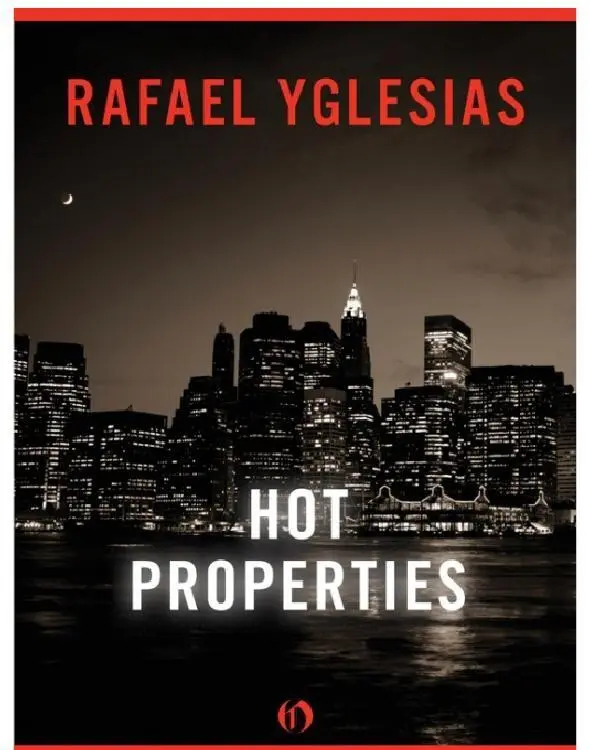
- Название:Hot Properties
- Автор:
- Издательство:Open Road Integrated Media LLC
- Жанр:
- Год:2010
- Город:New York
- ISBN:9781453205082
- Рейтинг книги:3 / 5. Голосов: 1
-
Избранное:Добавить в избранное
- Отзывы:
-
Ваша оценка:
Hot Properties: краткое содержание, описание и аннотация
Предлагаем к чтению аннотацию, описание, краткое содержание или предисловие (зависит от того, что написал сам автор книги «Hot Properties»). Если вы не нашли необходимую информацию о книге — напишите в комментариях, мы постараемся отыскать её.
Rafael Yglesias’s most sharp-tongued satire,
exposes the greed, envy, and backbiting in a media world bloated with money and power.
This ebook features a new illustrated biography of Rafael Yglesias, including rare photos and never-before-seen documents from the author’s personal collection.
Touted by the gossip columns as a roman a clef about the publishing world, Yglesias's fourth novel has definite commercial potential, since there are always people who like to read sordid tales about the media. Focusing on a group of ambitious, opportunistic New York yuppies, each desperate for success, power, fame, money and glamorous sexual partners, Yglesias follows his characters as their aspirations flourish or fade. And even for the one person who comes up with a smashing bestseller, happiness is an elusive emotion, banished by inner fear and self-loathing. The leading players in this fermenting brew are introduced in the book's opening scene, a dinner party so exquisitely awkward that even the reader is embarrassed. Thereafter we watch an aspiring playwright sell out to Hollywood; a sexy blonde discover she can really write, but must use her body to assure publication; a blocked novelist lose his scruples, professional and personal; a journalist at a leading newsmagazine realize that his way to the top has been sabotaged by office intrigue. Yglesias views his characters with cynicism, but he knows how to create the dramatic momentum that will have readers turning the pages. And if his book does become a bestseller, he will have the ironic last laugh.
Copyright 1986 Reed Business Information, Inc.
“
[is] the novel you want in the Hamptons. It lambastes the pretensions of the people you’ve been glaring at on the beach all day, and excoriates the city you’ve left behind.”
— “Sharp, funny, and fresh insight into the American literary world…”
—
From Publishers Weekly
Review
Hot Properties — читать онлайн бесплатно полную книгу (весь текст) целиком
Ниже представлен текст книги, разбитый по страницам. Система сохранения места последней прочитанной страницы, позволяет с удобством читать онлайн бесплатно книгу «Hot Properties», без необходимости каждый раз заново искать на чём Вы остановились. Поставьте закладку, и сможете в любой момент перейти на страницу, на которой закончили чтение.
Интервал:
Закладка:
Patty’s accusation was burlesqued, so Betty couldn’t answer it solemnly. Betty felt the charge was unfair. Patty herself, as was typical of her behavior in the past, had withdrawn from Betty as soon as her relationship with David had become serious, and then, once Patty felt the fish was landed and her life had become dull. Betty started getting phone calls, invitations to lunch, requests for dinner. It was true, however, that a tendency of Tony’s, a desire to socialize only with successful show-business people, had become more pronounced since his deal to write a movie for Bill Garth.
“And you, meanwhile,” Betty said, deciding to return Patty’s passing shot with a similar stroke, “entertain only editors in chief.”
Tony appeared, a drink in his hand. “Break it up, girls. The big cheeses are coming.”
Patty imitated a pouting child. “She started it.”
“Oh, she always does,” Tony said. “She’s famous for brawling.”
Patty laughed. Betty looked at her husband. He stepped back. Betty’s pale eyes, usually placid and reserved, seemed dark with anger. “I don’t think these endless jokes about my losing control are funny. If you think the idea that I could ever make a scene is so hilarious, maybe I’ll start making them, and then we’ll see how happy you are.”
“Hello!” David called out. “Where is everybody?”
There were other, lower voices, accompanying his.
“Oh God, they’re here,” Patty said with open despair and nervousness.
“I’m sorry,” Tony said to his wife in an abject tone. “I guess I’m on edge about seeing my father.”
“Well, don’t take it out on me.” Betty said, and walked past him, out toward David and his guests.
At the same moment, having left his company behind in the living area, David was heading in and he and Betty collided, bumping heads. David’s glasses fell off with a loud clatter.
“Oh Jesus!” Patty exclaimed.
“Careful!” David said, looking owlish, squinting pathetically at the floor. “Don’t step on them!” he cried desperately to the others while his own foot moved forward and made a sickening crunching sound as it landed on his spectacles.
“Oh my God,” Betty said, staring down. David removed his foot as if it had landed on a hot coal.
“You have another pair, right?” Tony asked, his tone implying that he suspected the answer was no.
David didn’t speak. He knelt down, picking up the shattered lenses tenderly, his face made grief-stricken by the bewildered expression of his denuded and abandoned eyes. The others stood by motionless: sympathetic sentinels at this funeral.
“David,” Patty asked gently. “Do you have another pair?”
He didn’t look up. “No,” he said. “These are my spares. I didn’t get the others fixed.” Now he peered at Patty like she was a ghostly figure. “Thought about it this week. Was going to. But I didn’t.”
For a moment they silently contemplated the tragic nature of this oversight. “How blind are you?” Tony said at last.
David stood. He put the glasses down on a counter. “I’ll be able to find the food on my plate,” he said bravely. “Come,” he said, “let me introduce you.” And he walked toward the living area ahead of them, his feet moving tentatively, an expert on a tightrope, his eyes desperately focused on finding each safe step, while his body pretended grace and ease.
Rounder and his wife were at the other end of the loft, standing side by side looking at the complex of elegant shelving David’s brother had built around the industrial elevator shaft. Rounder’s wife, Cathy, was tall, almost six feet, and blond, with the same big-boned, ruddy-cheeked heartiness as Rounder. Indeed, she was a beautiful female version of him. She had recently given birth to their second child, but she had also, making her seem even more awesome to Betty and Patty, gotten her doctorate in economics. Columbia University, as well as NYU, had offered her positions of some kind (details were unknown) when her husband was made editor in chief and they had had to move from Atlanta, forcing her to give up her teaching job. But, in a remarkably unchic gesture, she declined the offers, saying that she wanted to devote her time to her children, especially while her husband would be absorbed in getting a feel for Newstime.
Chico was slumped on one of David’s huge couches, staring at the enormous abstract painting (it was six feet long and four feet high) of a sharply defined bright yellow semicircle. He regarded it suspiciously, as if he suspected it of picking his pocket, or, at least, of impertinence. His wife, Louise, looked half his size, though she was really only a foot smaller, with a shock of short black frizzy hair and a thin eager body, always alert, back straight, eyes forward, like a hungry little bird. She, too, had a successful career in journalism, holding the number-two features-editor job at Town magazine. Louise sat on the edge of the couch, also regarding the abstract painting, but with a lively look, almost as if it were talking to her wittily.
While David introduced Chico and Louise, Rounder and Cathy moved from the shelving toward the living area. The moment greetings were done with, Cathy said to David, “Your brother designed all this?”
“And built it,” David said. He squinted at her briefly. “He got this place while he was trying to make it as a designer. He’d get some money together and then finish a section. Go back to work. And so on.”
“It’s beautiful,” Cathy said. She looked at Rounder. “We should talk to him about our new place.”
“If we stay,” Rounder said.
This led to a tedious discussion of New York real estate. David mostly listened. He felt silenced by his blindness. A headache came on rather quickly because of the strain of squinting at each speaker. Realizing this, David stopped looking and merely absorbed the voices: Rounder, self-absorbed, wading in with attitudes toward New York neighborhoods that he obviously only dimly understood; his wife, nervously joshing about “dangerous” areas like a smalltown girl; Chico, pretending he didn’t care at all about the status, elegance, or comfort of his apartment (David knew that, in fact, Chico had crippled himself with a huge mortgage in order to live on Central Park West just a few years ago); Betty, dogmatically saying that only Beekman Place and Sutton Place were truly acceptable, safe, and civilized areas, an attitude that only a rich girl like Betty could afford, but which she expressed rather as if it were a matter of taste, not money; Tony, elaborately explaining to Rounder the history of various reclaimed neighborhoods, such as SoHo, Chelsea, the Upper West Side, the Village (Tony’s observations were obvious, the stuff of Town magazine pieces and yet Tony said them as if they were brilliant, and Rounder actually listened as if he thought so too); meanwhile, Louise, the features editor of Town, smiled cheerfully at everyone but said nothing. And Patty? She told a horribly embarrassing story about being thrown out of her apartment because of all the crazy men she had been dating, and kidding that what made her relationship with David terribly important was that it rescued her from the New York roach-go-round of closet-size apartments at exorbitant rents.
Listening, hearing only the tones, David loathed them. Their self-satisfaction, their absorption in trivialities, disguised by an ironic self-satire which sounded hollow and insincere, was revealed by the sounds of their voices, abstracted from leavening smiles and gestures. And he loathed himself, because he knew he was so much like them. The loft, with its classy hypermodern design, had impressed Rounder and Chico, adding a layer of sophistication to their image of David. And he had said nothing to contradict their reaction, didn’t admit that he would never have volunteered to live that way. That if it weren’t his brother’s handiwork, he would have ripped it all out.
Читать дальшеИнтервал:
Закладка:
Похожие книги на «Hot Properties»
Представляем Вашему вниманию похожие книги на «Hot Properties» списком для выбора. Мы отобрали схожую по названию и смыслу литературу в надежде предоставить читателям больше вариантов отыскать новые, интересные, ещё непрочитанные произведения.








Обсуждение, отзывы о книге «Hot Properties» и просто собственные мнения читателей. Оставьте ваши комментарии, напишите, что Вы думаете о произведении, его смысле или главных героях. Укажите что конкретно понравилось, а что нет, и почему Вы так считаете.