Rafael Yglesias - Hot Properties
Здесь есть возможность читать онлайн «Rafael Yglesias - Hot Properties» весь текст электронной книги совершенно бесплатно (целиком полную версию без сокращений). В некоторых случаях можно слушать аудио, скачать через торрент в формате fb2 и присутствует краткое содержание. Город: New York, Год выпуска: 2010, ISBN: 2010, Издательство: Open Road Integrated Media LLC, Жанр: Современная проза, Юмористическая проза, на английском языке. Описание произведения, (предисловие) а так же отзывы посетителей доступны на портале библиотеки ЛибКат.
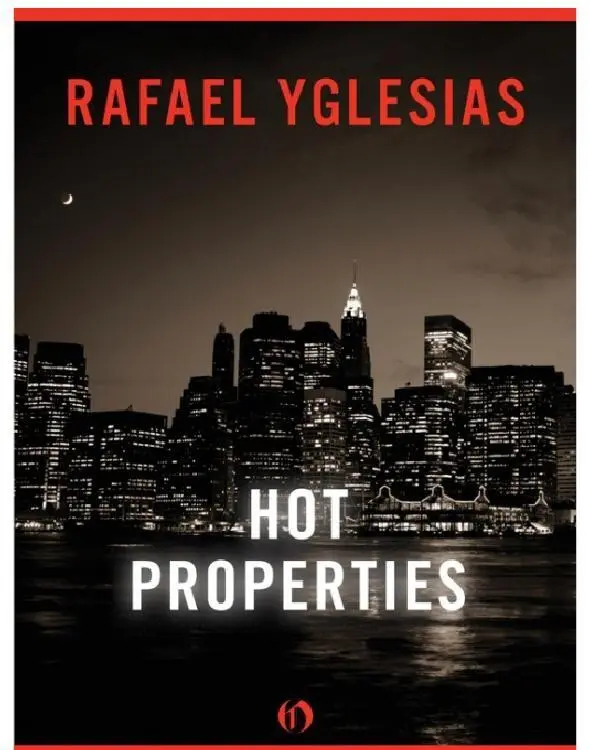
- Название:Hot Properties
- Автор:
- Издательство:Open Road Integrated Media LLC
- Жанр:
- Год:2010
- Город:New York
- ISBN:9781453205082
- Рейтинг книги:3 / 5. Голосов: 1
-
Избранное:Добавить в избранное
- Отзывы:
-
Ваша оценка:
Hot Properties: краткое содержание, описание и аннотация
Предлагаем к чтению аннотацию, описание, краткое содержание или предисловие (зависит от того, что написал сам автор книги «Hot Properties»). Если вы не нашли необходимую информацию о книге — напишите в комментариях, мы постараемся отыскать её.
Rafael Yglesias’s most sharp-tongued satire,
exposes the greed, envy, and backbiting in a media world bloated with money and power.
This ebook features a new illustrated biography of Rafael Yglesias, including rare photos and never-before-seen documents from the author’s personal collection.
Touted by the gossip columns as a roman a clef about the publishing world, Yglesias's fourth novel has definite commercial potential, since there are always people who like to read sordid tales about the media. Focusing on a group of ambitious, opportunistic New York yuppies, each desperate for success, power, fame, money and glamorous sexual partners, Yglesias follows his characters as their aspirations flourish or fade. And even for the one person who comes up with a smashing bestseller, happiness is an elusive emotion, banished by inner fear and self-loathing. The leading players in this fermenting brew are introduced in the book's opening scene, a dinner party so exquisitely awkward that even the reader is embarrassed. Thereafter we watch an aspiring playwright sell out to Hollywood; a sexy blonde discover she can really write, but must use her body to assure publication; a blocked novelist lose his scruples, professional and personal; a journalist at a leading newsmagazine realize that his way to the top has been sabotaged by office intrigue. Yglesias views his characters with cynicism, but he knows how to create the dramatic momentum that will have readers turning the pages. And if his book does become a bestseller, he will have the ironic last laugh.
Copyright 1986 Reed Business Information, Inc.
“
[is] the novel you want in the Hamptons. It lambastes the pretensions of the people you’ve been glaring at on the beach all day, and excoriates the city you’ve left behind.”
— “Sharp, funny, and fresh insight into the American literary world…”
—
From Publishers Weekly
Review
Hot Properties — читать онлайн бесплатно полную книгу (весь текст) целиком
Ниже представлен текст книги, разбитый по страницам. Система сохранения места последней прочитанной страницы, позволяет с удобством читать онлайн бесплатно книгу «Hot Properties», без необходимости каждый раз заново искать на чём Вы остановились. Поставьте закладку, и сможете в любой момент перейти на страницу, на которой закончили чтение.
Интервал:
Закладка:
“Who’s doing it?” Friedman asked. His eyes wandered the moment the question was out, scanning the room for other people whom he needed to say hello to.
“International,” Tony answered, furious that Paul wasn’t paying attention, and humiliated that he couldn’t think of a graceful way to deflect the questions.
Tony’s father slapped Paul on the back. “Okay, Paul. Our food’s getting cold. Get back to your table.”
“Yeah …” Paul said, staring off absently. “I’m with great people,” he added, his voice drained of enthusiasm. He then wandered off, stepping sluggishly, as though he were sleepwalking.
Richard Winters looked at Tony and Betty with a sarcastically raised eyebrow, and they laughed.
“What does he do?” Betty asked, having trouble believing that Paul could be competent at anything.
“PR,” Tony answered quickly. He sounded impatient, as if knowing what Paul Friedman did was an obviously essential bit of information.
“He’s good at it,” Richard said solemnly. “Crazy job. Demands a crazy person.”
“You were saying that you’ve heard there’ll be changes at International Pictures?” Tony said intently.
“Well …” Richard looked down at his plate. He sighed. “You know, rumors of management changes at the studios or the networks are constant. But I have reason to believe these are true. Shouldn’t concern you, Tony.”
Then why did you bring it up? Betty wondered. She had gone to the bathroom when Richard did because she felt Tony tense beside her. It was unpleasant feeling his worry. When they were courting and getting married, one of the qualities she loved in Tony was his easy manner, his sense of accomplishment, so unlike other young men. True, he had a material reason for his self-satisfaction: his first play had been produced successfully, at least by critical standards. With each production failing to accomplish anything more, not winning him money or greater praise, his cheerful attitude had worn thin, and with this movie deal, desperation seemed to have crept in. She had got up from the table to avoid hearing him worry over management changes, something that in the past Tony would have joked about, sure that only his own work and worth mattered, but apparently Paul had stalled the talk until now.
“I don’t care about who it is,” Tony said. “As long as it doesn’t fuck up International’s relationship with Garth.”
“If Garth wants to do your script,” Richard said, “you don’t have to worry who’s in charge at the studio.”
Tony heard the dismissive impatience in his father’s tone. He dropped the subject. Richard looked young for his age; tall and elegant in his pin-striped suit, his tanned face relaxed and open. He cut an impressive figure of strength and reliability, qualities that were not reflected in the distant mirror of his past.
Producers, agents and writers began to drop by their table, greeting Richard like an old friend. They were the lesser lights of Elaine’s, contacts befitting a business-side network executive. Woody Allen remained aloof at his table, the world-famous novelists flanking them didn’t notice, this year’s Academy Award-winning actress fluttered past, her fur coat brushing against Tony’s back when she squealed and opened her arms to hug someone. Tony took a malicious delight in observing his father’s second-rung status. At least in New York. TV was still TV, something you watched but didn’t talk about in intelligent company.
When they left, Tony and Betty were outside alone for a moment while Richard was held up inside, collared once again by Paul Friedman. Betty looked tired.
“Are you okay?” Tony asked.
“I’m tired.” She moved into his arms, burying her face in his chest.
“What’s the matter? Don’t you like having two dinners a night?” He felt alive, looking uptown at Second Avenue. A pack of taxis, freed by a green light, bolted, driving with menacing speed, riding the cracked, uneven road like surfers, their headlights bobbing, turn signals flickering a brief warning before they hurled in front of each other, competing for customers or the next free lane. Their machines were shameless incarnations of the city’s will to win at any cost. Tony felt their delight in the loss of moral constraint, of their triumph over law and good sense: the city is ours! their rattling chassis proclaimed.
Richard swung open the door and stepped down onto the street, breathing deeply. “Ah!” he exclaimed. His overcoat blew open in the wind, exposing his pink Brooks Brothers shirt. “Remind me never to go there again,” he said to Tony.
“Why does anybody go there?” Betty asked.
“To be seen,” Tony snapped, as though having to give the answer was an imposition.
“Sure ain’t for the food,” Richard said. “Well, do I put you kids in a cab, or would you like to stop at the hotel for a drink?”
Betty felt Tony’s body tense. He moved away from her to see her face. “Can you stay up, honey?” he asked with a strained note of consideration.
They had had fights over Tony’s willingness to keep a social evening going beyond Betty’s endurance of fatigue (and pretentiousness, she would have added). She knew he wanted to enjoy his father’s room service at the Pierre, that he hoped to grill him more about the International rumors or whatever else Richard might gossip about. Normally she took the position that if she wanted to go home, Tony should go with her. Her father had taken endless business trips, leaving Betty with the romantic notion that togetherness implied happiness; in her parents’ marriage, separation certainly hadn’t. But she couldn’t complain if Tony wanted to spend extra time with his father, especially since they rarely saw each other. What she resented, and what disappointed her, was that Tony’s desire to hang on to his dad had nothing to do with filial affection. “I’ll go home, sweetie,” she said. “You stay with your dad.”
Once alone in the cab with his father, Tony felt free, at ease for the first time that evening. He had found the preliminary round of dining at David’s and Patty’s wearing, and the meal with Richard irritating because of the constant interruptions. He had also felt Betty’s impatience with every conversation he tried to have with his father. Why was that? She had always disapproved when Tony spoke slightingly of his father. Why was she bothered by his desire to get to know him better? Wasn’t that her sentimental notion of how he should behave? Betty always seemed displeased with him since the first script conference in LA. Did she know? Was that why? Or was it coming from him: a dissatisfaction he thought he had cleverly concealed?
He looked at his father’s strong jaw, flashing yellow, red, amber, in the reflected glare of New York’s street and traffic lights. Richard had a distant look while he watched the streets go by. “I miss this town,” he said. He looked at Tony. “I guess you always miss the setting of your youth.” He looked back at the city. “I didn’t have a dime when I lived in New York. I still get a big kick out of being on expense account here: doing all the things I dreamt of when I was a kid.”
“You sound like a play,” Tony said. From Tony, that was high praise.
Richard laughed. “More like Playhouse Ninety.”
“Did you do any work on Playhouse Ninety?”
“No.” Richard shook his head and frowned. Tony felt abruptly self-conscious: he had placed his father back in the shameful fifties. Their cab pulled up to the carpeted sidewalk of the Pierre and a uniformed doorman with gold-braided epaulets moved to open the door. “The Golden Age of Television,” Richard said, leaning forward to give the driver money, “was mostly garbage, you know.”
Читать дальшеИнтервал:
Закладка:
Похожие книги на «Hot Properties»
Представляем Вашему вниманию похожие книги на «Hot Properties» списком для выбора. Мы отобрали схожую по названию и смыслу литературу в надежде предоставить читателям больше вариантов отыскать новые, интересные, ещё непрочитанные произведения.







Обсуждение, отзывы о книге «Hot Properties» и просто собственные мнения читателей. Оставьте ваши комментарии, напишите, что Вы думаете о произведении, его смысле или главных героях. Укажите что конкретно понравилось, а что нет, и почему Вы так считаете.