Rafael Yglesias - Hot Properties
Здесь есть возможность читать онлайн «Rafael Yglesias - Hot Properties» весь текст электронной книги совершенно бесплатно (целиком полную версию без сокращений). В некоторых случаях можно слушать аудио, скачать через торрент в формате fb2 и присутствует краткое содержание. Город: New York, Год выпуска: 2010, ISBN: 2010, Издательство: Open Road Integrated Media LLC, Жанр: Современная проза, Юмористическая проза, на английском языке. Описание произведения, (предисловие) а так же отзывы посетителей доступны на портале библиотеки ЛибКат.
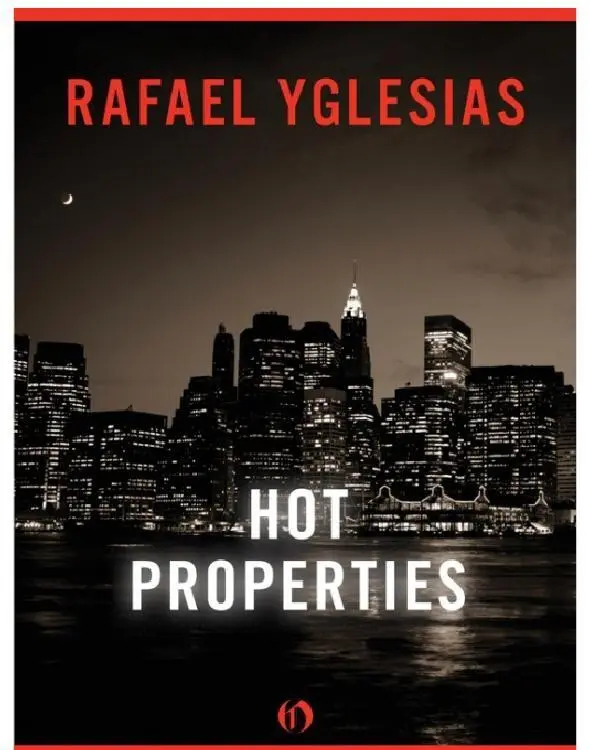
- Название:Hot Properties
- Автор:
- Издательство:Open Road Integrated Media LLC
- Жанр:
- Год:2010
- Город:New York
- ISBN:9781453205082
- Рейтинг книги:3 / 5. Голосов: 1
-
Избранное:Добавить в избранное
- Отзывы:
-
Ваша оценка:
Hot Properties: краткое содержание, описание и аннотация
Предлагаем к чтению аннотацию, описание, краткое содержание или предисловие (зависит от того, что написал сам автор книги «Hot Properties»). Если вы не нашли необходимую информацию о книге — напишите в комментариях, мы постараемся отыскать её.
Rafael Yglesias’s most sharp-tongued satire,
exposes the greed, envy, and backbiting in a media world bloated with money and power.
This ebook features a new illustrated biography of Rafael Yglesias, including rare photos and never-before-seen documents from the author’s personal collection.
Touted by the gossip columns as a roman a clef about the publishing world, Yglesias's fourth novel has definite commercial potential, since there are always people who like to read sordid tales about the media. Focusing on a group of ambitious, opportunistic New York yuppies, each desperate for success, power, fame, money and glamorous sexual partners, Yglesias follows his characters as their aspirations flourish or fade. And even for the one person who comes up with a smashing bestseller, happiness is an elusive emotion, banished by inner fear and self-loathing. The leading players in this fermenting brew are introduced in the book's opening scene, a dinner party so exquisitely awkward that even the reader is embarrassed. Thereafter we watch an aspiring playwright sell out to Hollywood; a sexy blonde discover she can really write, but must use her body to assure publication; a blocked novelist lose his scruples, professional and personal; a journalist at a leading newsmagazine realize that his way to the top has been sabotaged by office intrigue. Yglesias views his characters with cynicism, but he knows how to create the dramatic momentum that will have readers turning the pages. And if his book does become a bestseller, he will have the ironic last laugh.
Copyright 1986 Reed Business Information, Inc.
“
[is] the novel you want in the Hamptons. It lambastes the pretensions of the people you’ve been glaring at on the beach all day, and excoriates the city you’ve left behind.”
— “Sharp, funny, and fresh insight into the American literary world…”
—
From Publishers Weekly
Review
Hot Properties — читать онлайн бесплатно полную книгу (весь текст) целиком
Ниже представлен текст книги, разбитый по страницам. Система сохранения места последней прочитанной страницы, позволяет с удобством читать онлайн бесплатно книгу «Hot Properties», без необходимости каждый раз заново искать на чём Вы остановились. Поставьте закладку, и сможете в любой момент перейти на страницу, на которой закончили чтение.
Интервал:
Закладка:
“What have you been doing to my boy?” Maureen demanded of Garth in a melodramatic tone while still crushing Tony.
“I’m innocent,” Garth said. “The producer made me do it.”
“He comes to town.” she said, releasing Tony and slapping him on the shoulder. “Doesn’t phone, doesn’t tell me where he’s staying. Is this a son or a viper?”
“Neither, darling,” Foxx said. “He’s a screenwriter.”
Maureen pushed at Tony. “Let me in, you louse.” Tony slid over. Maureen got in, saying, “You making a deal with my boy, or just jerking him off?”
“Around, darling, not off,” Foxx corrected, while Garth convulsed with laughter.
“I always get idioms mixed up,” Maureen said, winking at Tony. Her double entendre, disguised as naïveté, was an old joke between them. “Well, which is it?”
Garth smiled. “That was the question I was going to ask Jimmy. But I was going to wait until Tony left.”
“Since when are you diplomatic?” Maureen said to Garth.
Tony kept waiting for an entrance into this banter — and praying that his mother would stop just short of totally humiliating him. She usually did, but there had been miserable exceptions.
“Maureen, I’m hurt,” Garth said, and looked it too.
“Of course we want to hire him,” Foxx said. “But the studio has to approve.”
Garth smiled.
Tony wondered.
Maureen said, “That’s bullshit, darling. If Bill Garth and Jimmy Foxx tell a studio they want a writer, the studio hires him.” She turned to Tony and kissed him full on the lips. “You’ve got the job. Stick it to them on the negotiation. They’ll pay your price.”
Garth roared, throwing his head back and slapping Foxx on the back. Even Foxx couldn’t control his face, beaming at Maureen.
Tony, stunned, the exhaustion of his trip and the long night of talk returning through the anesthesia of adrenaline, looked away from the group and scanned the Polo Lounge.
Most of the tables were looking at him.
Wondering.
Who was that kid with the famous actor and actress? Who was that masked man seated with Jim Foxx? Should we know him?
Yes, Tony answered silently, while the others laughed.
GARLANDS DEAL MEMO
re: Fred Tatter novel. The Locker Room. $20,000 advance. Payable: $5,000 on signing; $5,000 on delivery of a mutually satisfactory one hundred pages; $10,000 on delivery of a mutually satisfactory completed manuscript. Bart Cullen, agent. Robert Holder, editor.
NEWSTIME INTEROFFICE MEMO
John Syms will be detached from senior-editing Nation to Future Projects for six months. Jim Daily will senior-edit Nation during his absence. David Bergman will fill in to senior-edit Business.
SHADOW BOOKS DEAL MEMO
Patty Lane, flat fee, $5,000 for untitled romance novel.
INTERNATIONAL PICTURES DEAL MEMO
Tony Winters hired to write first-draft screenplay on Concussion. William Garth. Jim Foxx producers. William Garth star. $50,000 draft and set against $175,000. Contracts to follow.
PART TWO
CHAPTER 7
For nine months Fred had lived a life once only dreamt of: he was a writer under contract for a novel. The legal agreement itself was precious. He kept the thirty-five-page document at the front of his file drawer. He saw the edge of its nineteenth-century typeface at the start and finish of each work session, when he would remove and replace that day’s writing. Sometimes, late at night, he would get out of bed and surreptitiously sneak into his study, quietly pulling open the drawer, and gaze at the contract: a teenage boy enjoying a stash of pornography.
At first the glances were passionate, their purpose to reexperience a thrill. But after two months, bogged down in the second chapter, feeling inadequate to the task of actually producing a novel, he made the nightly excursions for reassurance. A confirmation that he, in fact, had a contract.
After nine months, Fred started to read the legal agreement. By then he was close to finishing the first one hundred pages of his novel. Now he worried that his prose was bad, that Bob Holder would reject the novel when he handed it in. He knew, from Marion among others, that the five-thousand-dollar portion of the twenty-thousand-dollar advance he had received on signing the contract would have to be returned only if another publisher wished to accept Fred’s novel. Nevertheless, late one night he read through the document to confirm this fact.
The quest was pointless, in a way. If his novel were rejected by Holder, and then by every other publisher, not having to return the five thousand dollars would hardly compensate Fred for such a devastating failure. Better never to have gotten a deal than to have had one and blown it. He would rather have died of thirst in a desert of mediocrity than have had his lips cruelly wetted by a few drops of the rain of success.
Still, he read through the clauses, looking for the legal reassurance that, even after a hurricane of rejection, he would be left clutching his five thousand dollars. He never got there. His eye was caught by an earlier clause: “$5,000 payable on signing. $5,000 payable on delivery of a mutually satisfactory one hundred pages. $10,000 payable on delivery of a mutually satisfactory completed manuscript.”
What did “mutually satisfactory” mean? For a moment he thought, illogically, it meant that Holder would have to accept his novel if he, Fred, found it satisfactory. Then he absorbed the phrase. The only protection it gave him was that if Holder liked his novel and Fred didn’t, Fred could prevent Holder from publishing it. This notion delighted Fred, and not simply because of its obvious improbability: the chance that he might dislike his own work while others approved of it was fundamentally unsound. The suggestion that his opinion of his work needn’t be in tow to the world’s was as absurd to Fred as the possibility that he might be granted the ability to fly while the rest of humanity remained earthbound. To be a yo-yo jerked up and cast down by an unseen and whimsical giant, spinning on a string of hope, seemed an immutable natural law to him, a fate no one could escape.
He phoned Karl Stein first thing in the morning to chat about that silly clause in his contract, ignoring Karl’s request, made to all his friends, that they not interrupt him before noon. Since the disappointing publication of Stewardess, Karl had had trouble writing his next book, and he liked to keep his mornings free of distractions. Fred had been ignoring Karl’s injunction from the day he got his deal for The Locker Room. Fred justified his violations by telling himself that Karl wasn’t serious. For although Karl would say, “Fred, I can only talk for a few minutes,” at the start of the conversation, it was almost always Karl who would end up telling a story or worrying over a plot point in his new novel, thereby extending the call for an hour.
That morning Fred was startled when he had heard Karl’s voice blare loudly in the phone with the telltale whoosh of a tape recorder, saying, “Hello. This is Karl Stein. I’m not in right now. But if you leave your name and number when you hear the beep, I’ll get back to you as soon as I can.”
“What!” Fred said, after the beep, with mock outrage. “A phone-answering machine! I can’t believe it! And I certainly don’t believe that you’re out at nine-thirty in the morning!” Fred guffawed into the receiver. “I was just calling to tell you something I found in my book contract …” Fred paused and waited. He knew Karl would be monitoring the machine, listening to Fred talk. Fred thought that the suggestion he had something interesting in his book contract, keeping in mind that Karl was also being published by Bob Holder and Garlands, might provoke Karl—
Читать дальшеИнтервал:
Закладка:
Похожие книги на «Hot Properties»
Представляем Вашему вниманию похожие книги на «Hot Properties» списком для выбора. Мы отобрали схожую по названию и смыслу литературу в надежде предоставить читателям больше вариантов отыскать новые, интересные, ещё непрочитанные произведения.








Обсуждение, отзывы о книге «Hot Properties» и просто собственные мнения читателей. Оставьте ваши комментарии, напишите, что Вы думаете о произведении, его смысле или главных героях. Укажите что конкретно понравилось, а что нет, и почему Вы так считаете.