Rafael Yglesias - Hot Properties
Здесь есть возможность читать онлайн «Rafael Yglesias - Hot Properties» весь текст электронной книги совершенно бесплатно (целиком полную версию без сокращений). В некоторых случаях можно слушать аудио, скачать через торрент в формате fb2 и присутствует краткое содержание. Город: New York, Год выпуска: 2010, ISBN: 2010, Издательство: Open Road Integrated Media LLC, Жанр: Современная проза, Юмористическая проза, на английском языке. Описание произведения, (предисловие) а так же отзывы посетителей доступны на портале библиотеки ЛибКат.
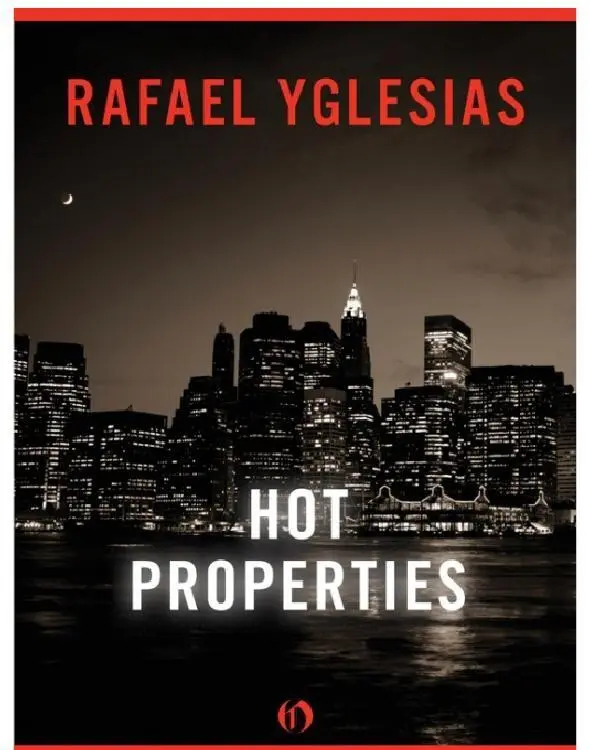
- Название:Hot Properties
- Автор:
- Издательство:Open Road Integrated Media LLC
- Жанр:
- Год:2010
- Город:New York
- ISBN:9781453205082
- Рейтинг книги:3 / 5. Голосов: 1
-
Избранное:Добавить в избранное
- Отзывы:
-
Ваша оценка:
Hot Properties: краткое содержание, описание и аннотация
Предлагаем к чтению аннотацию, описание, краткое содержание или предисловие (зависит от того, что написал сам автор книги «Hot Properties»). Если вы не нашли необходимую информацию о книге — напишите в комментариях, мы постараемся отыскать её.
Rafael Yglesias’s most sharp-tongued satire,
exposes the greed, envy, and backbiting in a media world bloated with money and power.
This ebook features a new illustrated biography of Rafael Yglesias, including rare photos and never-before-seen documents from the author’s personal collection.
Touted by the gossip columns as a roman a clef about the publishing world, Yglesias's fourth novel has definite commercial potential, since there are always people who like to read sordid tales about the media. Focusing on a group of ambitious, opportunistic New York yuppies, each desperate for success, power, fame, money and glamorous sexual partners, Yglesias follows his characters as their aspirations flourish or fade. And even for the one person who comes up with a smashing bestseller, happiness is an elusive emotion, banished by inner fear and self-loathing. The leading players in this fermenting brew are introduced in the book's opening scene, a dinner party so exquisitely awkward that even the reader is embarrassed. Thereafter we watch an aspiring playwright sell out to Hollywood; a sexy blonde discover she can really write, but must use her body to assure publication; a blocked novelist lose his scruples, professional and personal; a journalist at a leading newsmagazine realize that his way to the top has been sabotaged by office intrigue. Yglesias views his characters with cynicism, but he knows how to create the dramatic momentum that will have readers turning the pages. And if his book does become a bestseller, he will have the ironic last laugh.
Copyright 1986 Reed Business Information, Inc.
“
[is] the novel you want in the Hamptons. It lambastes the pretensions of the people you’ve been glaring at on the beach all day, and excoriates the city you’ve left behind.”
— “Sharp, funny, and fresh insight into the American literary world…”
—
From Publishers Weekly
Review
Hot Properties — читать онлайн бесплатно полную книгу (весь текст) целиком
Ниже представлен текст книги, разбитый по страницам. Система сохранения места последней прочитанной страницы, позволяет с удобством читать онлайн бесплатно книгу «Hot Properties», без необходимости каждый раз заново искать на чём Вы остановились. Поставьте закладку, и сможете в любой момент перейти на страницу, на которой закончили чтение.
Интервал:
Закладка:
“Anyway, I had just read the fourth, the fifth, I don’t know what draft of Concussion —”
“Is that the title of this project?” Tony asked.
“Working title,” Foxx said hastily. “We need something—”
“Less medical!” Garth said impatiently. “Anyway, I’m sitting clapping at the curtain, tears coming down my face, and I think: Why the fuck didn’t we hire this kid to write Concussion?”
Tony smiled. “So why didn’t you?”
“ ’Cause the studio wants people with credits, as if that proves something. Concussion’s a thriller, that’s what’s gonna sell it to the public. Like a Hitchcock movie, it’ll mostly be a glamorous chase picture. But — and it’s a big but — what gives it resonance, some depth, is this: we take a guy in his mid-thirties, he’s in Washington, he’s made it, he’s a partner in a firm that does a lot of antitrust work, basically fighting the Environmental Protection Agency, you know, all the regulating bodies of the Justice Department. So, he’s an establishment guy. But in the sixties, he was a radical. And a real radical. Fell in love with a beautiful, mysterious woman—”
“Meryl Streep,” Foxx offered.
Tony smiled involuntarily, but then he remembered who these people were. If they wanted Meryl Streep for a part, they could get her.
“Yeah, I’d love to work with Meryl again,” Garth said. “She’s terrific. And she’d be perfect for this. Anyway, she’s very radical, and part of the reason he went along with going underground, making bombs, was that he was in love with her.”
“This is all back story,” Foxx said.
Garth smirked. “He says that ’cause it scares the shit out of the studio. Like I’m gonna make a movie in which I blow up the President.”
“Not a bad idea,” Tony said.
“Yeah.” Garth winked at him. “You get the idea. It’s all back story, and he’s sorry he ever had anything to do with making bombs—”
“Why did he stop?”
“Ah!” Garth leaned forward eagerly. “This is how the movie begins. It’s 1968. We see a quiet town house in Greenwich Village. I’m in the basement with Meryl. Quickly establish I love her while I argue with her that we shouldn’t place the bomb — which we see her making along with two other characters — in a situation where anyone could be hurt. She’s very hard-line. Finally, I say we need milk, or they want sandwiches for lunch—”
“He goes out for lunch,” Foxx said impatiently. “He can’t go out for milk.”
“Whatever,” Garth said. “Doesn’t matter. I go out. I’m about halfway down the block—”
“Town house blows up,” Tony said for him. “You’re doing the Eleventh Street incident.”
“Exactly. You see?” Garth said to Foxx. “Tony knows what I’m talking about. The other writers had never heard of the Eleventh Street town house.”
“That’s great that you know about it,” Foxx said with a big smile at Tony.
“So,” Garth said, again running a hand through his hair, “the town house blows up. Cut, dissolve, fifteen years later. I’m an establishment guy in a real conservative law firm. You find out that Meryl was presumably killed in the explosion, that I’ve never gotten over her, that I was totally turned off politics by her death, and so on. And then, Nyack happens.”
“This is great,” Tony said. “It’ll be like Vertigo, only it’s the sixties coming back to haunt him.”
Garth leaned back with a big smile and gestured toward him, the star asking the audience to acknowledge the presence and talent of his costars. “You’ve got it.”
Foxx, however, was frowning. “Nyack?” he said with distaste, as if someone had asked him to move there.
“You know, the terrorist bank robbery,” Garth said.
“In the script?” Foxx asked.
“Yeah,” Garth said patiently. “That’s based on a real incident. The Nyack thing. You didn’t know that?”
“I thought that was invented. Is there going to be a legal problem?”
“No, no, no.”
“Do we need it?” Foxx said. “I don’t think it works. Can’t Meryl’s character come back as something else? I don’t like her killing cops and being a bank robber.”
“But she hasn’t actually done the robbery!” Garth said, his tone so aggrieved that Tony knew this was a point that had been argued many times.
“That distinction is unimportant,” Foxx said. “All the audience will know is that she’s a terrorist. Saying she’s innocent of a particular act of terrorism won’t change that. She won’t be sympathetic. Meryl would never play the part!” Foxx burst out with abrupt impatience.
“Why make it clear?” Tony asked.
They both stared at him. Their looks were blank, as if they had forgotten he was there. “What do you mean?” Garth snapped.
“Hitchcock wouldn’t make it clear. Our hero, after the flashback, would be sitting at home watching the TV news coverage of the Nyack robbery with a look on his face that’d tell the audience it frightened him, and then there’d be a knock on the door. And Meryl, beautiful and distraught, would be there, telling a breathless and confused story of how she was being set up, of her years underground, and so on. A story whose truth we wouldn’t know until the end of the picture. We’d have a hero who intellectually thinks she’s guilty, but emotionally needs her to be innocent.” Tony turned to Foxx. “Meryl, if the part was written properly, might want to play it because it would allow her to simultaneously play a villain and the romantic lead. The best of both roles in fact.”
Foxx listened. He looked Tony in the eyes while nodding agreement: his eyes were suspicious, however, searching doubtfully for a catch, a hidden trick to Tony’s explanation. At the finish they flickered, and Foxx leaned back, looking up at the ceiling.
Garth, meanwhile, reached across the table and rubbed Tony’s head — an affectionate big brother. “That’s brilliant,” he said.
Tony knew it wasn’t brilliant. But he loved Garth saying so. He flushed at having his hair tousled: he knew his ego was being seduced; but he didn’t care; it felt too good to protest.
Tony looked at Foxx. He knew now that Foxx was the impediment to his being hired. He had also realized that Gloria Fowler’s sudden inspiration to be his agent had come from her certain knowledge that Garth wanted to hire him. She had been dishonest, pretending that she had picked him out of the haystack of off-Broadway theater; but the credit for that belonged to Garth. I’m too naive, Tony said to himself while he waited for Foxx’s eyes to come back down from the ceiling. He knew Foxx wanted the political background out of the script, and therefore he would see Tony as a step backward. Tony had made it sound like he would only use it as a Hitchcockian veil of suspense: if Foxx bought that, he’d get the job.
“Well …?” Garth said to Foxx. “What are you doing? Checking the sprinkler system?”
Foxx lowered his eyes. They brightened at something. A smile came over his face and he seemed to straighten in readiness. Garth followed his gaze and also smiled. Tony, still waiting for Foxx’s judgment, felt hands come around his head and cover his eyes. He smelled a perfume he had known all his life.
“What’s the matter? You never write. You never call.” said a guttural female voice. Laughter lay only an inch below its deep surface; an amusement that had cued audiences in the subtle way only a great comedienne can that a joke was being played, and thereby got even bigger laughs than the lines deserved.
“Hi, Ma,” Tony said, playing the comedy in the harassed voice of a teenager.
His mother released her blindfold and then he was hugged violently, pressed into her substantial breasts, suffused by her familiar odor. Out of the crush, he could see with one eye that surrounding tables were looking on with self-conscious delight.
Читать дальшеИнтервал:
Закладка:
Похожие книги на «Hot Properties»
Представляем Вашему вниманию похожие книги на «Hot Properties» списком для выбора. Мы отобрали схожую по названию и смыслу литературу в надежде предоставить читателям больше вариантов отыскать новые, интересные, ещё непрочитанные произведения.








Обсуждение, отзывы о книге «Hot Properties» и просто собственные мнения читателей. Оставьте ваши комментарии, напишите, что Вы думаете о произведении, его смысле или главных героях. Укажите что конкретно понравилось, а что нет, и почему Вы так считаете.