Rafael Yglesias - Hot Properties
Здесь есть возможность читать онлайн «Rafael Yglesias - Hot Properties» весь текст электронной книги совершенно бесплатно (целиком полную версию без сокращений). В некоторых случаях можно слушать аудио, скачать через торрент в формате fb2 и присутствует краткое содержание. Город: New York, Год выпуска: 2010, ISBN: 2010, Издательство: Open Road Integrated Media LLC, Жанр: Современная проза, Юмористическая проза, на английском языке. Описание произведения, (предисловие) а так же отзывы посетителей доступны на портале библиотеки ЛибКат.
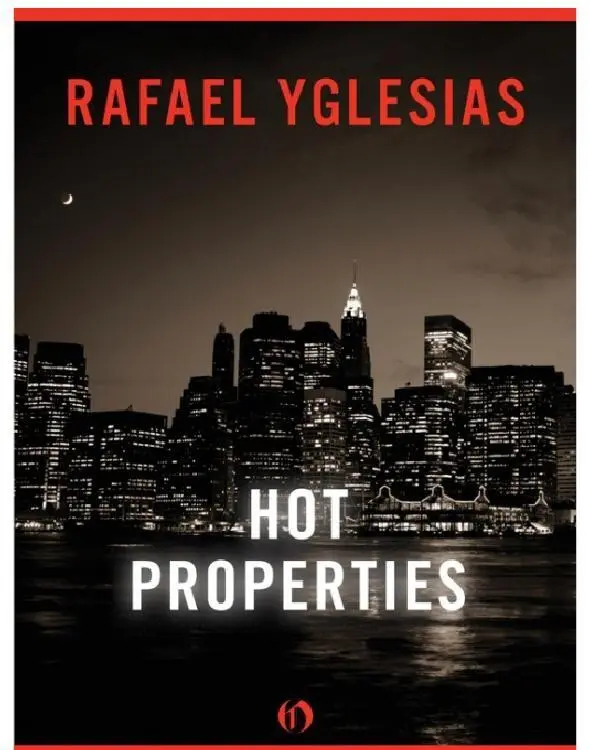
- Название:Hot Properties
- Автор:
- Издательство:Open Road Integrated Media LLC
- Жанр:
- Год:2010
- Город:New York
- ISBN:9781453205082
- Рейтинг книги:3 / 5. Голосов: 1
-
Избранное:Добавить в избранное
- Отзывы:
-
Ваша оценка:
Hot Properties: краткое содержание, описание и аннотация
Предлагаем к чтению аннотацию, описание, краткое содержание или предисловие (зависит от того, что написал сам автор книги «Hot Properties»). Если вы не нашли необходимую информацию о книге — напишите в комментариях, мы постараемся отыскать её.
Rafael Yglesias’s most sharp-tongued satire,
exposes the greed, envy, and backbiting in a media world bloated with money and power.
This ebook features a new illustrated biography of Rafael Yglesias, including rare photos and never-before-seen documents from the author’s personal collection.
Touted by the gossip columns as a roman a clef about the publishing world, Yglesias's fourth novel has definite commercial potential, since there are always people who like to read sordid tales about the media. Focusing on a group of ambitious, opportunistic New York yuppies, each desperate for success, power, fame, money and glamorous sexual partners, Yglesias follows his characters as their aspirations flourish or fade. And even for the one person who comes up with a smashing bestseller, happiness is an elusive emotion, banished by inner fear and self-loathing. The leading players in this fermenting brew are introduced in the book's opening scene, a dinner party so exquisitely awkward that even the reader is embarrassed. Thereafter we watch an aspiring playwright sell out to Hollywood; a sexy blonde discover she can really write, but must use her body to assure publication; a blocked novelist lose his scruples, professional and personal; a journalist at a leading newsmagazine realize that his way to the top has been sabotaged by office intrigue. Yglesias views his characters with cynicism, but he knows how to create the dramatic momentum that will have readers turning the pages. And if his book does become a bestseller, he will have the ironic last laugh.
Copyright 1986 Reed Business Information, Inc.
“
[is] the novel you want in the Hamptons. It lambastes the pretensions of the people you’ve been glaring at on the beach all day, and excoriates the city you’ve left behind.”
— “Sharp, funny, and fresh insight into the American literary world…”
—
From Publishers Weekly
Review
Hot Properties — читать онлайн бесплатно полную книгу (весь текст) целиком
Ниже представлен текст книги, разбитый по страницам. Система сохранения места последней прочитанной страницы, позволяет с удобством читать онлайн бесплатно книгу «Hot Properties», без необходимости каждый раз заново искать на чём Вы остановились. Поставьте закладку, и сможете в любой момент перейти на страницу, на которой закончили чтение.
Интервал:
Закладка:
Fred nodded uncertainly.
“Tell me how you see your book,” Holder went on, and leaned back, putting his arms behind his head and looking pleasantly expectant.
“Uh …” Fred lit his cigarette. He felt like a teenager doing it. As if he were unused to smoking. “Well, I think I say it in the outline. I want to show how all this modern stuff about women and sex is basically bullshit. You can’t fight the fact that men, when they start feeling old or beat in some way, feel like screwing around. And it doesn’t mean they don’t love their wives or that their lives are bad.”
“Are you saying—”
The assistant entered with a cup of coffee for Fred. Holder went on talking. Fred took the cup and felt embarrassed that she might have heard what he said. She was a woman. What if she told Holder it was a disgusting idea? He made a point of thanking her, remembering Marion’s bitching about how casually assistants are treated. She did seem pleased, but Fred missed what Holder said.
“I’m sorry,” he said. “What did you say?”
Holder frowned and let his chair tip forward so he was back to his combative attitude: arms on the desk, leaning toward Fred aggressively. “You’re going to go after … you know, marriage counseling, therapy — be honest — all that.”
Fred hesitated. Maybe Holder didn’t agree with his point of view. Maybe Holder didn’t like the outline because he once had an affair, now regrets it, made up with his wife— he looked and saw a wedding ring on Holder’s left hand— but it was too late anyway because Fred had already nodded yes.
“Great!” Holder said, leaning back and smiling. “That’s what makes this a good book. Get a lot of controversy. Get people talking. We can even get something that’s always a marketing problem with novels, namely some talk-show appearances, if we present it as a kind of confessional from you about how modern young men are. You know, the women writers always get that kind of subsidiary publicity on their books, ’cause they can go on talk shows and discuss their books like their books teach you how to live. Know what I mean?”
“Like The Women’s Room?”
“Yeah! Exactly. Though with you, we got a much better, much more salable presence. You know? You’d be great on Phil Donahue. Man, does that show sell books. I’ve just brought out Greenhouse. About the earth heating up, the ice caps melting. Well, we got the author on Donahue last week. Put the book right on the bestseller list.”
“Really? His show does that?”
“His show. Nightline, Good Morning America. The Today Show used to be great—”
“But since the ratings went down, they’re no good?”
“They’re still good. I don’t mean to say they don’t sell books.” Holder said this as if he were speaking in public, like a politician afraid to make clear statements. “But they’re not a top priority. Anyway, your book could attract all of them. And that’s great for me. I can really push within the house. I mean, it’s a terrible thing to admit, but a novelist who can get on a talk show is worth the talent of seven Tolstoys.”
Fred laughed appreciatively. “I gotta remember to quote you to my wife. She’s an editor at Goodson—”
“What’s her name?”
“Marion Tatter.”
Holder squinted. “I don’t know her.”
“Anyway, she’ll like that.”
“It’s true. Sad, but true. Anyway, getting back to your book. I’ve got a few problems with it, and I wanted to see if we put our heads together whether we could solve them. First, I don’t like it being set in New York.”
Fred nodded.
“I don’t like the sense,” Holder went on, “that it’s a poor man’s Philip Roth novel — you know, Jewish introverted hero who really, deep down, wants to be fucking his brains out, only he’s too guilty about the Holocaust or something. That’s a distraction from what we’ve discussed. We want this to be the male answer to The Women’s Room —”
“We could call it The John,” Fred said out of nervousness. He felt left out, lectured to, and he wanted to show he had some intelligence.
It must have been the right comment, because Holder banged his hand on his desk and laughed. Laughed hard, his mouth open, issuing staccato bursts of sound. “Not a bad idea,” he said. “Anyway, the point is, let’s stay away from any superficial resemblance to a whiny Roth book. Make the hero a WASP, set it in the Midwest or maybe California — LA might not be a bad idea, after all that’s where all the fads come from. What do you think?”
“I think you’re right.”
“Good,” Holder said, with a touch of surprise, as if he had expected a hassle. But the victory sat uneasily on his head. “You’re sure you agree? That’s not giving up anything important to you?”
This worried Fred. He wanted to make it clear he would do anything Holder wanted, but without seeming like a hack, a whore who would spread his legs for even a hint of payment. Instinctively Fred knew that no matter how much they junked up the plot of the book, he must convince Holder that he was a serious artist (I am, he insisted to himself), and make even the most calculated and topical novel read like literature. “Well,” Fred said, and pressed out his cigarette. He wanted to say: I can do it, whatever you want, I can do it. “The minute you said to me that the outline made it sound like a Roth novel, I understood. That isn’t what I’m going for. I guess I was worried people wouldn’t think I could do a non-Jewish, non-New York book. Fact is, I’d rather it wasn’t.”
“Good,” Holder said, now convinced Fred’s concession was sincere. “I have another problem with the outline.” He paused, as if this were a delicate moment. “I don’t think it should start in the late sixties and follow the couple up until our hero’s crisis. It should start with the crisis. And stay in the present, using all the current pop psychology that’s around.”
“You mean, start with him having an affair?”
“Or wanting to. Yeah.”
This bothered Fred, but his mind was blank as to why. He had adjusted to the notion of changing the setting and the ethnic background of the hero — after all, were those really changes? — but to throw out the first ten years the book was supposed to cover …?
“I’ll tell you why,” Holder said after Fred’s silence had gone on for a while. “You want the book to be about this biological incompatibility between men and women, right? Men aren’t monogamous, that’s your thesis, right?”
Fred nodded uncertainly, like a witness being interrogated by a crack lawyer, afraid to admit even the most harmless and obvious fact, lest it lead to a damning conclusion.
“See,” Holder said, leaning forward earnestly, pleading his point, “then doing it with our hero being young, meeting his wife, marrying her, and so on, takes you down the wrong road. You want it to be that he’s happy, he’s settled, all that crap. Deciding to get married, establishing a career, is behind him. His life is settled, he’s okay. He’s got it all. Only—” Holder held up his finger suspensefully and lowered his voice ominously. “Only he wants all those beautiful young bodies out there!”
Fred was smiling and nodding throughout all this, as if he loved it, and agreed. Agreed so heartily that he was on the edge of his chair, almost ready to leap into Holder’s arms. “Un-huh,” he said, not wanting to say anything, because he didn’t know what he thought, he just wanted to encourage Holder’s enthusiasm.
“See what I mean? Starting it in the present focuses it. Makes it an advocate for your statement. And that gets us a tight narrative and”—he winked cynically—“maybe on the Phil Donahue show.”
Читать дальшеИнтервал:
Закладка:
Похожие книги на «Hot Properties»
Представляем Вашему вниманию похожие книги на «Hot Properties» списком для выбора. Мы отобрали схожую по названию и смыслу литературу в надежде предоставить читателям больше вариантов отыскать новые, интересные, ещё непрочитанные произведения.








Обсуждение, отзывы о книге «Hot Properties» и просто собственные мнения читателей. Оставьте ваши комментарии, напишите, что Вы думаете о произведении, его смысле или главных героях. Укажите что конкретно понравилось, а что нет, и почему Вы так считаете.