Rafael Yglesias - Hot Properties
Здесь есть возможность читать онлайн «Rafael Yglesias - Hot Properties» весь текст электронной книги совершенно бесплатно (целиком полную версию без сокращений). В некоторых случаях можно слушать аудио, скачать через торрент в формате fb2 и присутствует краткое содержание. Город: New York, Год выпуска: 2010, ISBN: 2010, Издательство: Open Road Integrated Media LLC, Жанр: Современная проза, Юмористическая проза, на английском языке. Описание произведения, (предисловие) а так же отзывы посетителей доступны на портале библиотеки ЛибКат.
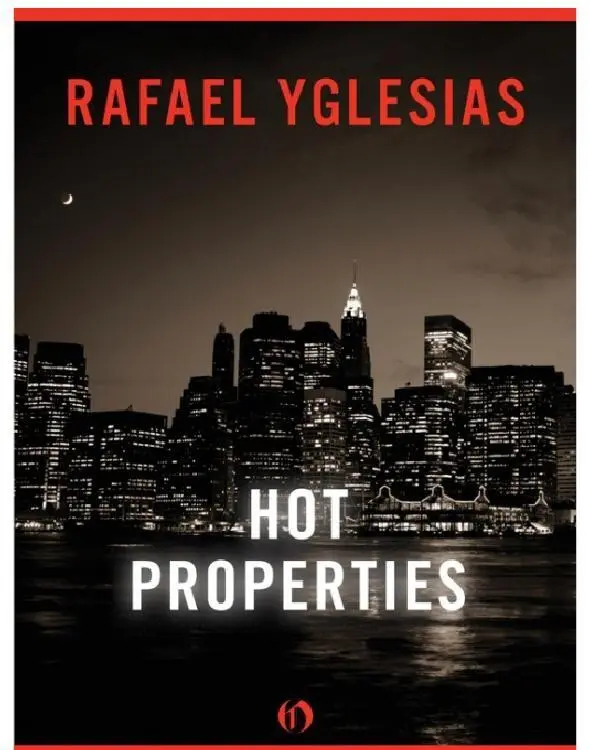
- Название:Hot Properties
- Автор:
- Издательство:Open Road Integrated Media LLC
- Жанр:
- Год:2010
- Город:New York
- ISBN:9781453205082
- Рейтинг книги:3 / 5. Голосов: 1
-
Избранное:Добавить в избранное
- Отзывы:
-
Ваша оценка:
Hot Properties: краткое содержание, описание и аннотация
Предлагаем к чтению аннотацию, описание, краткое содержание или предисловие (зависит от того, что написал сам автор книги «Hot Properties»). Если вы не нашли необходимую информацию о книге — напишите в комментариях, мы постараемся отыскать её.
Rafael Yglesias’s most sharp-tongued satire,
exposes the greed, envy, and backbiting in a media world bloated with money and power.
This ebook features a new illustrated biography of Rafael Yglesias, including rare photos and never-before-seen documents from the author’s personal collection.
Touted by the gossip columns as a roman a clef about the publishing world, Yglesias's fourth novel has definite commercial potential, since there are always people who like to read sordid tales about the media. Focusing on a group of ambitious, opportunistic New York yuppies, each desperate for success, power, fame, money and glamorous sexual partners, Yglesias follows his characters as their aspirations flourish or fade. And even for the one person who comes up with a smashing bestseller, happiness is an elusive emotion, banished by inner fear and self-loathing. The leading players in this fermenting brew are introduced in the book's opening scene, a dinner party so exquisitely awkward that even the reader is embarrassed. Thereafter we watch an aspiring playwright sell out to Hollywood; a sexy blonde discover she can really write, but must use her body to assure publication; a blocked novelist lose his scruples, professional and personal; a journalist at a leading newsmagazine realize that his way to the top has been sabotaged by office intrigue. Yglesias views his characters with cynicism, but he knows how to create the dramatic momentum that will have readers turning the pages. And if his book does become a bestseller, he will have the ironic last laugh.
Copyright 1986 Reed Business Information, Inc.
“
[is] the novel you want in the Hamptons. It lambastes the pretensions of the people you’ve been glaring at on the beach all day, and excoriates the city you’ve left behind.”
— “Sharp, funny, and fresh insight into the American literary world…”
—
From Publishers Weekly
Review
Hot Properties — читать онлайн бесплатно полную книгу (весь текст) целиком
Ниже представлен текст книги, разбитый по страницам. Система сохранения места последней прочитанной страницы, позволяет с удобством читать онлайн бесплатно книгу «Hot Properties», без необходимости каждый раз заново искать на чём Вы остановились. Поставьте закладку, и сможете в любой момент перейти на страницу, на которой закончили чтение.
Интервал:
Закладка:
The phone rang and Fred picked it up casually. He had been standing in front of the stove, pouring water into his coffee filter, thinking bitterly of Friday’s poker game. Regret, resentment, and anger over his losses had snaked itself around his trepidation about Holder reading his outline. By Sunday night his obsession with his defeat at the hands of those successful writers had strangled his own career anxieties. Fred had lied to Marion about the game, telling her he had lost a little, which forced him to call Karl and ask him never to mention that he had dropped three hundred bucks.
“You shouldn’t play, Fred,” Karl had said, “if you can’t afford—”
“Are you kidding? I got fourteen grand in the bank—”
“Really?” Karl said with a tone of surprise — annoyed surprise — that worried Fred.
“Well, yeah, I mean, it’s our savings, but still … Look, she would bust my ass about it—”
“Don’t worry. I won’t tell her.”
“And I want a shot at getting my money back, right?” Fred said, his irritation at losing overcoming any delicacy he might have felt about demanding another invitation.
Karl had tried to convince him he shouldn’t play again. When Fred pressed him, Karl told him flat out that he was a terrible player and would consistently lose.
“Well, let’s just say I like losing to famous writers, okay?” Fred said, somehow thinking this would put Karl in his place.
And so Monday morning, while pouring the boiling water into his Melitta, when the phone rang, for once Fred didn’t anticipate that it was his million-dollar call, the career-transforming moment. Usually, when he was waiting for news, his heart skipped every time the phone rang, but this time the fantasies of pulling an endless succession of full houses on Sam Wasserman opiated him, and he picked up the receiver dully. “Hello?”
“Fred Tatter?” It was the neutral voice of a secretary.
“Yes?”
“Bob Holder calling. Could you please hold?”
“Sure,” he said, and his soul knew despair, triumph, terror, and awe — all within the few seconds it took for Bob Holder to come on.
“Hi!” said a young aggressive voice. “Fred?”
“Hello.”
“Glad I got ya. Read your outline last night. Had to talk to ya first thing. I love this concept. Think it could make a great book. What do you think?”
Fred said nothing, confused, thinking momentarily that a third person must be on the phone somewhere, and that Holder’s question was directed at this stranger. But the silence told him it was meant for him. “Oh. Yeah,” he said. “I think it’s great.”
“Well,” Holder said. “I don’t think it’s great now. See, your outline doesn’t hit it, doesn’t hit it hard enough. I want to meet and talk about it. Okay?”
“Sure.”
“I got some free time this morning. That’s why I called first thing. Can you come up at eleven? I have a lunch at twelve-thirty. But that’s all the time I’ll need.”
“Sure.”
“Great. Know where we are?”
“Sure.”
“Great. See you at eleven.”
And Holder was off the phone. Fred hung up slowly. He had the feeling that the call hadn’t occurred. He stood in front of the stove watching the water drip through, his mind unable to apprehend what had been said by Holder.
The phone rang. Fred picked up sluggishly, a woozy fighter dumbly wading in for the final punishing blows. “Hello?”
“Fred? It’s Janice. Bart’s calling.”
“Okay,” he said slowly, but she was already off and Bart was on:
“Fred? Did you hear from Bob?”
“Yes. He just called.”
“He’s really excited. I think we’ve got a deal.”
“Really?” Fred asked in disbelief.
“Wasn’t that your impression?” Bart said, his voice impatient. “What did he say?”
“Well, he said he liked the idea — actually he said ‘concept’—but he didn’t think the outline had—”
“Oh yeah,” Bart said, bored, as if this came as no surprise. “He doesn’t think the outline is right. You and I discussed that. Remember, Fred? Not making the hero Jewish. Setting it somewhere other than New York. Bob has some other ideas. He said he wanted to meet with you. Did he arrange a meeting?”
“Yes. I’m seeing him at eleven. But he didn’t say why.”
“Well, that’s the reason. He wants to tell you some of his ideas and see if you guys are in sync. If so, then I think you’ve got a deal.”
“Huh,” Fred said. He wanted to ask if he would have to write another proposal after talking with Holder about his ideas, but he felt inhibited, as if the question was impolite, as if he were prying into affairs that weren’t his business.
“Okay, Fred. I think we’re rolling. Call me after the meeting.”
“Sure. ‘Bye. Thank you.” But Fred was already talking into silence. Was everybody else speeded up, or was he moving in slow motion?
He finally poured himself a coffee — it seemed a century ago that he had decided to make himself a cup — and drank it. He stood there like the victim of an accident: in shock, unable to fully remember the details or understand the consequences of a terrifying crash. Was this good news? Or was it simply no news? If Holder wanted a brand-new outline with all the plotting changed, why did that mean he was close to a deal? If he failed to write the new outline satisfactorily. Holder would end up turning it down. Why was Bart so pleased by these events? Why was Holder behaving so eagerly and expressing so much excitement, if he didn’t like the outline? There was nothing to be excited about except the outline. The situation made no sense to Fred.
And yet he wanted to believe.
He finished his coffee and realized the meeting was only an hour away.
He began to feel alive. His senses seemed to turn on all at once. His stomach growled, his heart pounded, his mind began to replay the two telephone conversations, and soon he was hurrying to shower, shave, and dress, worried he would be late, worried he wouldn’t be sharp and clever at the meeting, worried that he would blow it, blow his one chance, his only hope.
By the time he hailed a cab to go to Holder’s office, he was a nervous wreck. He entered the editorial reception area for Garlands and asked for Bob Holder tentatively, prepared to be told that Bob Holder had no idea who he was or why he would want to see someone named Fred Tatter.
But he was cheerfully informed that he was expected and that Bob’s assistant would be right out to guide him through the tortuous dusky-glass-walled, gray-carpeted halls to Bob Holder’s corner office with its canyonlike view of Sixth Avenue. And all this happened quickly, too quickly almost. Fred found himself seated across from Holder, nervously fumbling for a cigarette while telling the assistant that he wanted milk in his coffee. Holder sat at his desk, leaning forward on his elbows, looking at him with keen delight, like a kid eagerly ready to play a tough game of Monopoly.
Holder was a plump fellow in his early thirties, his curly hair cut short, so that it seemed tense, a boiling surface for a restless overheated brain. He was squeezed into a gray woolen sweater that made his biceps look powerful and outlined his well-fed belly; and the elbows were well-worn, the right one even showing a bit of his white-and-red-striped Brooks Brothers shirt. His desk was clear, but behind him on built-in shelves beneath his windows were mounds of manuscripts. A large appointment book was open beside the phone and the month was marked with meetings — a whole hour with him seemed luxurious.
“You’re just as I pictured you,” Holder said with a mischievous, energetic smile. Fred kept expecting to be challenged to a friendly arm-wrestling contest.
Читать дальшеИнтервал:
Закладка:
Похожие книги на «Hot Properties»
Представляем Вашему вниманию похожие книги на «Hot Properties» списком для выбора. Мы отобрали схожую по названию и смыслу литературу в надежде предоставить читателям больше вариантов отыскать новые, интересные, ещё непрочитанные произведения.








Обсуждение, отзывы о книге «Hot Properties» и просто собственные мнения читателей. Оставьте ваши комментарии, напишите, что Вы думаете о произведении, его смысле или главных героях. Укажите что конкретно понравилось, а что нет, и почему Вы так считаете.