Rafael Yglesias - Hot Properties
Здесь есть возможность читать онлайн «Rafael Yglesias - Hot Properties» весь текст электронной книги совершенно бесплатно (целиком полную версию без сокращений). В некоторых случаях можно слушать аудио, скачать через торрент в формате fb2 и присутствует краткое содержание. Город: New York, Год выпуска: 2010, ISBN: 2010, Издательство: Open Road Integrated Media LLC, Жанр: Современная проза, Юмористическая проза, на английском языке. Описание произведения, (предисловие) а так же отзывы посетителей доступны на портале библиотеки ЛибКат.
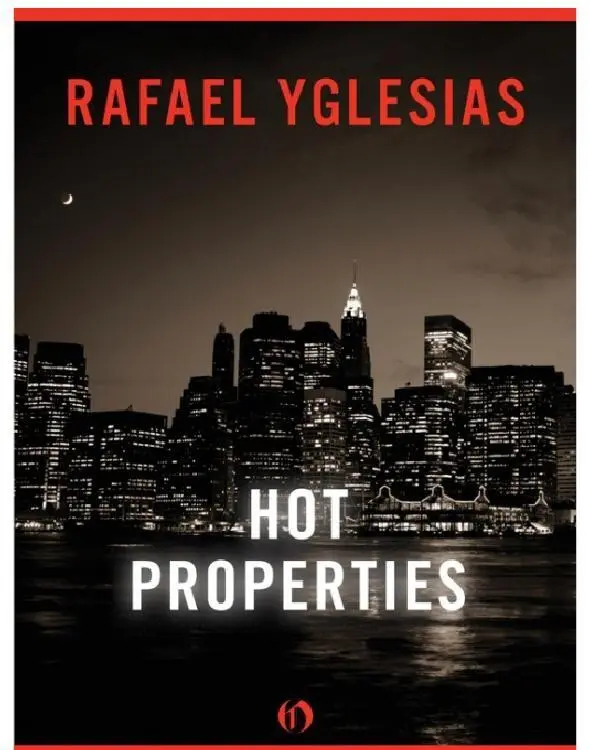
- Название:Hot Properties
- Автор:
- Издательство:Open Road Integrated Media LLC
- Жанр:
- Год:2010
- Город:New York
- ISBN:9781453205082
- Рейтинг книги:3 / 5. Голосов: 1
-
Избранное:Добавить в избранное
- Отзывы:
-
Ваша оценка:
Hot Properties: краткое содержание, описание и аннотация
Предлагаем к чтению аннотацию, описание, краткое содержание или предисловие (зависит от того, что написал сам автор книги «Hot Properties»). Если вы не нашли необходимую информацию о книге — напишите в комментариях, мы постараемся отыскать её.
Rafael Yglesias’s most sharp-tongued satire,
exposes the greed, envy, and backbiting in a media world bloated with money and power.
This ebook features a new illustrated biography of Rafael Yglesias, including rare photos and never-before-seen documents from the author’s personal collection.
Touted by the gossip columns as a roman a clef about the publishing world, Yglesias's fourth novel has definite commercial potential, since there are always people who like to read sordid tales about the media. Focusing on a group of ambitious, opportunistic New York yuppies, each desperate for success, power, fame, money and glamorous sexual partners, Yglesias follows his characters as their aspirations flourish or fade. And even for the one person who comes up with a smashing bestseller, happiness is an elusive emotion, banished by inner fear and self-loathing. The leading players in this fermenting brew are introduced in the book's opening scene, a dinner party so exquisitely awkward that even the reader is embarrassed. Thereafter we watch an aspiring playwright sell out to Hollywood; a sexy blonde discover she can really write, but must use her body to assure publication; a blocked novelist lose his scruples, professional and personal; a journalist at a leading newsmagazine realize that his way to the top has been sabotaged by office intrigue. Yglesias views his characters with cynicism, but he knows how to create the dramatic momentum that will have readers turning the pages. And if his book does become a bestseller, he will have the ironic last laugh.
Copyright 1986 Reed Business Information, Inc.
“
[is] the novel you want in the Hamptons. It lambastes the pretensions of the people you’ve been glaring at on the beach all day, and excoriates the city you’ve left behind.”
— “Sharp, funny, and fresh insight into the American literary world…”
—
From Publishers Weekly
Review
Hot Properties — читать онлайн бесплатно полную книгу (весь текст) целиком
Ниже представлен текст книги, разбитый по страницам. Система сохранения места последней прочитанной страницы, позволяет с удобством читать онлайн бесплатно книгу «Hot Properties», без необходимости каждый раз заново искать на чём Вы остановились. Поставьте закладку, и сможете в любой момент перейти на страницу, на которой закончили чтение.
Интервал:
Закладка:
She reread the pages, wondering at her heroine’s wild shifts in mood, riding a crest of hope like a surfer, covered with the spray of vigor and romance, only to crash ominously on the shore as the chapter ended, so the reader would turn the page eagerly … so Shadow Books would hire her to write the rest.
Maybe it isn’t such bullshit, Patty told herself, thinking of the past week. After all, she had paddled out into life’s ocean, stripped naked, and trusted herself to cold waves, been slapped and rebuked by them, only to rise glorious and young at last, commanding nature to carry her safely to the sun-blessed shore of love and work and happiness.
Tony Winters returned to the Beverly Hills Hotel at five-thirty in the morning still innocent of adultery. Only their talk had progressed to intimacies: Lois told him about her one-year marriage to a TV producer who went from taking cocaine once a week to a restless snorting that left him hopping with enraged incoherence by two o’clock every afternoon.
She asked a lot of questions about his mother, and he answered them honestly, not worried that to tell Lois (the producer of his mother’s series) such things might be indiscreet. Lois was too vulnerable, obviously scarred by her marriage, bluffing toughness; for Tony to believe she was capable of misusing such information.
But when he got back to the hotel, drunk with fatigue, his legs aching, his eyes watering, suffering from what felt like a broken back, his sinuses clogged and his throat sore from too much smoking, and stood himself under the shower, he abruptly lost his confidence in her. I’m a rube, he thought. She probably went out to dinner with me to get precisely that kind of gossip. He could vividly imagine her at work tomorrow telling the gang all the scandals, laughing at the pretentious, ignorant New York writer with two parents in show business who didn’t know a thing about movie deals.
He ordered coffee from room service to keep himself up until the eight-o’clock breakfast with Bill Garth and … and whom? He sat on the bed and realized with dread he had forgotten the producer’s name. One of the few powerful independent producers in the business, Lois had called him, claiming he, rather than Garth, would probably decide whether to hire Tony.
Room service arrived looking as sleepy as he, with the pink-and-green linen motif of the hotel, and he drank his coffee, his stomach rumbling angrily at its arrival. There was a wave of nausea moments later, so severe that Tony thought he was not only about to vomit but also that he was fatally ill. Could he cancel? he wondered, writhing on the bed while fighting off the queasiness.
But that passed.
What was that producer’s name? His cheek lay on the rough bedspread, and he felt warm about his eyes. He closed them and remembered being on the plane — the steady hum of the motor, the keen promise he had felt about the trip. It seemed like weeks ago, but it was only yesterday afternoon, a little more than …
There was ringing. Lots of ringing. Shut up. Shut up. I’m sleeping.
He gasped and sat up. There was bright sunlight all around him, so bright the sun seemed to be inside the room. He had overslept!
He grabbed the phone. He said something into it. It was supposed to be hello.
“Tony?” a female voice said doubtfully.
“Yes!”
“Hi, it’s Lois. I just wanted to make sure you were awake. Did you fall asleep?”
“Oh, God. Thank you. Yes. What time is it?”
“Seven-forty-five. You’ve got fifteen minutes.”
“Okay! Bye!”
“Call me,” Lois said eagerly. “Let me know what happens.”
“Sure.” He started to hang up and then caught himself. “Where?”
“The number is—”
“I don’t have a pen—”
“Call the network at Studio City. Ask for the show. Then ask for me.”
He shaved as quickly as he could, given that the floor seemed, every once in a while, to buckle and wave beneath him. He wondered if it was an earthquake, but his puffy and pale face and his bloodshot eyes told him otherwise. When he bent over to rinse off, he almost pitched into the sink. He rubbed hot water into his skin and then stared into his eyes. “You’re a mess,” he told himself. “If you can’t handle a breakfast, how the fuck are you going to write a screenplay?”
He groaned and rested for a moment, trying to settle his erratic breathing and his uncertain stomach. When he looked back in the mirror, he had an answer:” ’Cause it’s the breakfast that’s really tough.”
He laughed at himself, as if he were in an audience, not feeling his anguish and tension, but merely observing how childishly he was overreacting.
That’s what you’ve got to do. Play this like it’s a part. A role you’ve written.
Tony walked out of the room, his back straight, and ambled casually toward the stairs, his feet moving silently on the thick green-striped carpet. You’re smart, modest, pleasant, and sure of yourself, he said as he appeared in the lobby and turned toward the elevator banks.
You’re smart, modest, quite pleasant, and impossibly sure of yourself, he told himself as he approached the narrow arched entrance to the Polo Lounge. A woman dressed in a silk blouse and a tweed skirt came up to him.
“Reservation?” she asked languidly.
Only then did he realize she worked there. “I’m meeting Bill Garth.”
“Yes,” she said with anxious eagerness, “he’s here.”
Tony ignored the glances — evaluating ones, he was sure — as they walked toward the back, heading for a bank of booths against one wall. Garth was there along with the producer (his name! what was it?), and as Tony approached they broke off what appeared to be a serious discussion. Garth’s face, that famous but relatively ordinary face, with his slightly bent nose, high forehead, and darting clever eyes, looked up at him.
You’re very smart, very modest, extremely pleasant, and utterly, totally, eternally sure of yourself, Tony said to himself.
David Bergman tossed his yogurt into the black plastic wastebasket under his desk and stared at his typewriter. It was an old Royal, a rattling gray manual that writers at the magazine insisted on, believing it created more than a superficial kinship with the great journalists of the past. David had gone along with the tradition, just as he had adopted their style of dress, their drinking hours, and their political attitudes. He had become a member of the club, body and soul, but now that he was recognized as a top writer, a power hitter who could win the ballgame in the late innings, he wanted out.
For a day, he thought he had crossed the line from the playing field to the front office. The weekend with Patty had overwhelmed such thoughts. But when he entered the building that morning, walking past the huge blowup of that week’s cover, the disappointment of Chico’s promise falling through made him sag unhappily. He loathed the routine: carrying his paper bag with coffee and yogurt, reading the competition, admitting to himself that their story was very similar, indeed almost identical to his, and waiting for orders from above as to what his subject matter for the week would be.
He picked up his phone and dialed Chico’s extension. He hadn’t decided what he would say — a unique approach for him, normally he mentally rehearsed every conversation with a boss — but he felt there was nothing to lose by complaining. His job was secure and his chances for a promotion, if they had been scuttled by the hiring of Rounder, couldn’t sustain any further damage.
“Hi, Linda,” David said. “It’s David Bergman. Is he there?”
“He’s in a meeting with Syms and Rounder. He’ll get back to you.”
“Syms and Rounder?” David said. He had — he made a point of having — a good relationship with all of the Marx Brother secretaries. “What’s going on? A triple suicide?”
Читать дальшеИнтервал:
Закладка:
Похожие книги на «Hot Properties»
Представляем Вашему вниманию похожие книги на «Hot Properties» списком для выбора. Мы отобрали схожую по названию и смыслу литературу в надежде предоставить читателям больше вариантов отыскать новые, интересные, ещё непрочитанные произведения.








Обсуждение, отзывы о книге «Hot Properties» и просто собственные мнения читателей. Оставьте ваши комментарии, напишите, что Вы думаете о произведении, его смысле или главных героях. Укажите что конкретно понравилось, а что нет, и почему Вы так считаете.