Rafael Yglesias - Hot Properties
Здесь есть возможность читать онлайн «Rafael Yglesias - Hot Properties» весь текст электронной книги совершенно бесплатно (целиком полную версию без сокращений). В некоторых случаях можно слушать аудио, скачать через торрент в формате fb2 и присутствует краткое содержание. Город: New York, Год выпуска: 2010, ISBN: 2010, Издательство: Open Road Integrated Media LLC, Жанр: Современная проза, Юмористическая проза, на английском языке. Описание произведения, (предисловие) а так же отзывы посетителей доступны на портале библиотеки ЛибКат.
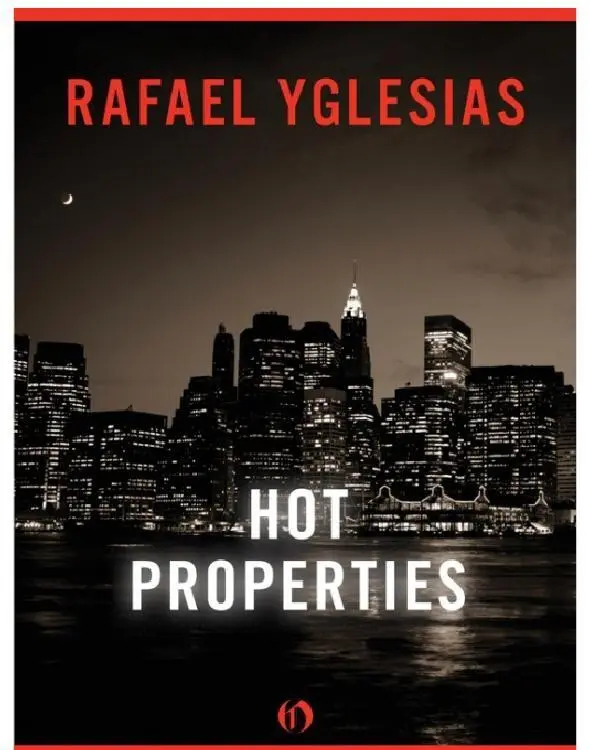
- Название:Hot Properties
- Автор:
- Издательство:Open Road Integrated Media LLC
- Жанр:
- Год:2010
- Город:New York
- ISBN:9781453205082
- Рейтинг книги:3 / 5. Голосов: 1
-
Избранное:Добавить в избранное
- Отзывы:
-
Ваша оценка:
Hot Properties: краткое содержание, описание и аннотация
Предлагаем к чтению аннотацию, описание, краткое содержание или предисловие (зависит от того, что написал сам автор книги «Hot Properties»). Если вы не нашли необходимую информацию о книге — напишите в комментариях, мы постараемся отыскать её.
Rafael Yglesias’s most sharp-tongued satire,
exposes the greed, envy, and backbiting in a media world bloated with money and power.
This ebook features a new illustrated biography of Rafael Yglesias, including rare photos and never-before-seen documents from the author’s personal collection.
Touted by the gossip columns as a roman a clef about the publishing world, Yglesias's fourth novel has definite commercial potential, since there are always people who like to read sordid tales about the media. Focusing on a group of ambitious, opportunistic New York yuppies, each desperate for success, power, fame, money and glamorous sexual partners, Yglesias follows his characters as their aspirations flourish or fade. And even for the one person who comes up with a smashing bestseller, happiness is an elusive emotion, banished by inner fear and self-loathing. The leading players in this fermenting brew are introduced in the book's opening scene, a dinner party so exquisitely awkward that even the reader is embarrassed. Thereafter we watch an aspiring playwright sell out to Hollywood; a sexy blonde discover she can really write, but must use her body to assure publication; a blocked novelist lose his scruples, professional and personal; a journalist at a leading newsmagazine realize that his way to the top has been sabotaged by office intrigue. Yglesias views his characters with cynicism, but he knows how to create the dramatic momentum that will have readers turning the pages. And if his book does become a bestseller, he will have the ironic last laugh.
Copyright 1986 Reed Business Information, Inc.
“
[is] the novel you want in the Hamptons. It lambastes the pretensions of the people you’ve been glaring at on the beach all day, and excoriates the city you’ve left behind.”
— “Sharp, funny, and fresh insight into the American literary world…”
—
From Publishers Weekly
Review
Hot Properties — читать онлайн бесплатно полную книгу (весь текст) целиком
Ниже представлен текст книги, разбитый по страницам. Система сохранения места последней прочитанной страницы, позволяет с удобством читать онлайн бесплатно книгу «Hot Properties», без необходимости каждый раз заново искать на чём Вы остановились. Поставьте закладку, и сможете в любой момент перейти на страницу, на которой закончили чтение.
Интервал:
Закладка:
David got her arm off him and then slowly disengaged his leg. She stirred at that and turned around, her slim silky buttocks angled into him. She has a beautiful body, he told himself wonderingly. Wonderingly, because it was the kind of body that he had lusted for in high school and college and had never succeeded in getting. Now he had it and there was no sense of triumph or delight. The fantasy was no better than the reality — Patty was fabulous in bed. Her golden-haired vagina was moist and pink, her breasts firm, her stomach fiat and yet soft, her hips smooth but flowingly curved.
And she was so yielding! Her mouth was a willing slave, opening abjectly for his tongue, his penis, swallowing whatever he chose to inject. Why didn’t this thrill him? Wasn’t it his dream?
He couldn’t claim, as he tried to convince himself after their first and second dates, that she was merely a dumb blond, a mind and soul too numb to feel deeply or understand his life. Patty was bright, maybe not intellectual, but he had never liked that in women or men. She exuded cheerfulness and wit, qualities he not only enjoyed but also considered rare. Why weren’t these additions to her delicious body a cause for celebration? He ought to be madly in love, he told himself. To have this beautiful and charming woman cling to him was a great piece of good fortune. But he felt lonely in her presence. Lonely and false, as if he weren’t really experiencing the sex and the conversation, as if he were in disguise, reaping rewards that justly belonged to someone else.
This thought frightened him. He felt a chill of horror, as if his soul was about to break out and spin into the black universe, divorced from human life.
David moved and hugged Patty’s back, putting his arms around her waist. She moved and hugged his arms to her, saying, out of a half-sleep, “Mmmm.”
He put his cheek against her smooth back and pushed out any thought, absorbing her warmth. His fingers stroked her soft belly. He brushed her pubic hair and she arched up, catching his hand in her pelvis.
He moved quickly, in the dark, down, pushing his face in her buttocks. She opened her legs and rolled on her back, moaning in a sleepy voice as he put his mouth to her vagina.
He knelt on the bed and quickly, in desperate and frightened movements, licked her. Almost immediately she was wet, with that ferocious moisture her body could summon instantly. He pushed his mouth and nose and chin up and down, from side to side, obliterating the terrible memory of that vision of spiritual death.
He had no idea how long it took. It seemed only moments before her body kicked and heaved, her mouth making sounds of release. He felt intense pleasure at her pleasure, at letting her squeeze his head between her thighs.
After her climax, she pulled him up and kissed his mouth, wet from her sex. He looked into her eyes and said with great feeling:
“I love you.”
He was astonished that her reaction was to hold him close, hugging him as if he were a long-lost savior. He glanced at her face and saw there was the beginning of tears in her eyes.
Seeing her happiness, he felt the dreaded emptiness return, and regretted that he had spoken.
CHAPTER 6
Fred looked at his checkbook. In the dim fluorescent light of Karl’s bathroom he saw that the balance was one hundred and twenty-four dollars and sixty-seven cents. It was eleven-thirty, a half-hour before people would be permitted to quit, and he was down, by his rough calculation, close to two hundred dollars. He had the money. Marion and he had a ten-thousand-dollar certificate of deposit, and he had eight thousand in stocks with his broker. But when he had told Marion he was going to forgo magazine assignments for a year, they had done a strict budget so that they could live on her salary with only occasional intrusions into the eighteen thousand they had in the bank. Fred had repeatedly gone over the set limits, using up four thousand in three months. This two hundred would be seen by Marion as an idiotic extravagance, if for no other reason than that he would have to break the ten-thousand-dollar CD.
“But I would have had to break it for the rent check anyway,” Fred argued to Karl’s bathroom mirror. “It’s ridiculous,” he answered the imagined rage of Marion. “We have fourteen thousand dollars and you’re making me feel poor.”
He heard his name called from the dining room, where Karl had set up the game. He stared into the mirror and said, “Wake up!” and then yanked open the bathroom door and stormed down the long narrow hallway. He saw a bubble of paint at the end of the hall. Karl lived in a pre-World War II building on West End Avenue. And though many elegant details remained — marble fireplace, elaborate moldings, sliding wood doors that separated the large dining and living rooms — the building wasn’t being kept up, and Karl’s place had many patches of peeling and cracked paint. Karl was the big winner that night, up over two hundred dollars, and as Fred made the turn out of the hallway, he hit his fist against the bubble of paint, shattering it into pieces that fell on the floor.
Entering the room, Fred could see a cloud of cigarette smoke that hung like an evil ghost over the table. There were several cups and plates swollen by mounds of ashes. The dead butts lay in them like drowned insects. The blue, red, and white poker chips blared their colors in this fog, either arrogantly stacked for precise counting by winners, or slumping, disheveled, in front of losers. Fred had a messy pile, a very small one, in front of his empty seat.
The other players were all writers he had met casually once or twice before at dinners with Karl or at publication parties Marion had been invited to. They were, in order of prominence, Sam Wasserman, the former investigative reporter who, with the publication of a bestselling book on the murder of a middle-class young woman, had become more than a reporter and less than a novelist, and, while writing additional factual but very melodramatic books on other fancy murders, wrote a regular column for Town magazine that had a broad range from political commentary to complaints about the service at Bloomingdale’s; next down the ladder of success was Tom Lear, also a former reporter, who had sold a piece on a crack New York city detective to the movies, wrote the screenplay — while several carping stories appeared claiming the detective in Lear’s article had taken credit for other people’s achievements — and it was now being shot on location in New York; a rung farther down was Paul Goldblum, who had published two highly praised but unprofitable novels, but had received a National Endowment grant and a plum creative-writing teaching job at Columbia University; staring up at his rear end Was Richard Trout, a New York Times Metro reporter and nothing else, but he talked ceaselessly of a book he planned to write on the recently notorious murder of a local congressman who was rumored to be gay; and, last, William Truman, a childhood friend of Karl’s, who was a poet — publishing mostly in academic journals no one read — and supported himself with the aid of an enormous trust fund whose source was his grandfather’s investment in real estate (Fred had been told that Grandpa Truman once owned half of Ohio).
“Bong!” Sam Wasserman said on Fred’s entrance. “Final round.”
“Come on!” Paul Goldblum said. “You’re not quitting at midnight.”
“I gotta get home and finish my column,” Sam said in a grave tone, like a surgeon announcing he had a patient on the table waiting for an emergency operation.
Tom Lear, the only writer present who felt himself equal in stature to Wasserman, let out a loud Bronx cheer.
Karl smiled nervously. “It’s your deal, Fred.”
Читать дальшеИнтервал:
Закладка:
Похожие книги на «Hot Properties»
Представляем Вашему вниманию похожие книги на «Hot Properties» списком для выбора. Мы отобрали схожую по названию и смыслу литературу в надежде предоставить читателям больше вариантов отыскать новые, интересные, ещё непрочитанные произведения.








Обсуждение, отзывы о книге «Hot Properties» и просто собственные мнения читателей. Оставьте ваши комментарии, напишите, что Вы думаете о произведении, его смысле или главных героях. Укажите что конкретно понравилось, а что нет, и почему Вы так считаете.