Rafael Yglesias - Hot Properties
Здесь есть возможность читать онлайн «Rafael Yglesias - Hot Properties» весь текст электронной книги совершенно бесплатно (целиком полную версию без сокращений). В некоторых случаях можно слушать аудио, скачать через торрент в формате fb2 и присутствует краткое содержание. Город: New York, Год выпуска: 2010, ISBN: 2010, Издательство: Open Road Integrated Media LLC, Жанр: Современная проза, Юмористическая проза, на английском языке. Описание произведения, (предисловие) а так же отзывы посетителей доступны на портале библиотеки ЛибКат.
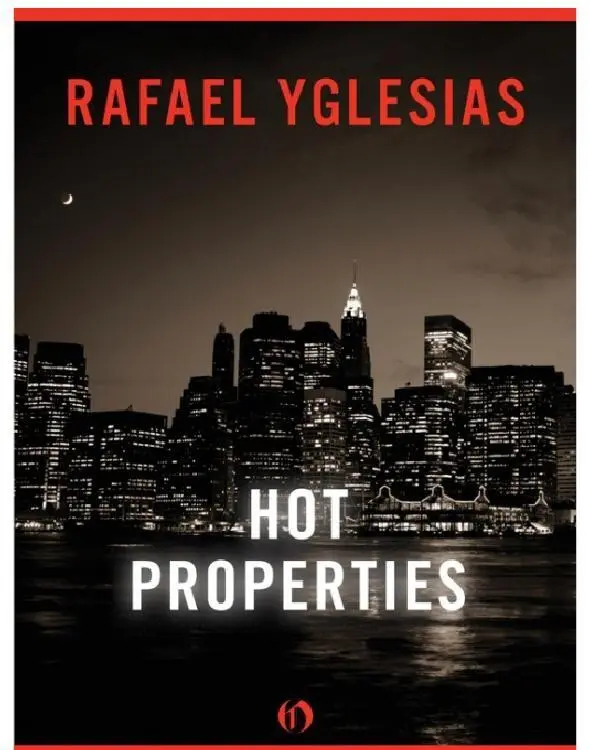
- Название:Hot Properties
- Автор:
- Издательство:Open Road Integrated Media LLC
- Жанр:
- Год:2010
- Город:New York
- ISBN:9781453205082
- Рейтинг книги:3 / 5. Голосов: 1
-
Избранное:Добавить в избранное
- Отзывы:
-
Ваша оценка:
Hot Properties: краткое содержание, описание и аннотация
Предлагаем к чтению аннотацию, описание, краткое содержание или предисловие (зависит от того, что написал сам автор книги «Hot Properties»). Если вы не нашли необходимую информацию о книге — напишите в комментариях, мы постараемся отыскать её.
Rafael Yglesias’s most sharp-tongued satire,
exposes the greed, envy, and backbiting in a media world bloated with money and power.
This ebook features a new illustrated biography of Rafael Yglesias, including rare photos and never-before-seen documents from the author’s personal collection.
Touted by the gossip columns as a roman a clef about the publishing world, Yglesias's fourth novel has definite commercial potential, since there are always people who like to read sordid tales about the media. Focusing on a group of ambitious, opportunistic New York yuppies, each desperate for success, power, fame, money and glamorous sexual partners, Yglesias follows his characters as their aspirations flourish or fade. And even for the one person who comes up with a smashing bestseller, happiness is an elusive emotion, banished by inner fear and self-loathing. The leading players in this fermenting brew are introduced in the book's opening scene, a dinner party so exquisitely awkward that even the reader is embarrassed. Thereafter we watch an aspiring playwright sell out to Hollywood; a sexy blonde discover she can really write, but must use her body to assure publication; a blocked novelist lose his scruples, professional and personal; a journalist at a leading newsmagazine realize that his way to the top has been sabotaged by office intrigue. Yglesias views his characters with cynicism, but he knows how to create the dramatic momentum that will have readers turning the pages. And if his book does become a bestseller, he will have the ironic last laugh.
Copyright 1986 Reed Business Information, Inc.
“
[is] the novel you want in the Hamptons. It lambastes the pretensions of the people you’ve been glaring at on the beach all day, and excoriates the city you’ve left behind.”
— “Sharp, funny, and fresh insight into the American literary world…”
—
From Publishers Weekly
Review
Hot Properties — читать онлайн бесплатно полную книгу (весь текст) целиком
Ниже представлен текст книги, разбитый по страницам. Система сохранения места последней прочитанной страницы, позволяет с удобством читать онлайн бесплатно книгу «Hot Properties», без необходимости каждый раз заново искать на чём Вы остановились. Поставьте закладку, и сможете в любой момент перейти на страницу, на которой закончили чтение.
Интервал:
Закладка:
“Fred, you won’t get a contract for a novel from outlines,” she had said with a tone of absolute knowledge about publishing. “First novels, unless they’re by people who are very famous for some other reason, are always written on spec.”
“That’s bullshit,” Fred had said. “What about Karl?”
“Fred, Karl had written six books on spec!”
Fred guffawed and jiggled his food. “If his publisher had read any of those manuscripts, he wouldn’t have given him lunch, much less a contract.” She had no answer for that. He told her: “Bart got Karl his contract, and if he takes me on, he’ll get me one.” She hadn’t argued, but he knew she didn’t believe it, despite the evidence of Karl and his stewardess novel. Fred knew why. Marion had once said about Karl, “I don’t know if Karl’s a good writer, but he looks, talks, and thinks like a novelist.” She didn’t believe that about Fred. He was merely a nice Jewish boy to her. Maybe she doesn’t want me to succeed, he said to himself. Maybe she’s scared if I become a rich famous novelist, I’ll leave her.
He clicked down the buttons of the phone, got a dial tone, and called Marion back.
When he got her, he burst out, “What do you mean Bob Holder always asks for an exclusive look?”
Marion laughed. “That’s what you called me back about? You’re gonna drive yourself crazy—”
“How do you know that? You don’t know Holder.”
“I’ve met him. I don’t really know him. But Betty works at Garlands. She makes fun of Holder doing stuff like that. He thinks he’s a hotshot, so—”
“He is a hotshot, honey.”
“Okay, so he is a hotshot. And he likes to act like one.”
“But Betty didn’t say, specifically, that Holder always asks for an exclusive look?”
“Fred,” Marion said in a gentle but thoroughly contemptuous tone, “everybody would ask for an exclusive look if they thought they could get it. What’s the harm? If you don’t like it, you can still say no. If you do, then you don’t have the pressure of competing interest. Maybe Bart made it sound like a great thing, but an editor getting an exclusive look just gives the editor leverage. It doesn’t help the writer.”
Fred stared out the window at the traffic and people below. He only noticed them when he felt like a failure or a fool. They went on with their lives, ignorant of him.
“Fred?” Marion said tentatively into his silence.
She had made him see that his excitement was over nothing. His conviction that Bart could somehow manipulate an important editor into buying his outline was a fantasy; he had sat in Bart’s office and listened to him pitch the elixir of success, and bought it, only to discover it was simply the plain water of uncertain promises. “Do you think Bart’s a bad agent?” he asked suspiciously, as if she had been keeping a secret.
Marion grunted. It sounded like a startled laugh. “No, I didn’t say that. He’s flattering Holder by giving it to him exclusively. And he’s letting him know that Bart really thinks it’s a hot idea. That’s great. I was just trying to get you to calm down. Not to expect too much. Holder hasn’t read it. Until he has, it doesn’t mean a thing.”
“I don’t need that, you know. I realize I may get turned down. I know I may be a failure. I don’t need you to remind me.”
“Fred.” Said very sternly: a warning not to continue. “I don’t want to talk about this. You’re paranoid. I’ll call you later.” And she hung up.
He let the hand with the receiver drop to his side, as if the dismal emotions of the conversation had made it too heavy to hold up. He leaned his head against the wall and looked again at the people below. A delivery truck with the New York Post had stopped at a corner news kiosk to unload an edition. Two boys of about fifteen, coming home from school, passed the stacks of newspapers. They were short and probably Jewish. One of them was fat. His wrinkled white shirttails were hanging outside his pants. The other was skinny and wore thick black glasses. They stopped and peered at the back of the Post. It would be a sports story that caught their interest. Fred at their age looked like them and also would have peered at the headline with total absorption. In those days, it never occurred to him that writing served any purpose other than graduating from school or proving that Mickey Mantle was a better hitter than Willie Mays. That dumpy kid with his shirttails hanging out was innocent. He had yet to learn, as Fred had, that his appearance would cut him off from most of the fantasies that men have: he would never be thought of as glamorous, as sexy, as profound. No one would look at him and say, “There are a poet’s eyes, a sculptor’s hands, an actor’s voice, or the tall inspiring body of a leader.” That kid, gawking with happy concentration at the Post’s sports headline, hadn’t been faced with the certain knowledge that no tall, beautiful blond would go to bed with him — unless he paid her. “Money,” Fred said aloud, as if he were hurling a curse down at the boy below. “Money and fame are the only things that will help.”
He turned, despairing, and returned the receiver to its cradle. It rang instantly.
“Fred?” said a deep but tentative voice. “It’s Karl.”
“Hi.”
“How did the meeting go?”
“You knew about it?”
“Yeah, Bart told me he read an outline of yours. He said he liked it. Thought he could sell it.”
The poison of Marion’s pessimism left Fred’s system, as if wiped out by a miracle drug. “He did?”
“Yeah,” Karl said. ‘Didn’t he say that to you?”
“Yeah. He did. I’m crazy. You know, it happened three hours ago. I was high as a kite. But just now I was really feeling down—”
“Why? Isn’t he sending it out?”
“Yeah. He’s sending it to your editor.”
“Oh.” Karl sounded taken aback. “You mean Holder?” he asked idiotically, as if hoping against hope that Fred had made a mistake.
“Yeah. Does that bother you?”
“No, no,” Karl said so quickly that it was obvious he was disturbed.
“It shouldn’t,” Fred said almost pleadingly. It flashed in his mind that Karl might speak to Holder during the next few days (Karl’s novel was due out in five months and contact between them was probably frequent) and say something denigrating about him. Point out that Fred has never written a novel, that his experience as a writer was limited to twenty pieces on sports — and most of those were interviews, which hardly put great demands on Fred as a writer.
“No, of course not. I was thinking whether I should speak to him, tell him I know you—”
“Oh, you don’t have to do that,” Fred said anxiously, but as he spoke, he looked at the situation the other way. Holder obviously admired Karl; if Karl spoke well of Fred to Holder, perhaps it would add to the favorable impresssion of Bart’s recommendation. “Unless — do you think it would bother Holder?”
“Bother?” Karl said in a bewildered tone.
“I think you shouldn’t. He’d think I put you up to it.”
“Okay. I won’t say anything.”
“So,” Fred said, clearing his throat. He wanted to keep Karl on the line. Talking to Karl — Karl the novelist — made him feel his ambitions were real, answered the worry inside him that he was a victim of a delusion. But there was nothing in his mind other than talk of the outline, talk of the meeting with Bart, worry over what Holder would think.
“I was calling to invite you to a poker game. Do you play?” Karl asked.
Fred was delighted. He had heard Karl, on the social occasions they had spent together, refer to his weekly poker game, whose members were all established writers. Several times Fred had mentioned to Karl, rather awkwardly, how much he liked to gamble (Marion would always exclaim, “You do?” incredulously, humiliating him), hoping to provoke an invitation, but his comments were returned with blank looks from Karl, and, more ominously, after a while Karl stopped even mentioning his poker game.
Читать дальшеИнтервал:
Закладка:
Похожие книги на «Hot Properties»
Представляем Вашему вниманию похожие книги на «Hot Properties» списком для выбора. Мы отобрали схожую по названию и смыслу литературу в надежде предоставить читателям больше вариантов отыскать новые, интересные, ещё непрочитанные произведения.









Обсуждение, отзывы о книге «Hot Properties» и просто собственные мнения читателей. Оставьте ваши комментарии, напишите, что Вы думаете о произведении, его смысле или главных героях. Укажите что конкретно понравилось, а что нет, и почему Вы так считаете.