Rafael Yglesias - Hot Properties
Здесь есть возможность читать онлайн «Rafael Yglesias - Hot Properties» весь текст электронной книги совершенно бесплатно (целиком полную версию без сокращений). В некоторых случаях можно слушать аудио, скачать через торрент в формате fb2 и присутствует краткое содержание. Город: New York, Год выпуска: 2010, ISBN: 2010, Издательство: Open Road Integrated Media LLC, Жанр: Современная проза, Юмористическая проза, на английском языке. Описание произведения, (предисловие) а так же отзывы посетителей доступны на портале библиотеки ЛибКат.
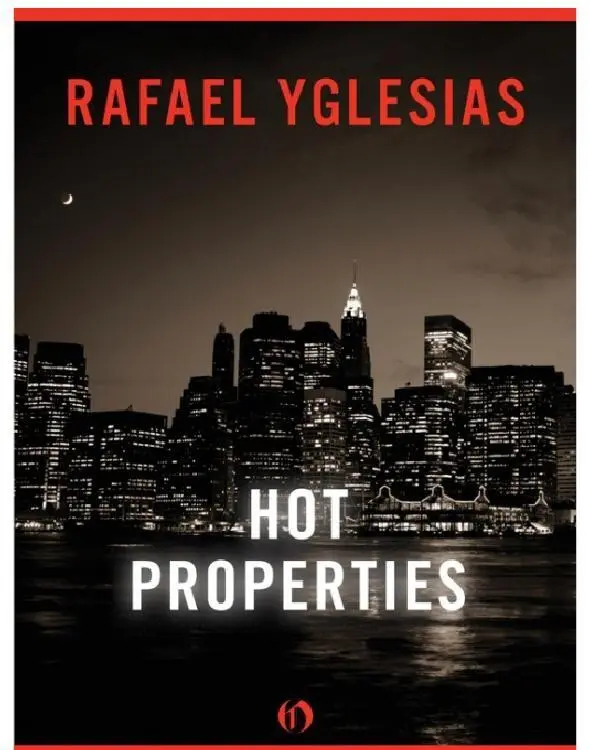
- Название:Hot Properties
- Автор:
- Издательство:Open Road Integrated Media LLC
- Жанр:
- Год:2010
- Город:New York
- ISBN:9781453205082
- Рейтинг книги:3 / 5. Голосов: 1
-
Избранное:Добавить в избранное
- Отзывы:
-
Ваша оценка:
Hot Properties: краткое содержание, описание и аннотация
Предлагаем к чтению аннотацию, описание, краткое содержание или предисловие (зависит от того, что написал сам автор книги «Hot Properties»). Если вы не нашли необходимую информацию о книге — напишите в комментариях, мы постараемся отыскать её.
Rafael Yglesias’s most sharp-tongued satire,
exposes the greed, envy, and backbiting in a media world bloated with money and power.
This ebook features a new illustrated biography of Rafael Yglesias, including rare photos and never-before-seen documents from the author’s personal collection.
Touted by the gossip columns as a roman a clef about the publishing world, Yglesias's fourth novel has definite commercial potential, since there are always people who like to read sordid tales about the media. Focusing on a group of ambitious, opportunistic New York yuppies, each desperate for success, power, fame, money and glamorous sexual partners, Yglesias follows his characters as their aspirations flourish or fade. And even for the one person who comes up with a smashing bestseller, happiness is an elusive emotion, banished by inner fear and self-loathing. The leading players in this fermenting brew are introduced in the book's opening scene, a dinner party so exquisitely awkward that even the reader is embarrassed. Thereafter we watch an aspiring playwright sell out to Hollywood; a sexy blonde discover she can really write, but must use her body to assure publication; a blocked novelist lose his scruples, professional and personal; a journalist at a leading newsmagazine realize that his way to the top has been sabotaged by office intrigue. Yglesias views his characters with cynicism, but he knows how to create the dramatic momentum that will have readers turning the pages. And if his book does become a bestseller, he will have the ironic last laugh.
Copyright 1986 Reed Business Information, Inc.
“
[is] the novel you want in the Hamptons. It lambastes the pretensions of the people you’ve been glaring at on the beach all day, and excoriates the city you’ve left behind.”
— “Sharp, funny, and fresh insight into the American literary world…”
—
From Publishers Weekly
Review
Hot Properties — читать онлайн бесплатно полную книгу (весь текст) целиком
Ниже представлен текст книги, разбитый по страницам. Система сохранения места последней прочитанной страницы, позволяет с удобством читать онлайн бесплатно книгу «Hot Properties», без необходимости каждый раз заново искать на чём Вы остановились. Поставьте закладку, и сможете в любой момент перейти на страницу, на которой закончили чтение.
Интервал:
Закладка:
“You want to set the book in New York,” Bart said in what seemed like an impatient and disappointed tone.
“No, no,” Fred said quickly, meaning to answer Bart’s impatience. He realized — with horror — that he had just accidentally agreed to setting it elsewhere.
“You’re just not sure about Detroit?” Bart prompted.
Fred nodded, abashed. Why didn’t he argue? Why was he letting his novel be changed without a fight?
“Detroit was just a notion. The important thing is to keep it out of New York. As long as you agree, that’s fine.” Bart leaned back with a satisfied expression. “This is going to be a big book, Fred. I considered making a hard-soft deal with Bob. He already brought it up — but now I don’t think so. We may get seven figures for the paperback rights if you can pull it off.”
Fred was electrified. Not by the talk of seven figures; that he knew was gossamer. It was Bob Holder bringing up a possible hard-soft deal. That meant he was already partly disposed toward making a deal even before seeing the outline. Jesus, why hadn’t he worked on the outline harder and longer? “Holder’s really excited, huh?”
“You know, it’s interesting, Fred. This idea of yours— it’s hot. Minute I heard it, I knew you had something. And Holder, who has, I think, the best instincts for commercial fiction in the country, was hopping. He was terrified I was going to give anyone else a shot at it.” ”
Fred felt scared. He learned forward. “Bart. Listen. Maybe, given all these changes, I should rewrite the outline before Holder sees it.”
“I’ve already sent it to him. Don’t worry. He doesn’t expect much from the outline. I told him you’d done it in a rush, that you’ll be eager to sit down with him before writing and really work out a detailed plot so there’ll be no surprises when you hand in the manuscript. You know, it’s best to involve an editor. Get their ego into the book. Make ’em feel almost as if they wrote it. Then they fight like a motherfucker for a big printing, ad budget. I think if you work closely with Holder, he’ll go to the mat and really fight for the book.”
Fred left Bart’s office thrilled. He hailed a cab and gave his home address. He lit a cigarette and looked out the window at New York City — perhaps too boring and provincial a location for his novel — but the crisp fall day’s sun glistened against the midtown skyscrapers and danced a celebration of welcome. Fred told the driver he had changed his mind, and asked him to steer for Brooks Brothers, and soon he was there, amidst all those insulated New York men; men who ran the banks, the newsmagazines, the television networks; powerful men, who, Fred fancied, glanced at him casually, as if he belonged, despite his coffee-stained pants. Self-confidence rose from him like a mist, obscuring that he was short, Jewish, and all those other insecurities that America had been bored to tears reading of. No, there would be no shouts of intruder from the powerful men, because, Fred believed, he now belonged.
Another major story had been assigned to David Bergman the week that Newstime became the subject of the news rather than a purveyor. Every day in the New York Post on page six (a garish page of show-business and media gossip) the “scandalous” story of Steinberg’s sudden firing and the confusion over who would be named Groucho — editor in chief — was given big play.
While David puzzled over the bureau reports on Haig’s problems, wild accounts of Mrs. Thorn’s dismissal of Steinberg appeared, were denied, and then reappeared with new embellishments. The original story was: she had walked in out of the blue and, despite Steinberg’s very profitable record, had fired him impulsively when, after she complained about a recent cover story, he told her not to interfere with his running of the magazine. Newstime editors and writers found themselves getting calls late Monday and early Tuesday from people at the Weekly trying to confirm or deny this. Everybody claimed to have no idea what had happened.
David tried to concentrate on the Haig story. His dismissal had been so widely anticipated that David couldn’t find a single new element to bring in now that the event had actually occurred. By Wednesday the story that Mrs. Thorn had had security guards appear to prevent Steinberg from taking any files and that she had had him led out in disgrace was causing a lot of laughter at the Weekly and among newsies in general.
But the attention of Newstime employees was on the question of who would be Steinberg’s successor. David was glad that he had his cover story to write, because he could plausibly ignore the nervous speculations in the hall. He had heard nothing more from Chico about his own potential promotion; he had tried to see Patty Lane again and had been too distracted and anxiety-ridden to enjoy her; and so he told himself to focus absolutely on the cover story and let events decide things for him.
By Thursday, contempt for Mrs. Thorn was rampant in Newstime’s halls. The writers decided the gossip was true. She must have fired Steinberg without thinking it through because she had not yet picked a new Groucho. By now Steinberg, for whom there had been little love and certainly no passion, was being discussed wistfully, as if his tenure had been a golden era, impossible to recapture.
Everyone’s mood was worsened by the emotional state of the remaining Marx Brothers, who, made restless by a vacancy above them, were suddenly trespassing on each other’s territory, as if to prove that they were qualified to head the magazine. Chico, who had been put in charge for that week’s issue, behaved as though the assignment was permanent. But his manner was irritable and defensive, like someone who suspects that if he should settle on his throne, he would discover that a prankster had moved it away, and he’d end up on his ass — with a roomful of spectators to laugh at him. David found his “blues,” so called because the rough drafts of articles were written on blue sheets that were edited by the appropriate senior editor and Marx Brother, coming back from Chico with crabby and picky margin notes requesting changes. This was unusual and worried David. Had someone convinced Chico that David was a poor choice to senior-edit Business and now Chico was out to cover himself by becoming David’s biggest critic?
But he, unlike the rest of the magazine, forced these worries down. He told himself that pretending lofty disinterest in the magazine’s power struggle would eventually redound to his credit. (He was right. Later, the nervous, gossipy behavior of some writers was remembered bitterly by the Marx Brothers.)
On Friday, everyone was taken by surprise. All the newshounds of New York had failed to pick up even a hint of what Mrs. Thorn did. She named an outsider as the new editor in chief. He was Richard Rounder, a six-foot-five blond, blue-eyed ex-Navy commander who had no background as a journalist but had been the founding editor in chief of New South magazine, one of the startling successes of the last decade. Everything about Rounder was unprecedented. Editors in chief of Newstime had always been both Northern and Eastern — Rounder was born and bred in Atlanta — and worked many years either as journalists or as editors of strictly news-gathering organs. And all but one had worked at Newstime for many years before being promoted to the top job. Rounder not only had never worked at Newstime, and had no background as a journalist, he also had no experience with weekly newsmagazines. New South was a slick, glossy monthly devoted mostly to lifestyle features, with an occasional exposé.
The gossips at the magazine (namely everyone), though they were taken by surprise — few had considered an outsider as a candidate, and those who had, picked former Newstime employees — adjusted instantly, as is the habit of journalists, with authoritative explanations. Rounder’s success had been with a feature magazine, therefore Mrs. Thorn obviously intended to improve Newstime’s “soft cover stories.” A remarkable number of people who only a day before had been insisting that Steinberg was fired because he did too many “soft covers” were now looking wise and grave as they pronounced that Rounder was hired to ensure that Newstime do more. Among the political writers, David’s immediate colleagues, Mrs. Thorn’s decision went over badly.
Читать дальшеИнтервал:
Закладка:
Похожие книги на «Hot Properties»
Представляем Вашему вниманию похожие книги на «Hot Properties» списком для выбора. Мы отобрали схожую по названию и смыслу литературу в надежде предоставить читателям больше вариантов отыскать новые, интересные, ещё непрочитанные произведения.








Обсуждение, отзывы о книге «Hot Properties» и просто собственные мнения читателей. Оставьте ваши комментарии, напишите, что Вы думаете о произведении, его смысле или главных героях. Укажите что конкретно понравилось, а что нет, и почему Вы так считаете.