Rafael Yglesias - Hot Properties
Здесь есть возможность читать онлайн «Rafael Yglesias - Hot Properties» весь текст электронной книги совершенно бесплатно (целиком полную версию без сокращений). В некоторых случаях можно слушать аудио, скачать через торрент в формате fb2 и присутствует краткое содержание. Город: New York, Год выпуска: 2010, ISBN: 2010, Издательство: Open Road Integrated Media LLC, Жанр: Современная проза, Юмористическая проза, на английском языке. Описание произведения, (предисловие) а так же отзывы посетителей доступны на портале библиотеки ЛибКат.
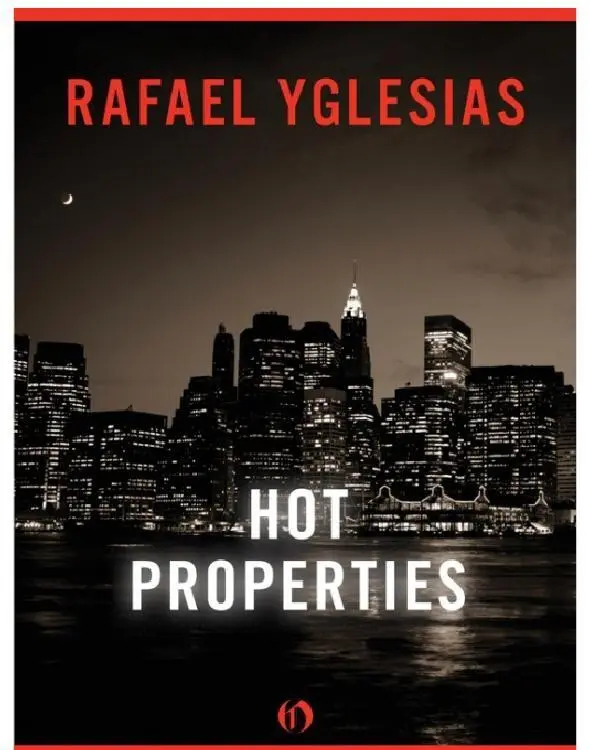
- Название:Hot Properties
- Автор:
- Издательство:Open Road Integrated Media LLC
- Жанр:
- Год:2010
- Город:New York
- ISBN:9781453205082
- Рейтинг книги:3 / 5. Голосов: 1
-
Избранное:Добавить в избранное
- Отзывы:
-
Ваша оценка:
Hot Properties: краткое содержание, описание и аннотация
Предлагаем к чтению аннотацию, описание, краткое содержание или предисловие (зависит от того, что написал сам автор книги «Hot Properties»). Если вы не нашли необходимую информацию о книге — напишите в комментариях, мы постараемся отыскать её.
Rafael Yglesias’s most sharp-tongued satire,
exposes the greed, envy, and backbiting in a media world bloated with money and power.
This ebook features a new illustrated biography of Rafael Yglesias, including rare photos and never-before-seen documents from the author’s personal collection.
Touted by the gossip columns as a roman a clef about the publishing world, Yglesias's fourth novel has definite commercial potential, since there are always people who like to read sordid tales about the media. Focusing on a group of ambitious, opportunistic New York yuppies, each desperate for success, power, fame, money and glamorous sexual partners, Yglesias follows his characters as their aspirations flourish or fade. And even for the one person who comes up with a smashing bestseller, happiness is an elusive emotion, banished by inner fear and self-loathing. The leading players in this fermenting brew are introduced in the book's opening scene, a dinner party so exquisitely awkward that even the reader is embarrassed. Thereafter we watch an aspiring playwright sell out to Hollywood; a sexy blonde discover she can really write, but must use her body to assure publication; a blocked novelist lose his scruples, professional and personal; a journalist at a leading newsmagazine realize that his way to the top has been sabotaged by office intrigue. Yglesias views his characters with cynicism, but he knows how to create the dramatic momentum that will have readers turning the pages. And if his book does become a bestseller, he will have the ironic last laugh.
Copyright 1986 Reed Business Information, Inc.
“
[is] the novel you want in the Hamptons. It lambastes the pretensions of the people you’ve been glaring at on the beach all day, and excoriates the city you’ve left behind.”
— “Sharp, funny, and fresh insight into the American literary world…”
—
From Publishers Weekly
Review
Hot Properties — читать онлайн бесплатно полную книгу (весь текст) целиком
Ниже представлен текст книги, разбитый по страницам. Система сохранения места последней прочитанной страницы, позволяет с удобством читать онлайн бесплатно книгу «Hot Properties», без необходимости каждый раз заново искать на чём Вы остановились. Поставьте закладку, и сможете в любой момент перейти на страницу, на которой закончили чтение.
Интервал:
Закладка:
He sat in the back of his limousine during the ride from LAX to the Beverly Hills Hotel and played with the bar and the temperature-control dial — he wanted to see if he could tell the difference between sixty-eight and sixty-six degrees — and said to himself over and over, this isn’t depressing, this is fun! And though the difference between his childhood visits and this trip was obvious — to see a father who has given your mother a nervous breakdown and blacklisted his friends is presumably of a different quality than being summoned by a world-famous actor and a powerful producer to “save the script”—nevertheless, the pure thrill of it, the preposterous treatment of him by the driver and hotel clerks as if he were the scion of royalty, the silly extravagance of first-class travel, all of it, was wonderful, perhaps his first real Christmas ever.
Two messages were waiting for him at the desk, from his father and mother. Of course, their names didn’t mean that to the slavish clerk. She was the star of the number-one television sitcom and his father was the head of programming for a major network. As always their stature in television land amused Tony, but once upstairs, disappointed that his room was small (writers don’t get suites, I guess, he thought), the two names scrawled on the message-form slips depressed him, reminded him of the other LA, blew in to the air-conditioned room a Santa Ana of greed, cowardice, and disloyalty.
He decided not to phone, his excuse being that it was late and he had an early meeting. But he couldn’t sleep and after unpacking with a meticulousness totally unlike him, he wanted to talk to someone. New York was out of the question; it was already late there. He was stumped for a while, until he thought of Billy Feldman, the son of a neighbor of his father’s, also a child of divorce, with whom Tony would play during his summers in Beverly Hills. Tony’s father had mentioned the last time they talked that Billy was in town working in the business. Tony found him through information, living in Hollywood.
“Hey, man! How are you? This is incredible, I was just talking about you.”
“I’m in town. I can’t sleep. I was hoping …”
“Sure — where are you?”
Fifteen minutes later Billy arrived at the hotel entrance and waved away the valet-parking attendant as Tony approached. Billy was driving a BMW sports car, wearing a pink T-shirt and white shorts and a pair of sunglasses pushed back onto the top of his head.
“What’s this?” Tony asked, getting in. “The Hal Prince look?”
Billy looked puzzled.
“The glasses,” Tony explained.
“Oh.” Billy seemed worried suddenly, as if he had committed a gaffe. “I forget I have them on, I’m sorry.”
“I was teasing,” Tony said. He slapped Billy on the leg. “Thank you for rescuing me. I was so lonely in that hotel room.”
“I know what you mean, man. They’re the worst. What are you doing in a hotel anyway? Between your mom and dad you’ve got forty-five rooms to stay in.”
“I’ve never seen Mom’s place. Think it’s big?”
“I know it is. I was there last week.”
“You were! For what? Don’t tell me she had a party.”
“Script conference. Haven’t you heard? You haven’t!” Billy seemed slightly miffed. “I’m a writer on her series,” he continued, obviously proud of this fact, and hurt that Tony wasn’t aware of his accomplishment.
“You are! No kidding. That’s terrific!” Tony said with conviction. Billy relaxed and told the story of how he landed his job as a “story editor” on Tony’s mother’s series. His account was given in a tone that implied the anecdote had the significance of legend, the way a war veteran might talk of his participation in the Normandy invasion. In telling how he got the assignment to write an episode, Billy seemed to discount that he had known Tony’s mother, as well as the executive producer, since childhood.
“So they gave me a week to write the script. I didn’t fucking sleep at all. By the time I handed it in, I was sure it was shit. And I just felt — I mean, I’m sure I was overdramatizing — that this was my last shot. If this script didn’t go, I don’t know, I would have just given up. Gone back east or something.”
“So after you wrote one episode, they made you a story editor?”
Billy frowned. He seemed both confused and irritated. “Well, the script I wrote was the car-wreck episode.”
Tony nodded and waited. Billy looked away from the road to glance at Tony and saw that his explanation had been insufficient.
“You know?” Billy said, now a little doubt creeping into the tone of the war veteran: perhaps his listener had never heard of World War II.
“The car-wreck episode,” Tony repeated. “That was this past season?”
“Tony, your mom won an Emmy for the car-wreck episode. Don’t tell me you haven’t seen that show!”
“Well …” Tony was about to say that he vaguely remembered seeing a few minutes of an episode about a car wreck, when he realized that such a comment would be more insulting than saying he had never seen it. Obviously Billy believed the car-wreck episode, if one saw it, would haunt the memory.
“Here we are!” Billy announced, in time to prevent Tony from saying anything.
“Joe Allen’s!” Tony exclaimed with genuine delight. “I forgot they have one in LA.”
“I thought it might make you less homesick,” Billy said.
When they walked in and Tony saw the familiar brick walls and the long old-fashioned bar at the entrance, he said, “You’re right.”
“Yeah, the first year I moved out here permanently, I ate here three times a week. I would’ve come more, except I was embarrassed. And broke.”
Billy walked past the headwaiter and on into the back room, heading for a table with two young women and room for two others. Tony followed, dismayed at the prospect of having to meet people. Billy introduced the women as Helen, his roommate, and her friend, Lois.
“As in Lane,” Billy added with a grin.
“And you’re Billy, as in the Kid,” Lois answered in a quiet drawl. The response, and the vague suggestion of hostility in her tone, interested Tony.
While they ordered drinks, and Tony, his stomach clock disordered, first decided he was hungry and ordered a hamburger, then had no desire for it on its arrival, they discussed their reasons for being in LA. All of them were New Yorkers. Billy, like Tony, was raised by his mother and had been visiting LA for years before he moved, but Helen and Lois both came to LA after college and worked as secretaries for movie studios. Helen was now a film editor (Tony eventually was able to determine without asking directly that she was still basically an assistant film editor, which could mean anything from being the real talent behind her boss to being the person who organized the loose strips at the end of the day — the lower end of the spectrum was more likely) and Lois had become a sitcom writer. Indeed, she had made it: she was the producer of his mother’s series, a title which meant that she supervised the assignments, acceptance, and final polishing of all the episodes, as well as writing four or five herself.
They all knew Tony’s story, to his surprise, but it turned out his mother was fond of bragging about his plays and (when he guessed this, and asked them, they cheerfully admitted it) implying that they wrote garbage for TV while her brilliant son was a “serious writer.”
Tony’s wringing this admission from them made them all great friends, especially when Tony laughed at his mother’s description of him as a “serious writer.” Tony said, “That means I don’t make any money.”
While Lois laughed at this remark, Tony smiled and looked into her eyes, thinking about making love to her, and it was clear to him that she would be willing. She had been expecting to loathe him; she was someone who had little free time for meeting single men; she knew mostly television types like Billy; and, of course, though Tony made fun of talk about himself as a “serious writer,” he knew that in fact he was a serious writer, and therefore possessed a sort of impoverished nobility that still awed people who worked in Hollywood. All this added up to her being an easy target for a seduction.
Читать дальшеИнтервал:
Закладка:
Похожие книги на «Hot Properties»
Представляем Вашему вниманию похожие книги на «Hot Properties» списком для выбора. Мы отобрали схожую по названию и смыслу литературу в надежде предоставить читателям больше вариантов отыскать новые, интересные, ещё непрочитанные произведения.








Обсуждение, отзывы о книге «Hot Properties» и просто собственные мнения читателей. Оставьте ваши комментарии, напишите, что Вы думаете о произведении, его смысле или главных героях. Укажите что конкретно понравилось, а что нет, и почему Вы так считаете.