Rafael Yglesias - Hot Properties
Здесь есть возможность читать онлайн «Rafael Yglesias - Hot Properties» весь текст электронной книги совершенно бесплатно (целиком полную версию без сокращений). В некоторых случаях можно слушать аудио, скачать через торрент в формате fb2 и присутствует краткое содержание. Город: New York, Год выпуска: 2010, ISBN: 2010, Издательство: Open Road Integrated Media LLC, Жанр: Современная проза, Юмористическая проза, на английском языке. Описание произведения, (предисловие) а так же отзывы посетителей доступны на портале библиотеки ЛибКат.
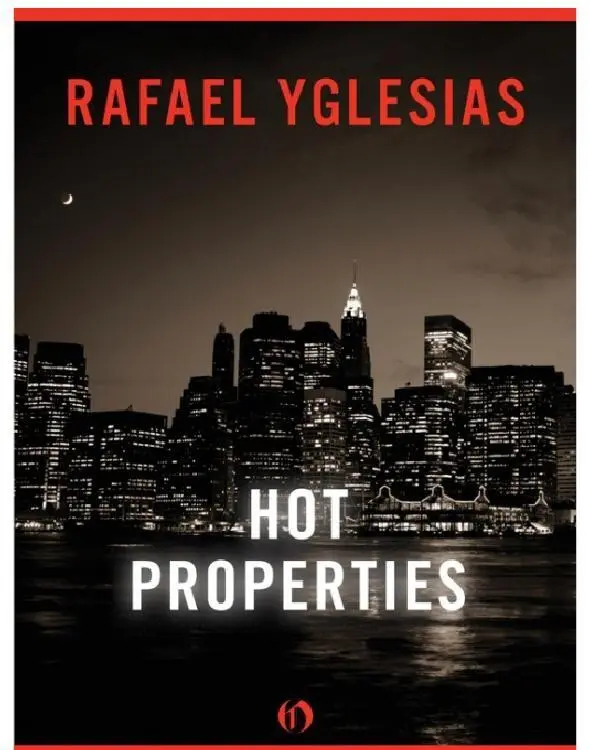
- Название:Hot Properties
- Автор:
- Издательство:Open Road Integrated Media LLC
- Жанр:
- Год:2010
- Город:New York
- ISBN:9781453205082
- Рейтинг книги:3 / 5. Голосов: 1
-
Избранное:Добавить в избранное
- Отзывы:
-
Ваша оценка:
Hot Properties: краткое содержание, описание и аннотация
Предлагаем к чтению аннотацию, описание, краткое содержание или предисловие (зависит от того, что написал сам автор книги «Hot Properties»). Если вы не нашли необходимую информацию о книге — напишите в комментариях, мы постараемся отыскать её.
Rafael Yglesias’s most sharp-tongued satire,
exposes the greed, envy, and backbiting in a media world bloated with money and power.
This ebook features a new illustrated biography of Rafael Yglesias, including rare photos and never-before-seen documents from the author’s personal collection.
Touted by the gossip columns as a roman a clef about the publishing world, Yglesias's fourth novel has definite commercial potential, since there are always people who like to read sordid tales about the media. Focusing on a group of ambitious, opportunistic New York yuppies, each desperate for success, power, fame, money and glamorous sexual partners, Yglesias follows his characters as their aspirations flourish or fade. And even for the one person who comes up with a smashing bestseller, happiness is an elusive emotion, banished by inner fear and self-loathing. The leading players in this fermenting brew are introduced in the book's opening scene, a dinner party so exquisitely awkward that even the reader is embarrassed. Thereafter we watch an aspiring playwright sell out to Hollywood; a sexy blonde discover she can really write, but must use her body to assure publication; a blocked novelist lose his scruples, professional and personal; a journalist at a leading newsmagazine realize that his way to the top has been sabotaged by office intrigue. Yglesias views his characters with cynicism, but he knows how to create the dramatic momentum that will have readers turning the pages. And if his book does become a bestseller, he will have the ironic last laugh.
Copyright 1986 Reed Business Information, Inc.
“
[is] the novel you want in the Hamptons. It lambastes the pretensions of the people you’ve been glaring at on the beach all day, and excoriates the city you’ve left behind.”
— “Sharp, funny, and fresh insight into the American literary world…”
—
From Publishers Weekly
Review
Hot Properties — читать онлайн бесплатно полную книгу (весь текст) целиком
Ниже представлен текст книги, разбитый по страницам. Система сохранения места последней прочитанной страницы, позволяет с удобством читать онлайн бесплатно книгу «Hot Properties», без необходимости каждый раз заново искать на чём Вы остановились. Поставьте закладку, и сможете в любой момент перейти на страницу, на которой закончили чтение.
Интервал:
Закладка:
“You’ve heard, of course.”
Pretending would be dumb. “Yeah.” But on the other hand, maybe David hadn’t heard the right rumor. “If what I’ve heard is what you’re talking about.”
“Steinberg is gone tomorrow. Syms will also be asked to leave. The last is a big secret. Everybody knows about Steinberg. With Syms out, we’ll have problems in Nation. We’re thin, especially in writing. And a number of our writers couldn’t possibly take over as senior editors. Bill Kahn couldn’t handle Nation.”
David, for the first time that day, began to realize that this shift in power might be wonderful for him. What if they made him Nation senior editor? Was that possible? Nation was the most prestigious senior-editing position on the magazine, the traditional stepping-stone to Marx Brother status and presumably the ideal background for editor in chief. David had always assumed that if Syms left, Bill Kahn would succeed him. Besides, David was very young to be made a senior editor. This notion so dominated his mind that he had trouble appearing at ease, and the trouble made him more nervous, as if his being caught thinking such an ambitious thought might make Chico change his mind. What was he thinking? Such a change wouldn’t be up to Chico alone; all the Brothers and Mrs. Thorn would have to agree on a promotion to senior-edit Nation.
“You agree, don’t you? About Kahn?”
Now this question from Chico seemed loaded, and with deadly bullets. David tried a traditional escape maneuver: “You mean Kahn is more interested in writing?”
“No. Kahn would love to be made senior editor. I mean, he couldn’t handle it. Isn’t that obvious?”
Bang, it was back in David’s court. Can I agree? he nervously questioned himself. I shouldn’t be hesitating. Senior-editing Nation wouldn’t allow hesitation. “I only know Bill as a writer. I mean, as a writer knows another writer. I read his stuff, that’s all. I have no idea how he might edit or develop ideas. He doesn’t seem interested in other people’s work, so perhaps he wouldn’t be a sympathetic editor. He would establish a tone.” Was any of that true? David wondered. Probably, he decided.
“Oh, Bill’s a superb writer,” Chico agreed. “But I don’t think he can handle people. That’s at least as important as editorial skills. That was Syms’s problem. He was arrogant.”
Chico citing Syms for arrogance? Chico was the most arrogant man in the world. Everything that came out of his mouth was a pronouncement, an absolute judgment, calmly delivered, with the self-assurance of a monarch. Chico could be chilling. David thought all this and noticed Chico’s use of the past tense when discussing Syms.
“You liked working for him, though,” Chico added, and sat down, his eyes — beady little things that seemed too small for his large body — peering at David.
“Yes.” David stared back. To lie about that would be thoroughly pointless. David had flourished under Syms, drawing more and more cover assignments in Nation (and away from Kahn) because of Syms’s support.
“But I get the feeling you can work with anyone,” Chico said.
Was that a compliment? Or was Chico accusing David of having no taste?
“That’s an important quality,” Chico continued. “To put out this magazine, we need as little tension and scraping of egos as possible. Good senior editors can work with anyone.”
Bingo. Something David had not expected for years was about to happen: senior editorship. And of Nation at that!
“I wanted to give you Nation to senior-edit,” Chico said, “but others feel you’re too young to be moved immediately, as a senior editor, into the most important and pressured position. They want to ease you into senior editing. As a compromise, you’ll be offered Business.”
David had had only a second to relish the hope that he might senior-edit Nation, but that moment was sufficiently captivating to make getting Business instead a disappointment. He knew that was an absurd feeling — to be a senior editor at his age, no matter what the department, was extraordinary. Besides, Business was the second-most-important position in the rank of senior editor, in fact the job that five years ago, when he first came to Newstime, he hoped he would someday hold. Meanwhile, he had to respond to this surreptitious and unofficial job offer, if that’s what it was.
“What happens to Jim?” David asked, referring to the current senior editor of Business.
“Well …” Chico grabbed a paper clip and began to unravel it, almost angrily. “You understand none of this is definite.”
“Of course.” So he couldn’t celebrate — yet.
“Presumably Jim would move to Nation.”
“Really?”
“Yeah, I agree. He’s not right for it. I don’t think he’ll be there for long.”
There was a loud buzz from the red intercom resting next to Chico’s phone. A disembodied voice boomed from its open speaker — in Newstime this intercom system, which provided the Marx Brothers and all the senior editors with direct lines to each other, had been nicknamed the Power Phone — and to David’s surprise, the harassed and irritable voice belonged to the owner, Mrs. Thorn. “Bill, can you come by now? I think we’re ready for a decision.”
“Be right there.”
David got to his feet immediately, noting the tension and expectation in Chico’s face. What was Chico waiting to hear? That he had been chosen to succeed Steinberg?
“I’ll speak to you tomorrow,” Chico said.
“Right.” And David turned, leaving this exalted floor, the home of the Animal Crackers, certain, for the first time in his career that he would one day work there. He smiled to himself, once alone in the back stairway, thinking of himself in college, not quite bright enough to be at the top, not handsome enough to dominate the coeds, not angry enough to be a radical, not talented enough to be an artist. But if tomorrow’s promise came true, he would be at the head of his class.
CHAPTER 4
Tony took a seven P.M. flight to Los Angeles a week after his meeting with Gloria. He had signed a twenty-page contract with her agency. Creative Artists International, and fired his sweet-tempered but lax theatrical agent, Boris. “I knew someday you’d go with the big boys,” Boris said in a resigned but friendly tone. “They may make you money — but they won’t love you like I have. They won’t notice that your scripts don’t have peanut butter on them anymore, or that your wife likes to fluff the hair around your ears.”
But it was precisely because Boris saw himself as a second mother, rather than as a businessman, that Tony wanted to fire him. He was signed with Creative Artists International for only seven days and already they had him flying first class on a 747 to LA, booked into the Beverly Hills Hotel, and scheduled for a meeting the next morning with Bill Garth, the actor, and Jim Foxx, the producer. All this was courtesy of International Pictures to discuss a project that was certain to be made. If Garth and Foxx liked his ideas, he would be perhaps a year away from seeing his name on the big screen. Sooner or later success in LA would get him to Broadway. That was Gloria Fowler’s love, and Tony preferred it.
Tony had flown first class to LA before. His father, using his CBS expense account, used to fly Tony out and back for summer vacations and alternate holidays. He had stayed with his mother at the Beverly Hills Hotel. He had met famous actors and producers before. But Tony had never been the object, the cause of spending, the focus of a Hollywood summons. While the stewardesses kept cheerfully getting him new drinks and extra dessert (only now, at thirty-two, did Tony finally treat the experience with the greedy enthusiasm of a boy), he realized: This is fun!
Читать дальшеИнтервал:
Закладка:
Похожие книги на «Hot Properties»
Представляем Вашему вниманию похожие книги на «Hot Properties» списком для выбора. Мы отобрали схожую по названию и смыслу литературу в надежде предоставить читателям больше вариантов отыскать новые, интересные, ещё непрочитанные произведения.








Обсуждение, отзывы о книге «Hot Properties» и просто собственные мнения читателей. Оставьте ваши комментарии, напишите, что Вы думаете о произведении, его смысле или главных героях. Укажите что конкретно понравилось, а что нет, и почему Вы так считаете.