Rafael Yglesias - Hot Properties
Здесь есть возможность читать онлайн «Rafael Yglesias - Hot Properties» весь текст электронной книги совершенно бесплатно (целиком полную версию без сокращений). В некоторых случаях можно слушать аудио, скачать через торрент в формате fb2 и присутствует краткое содержание. Город: New York, Год выпуска: 2010, ISBN: 2010, Издательство: Open Road Integrated Media LLC, Жанр: Современная проза, Юмористическая проза, на английском языке. Описание произведения, (предисловие) а так же отзывы посетителей доступны на портале библиотеки ЛибКат.
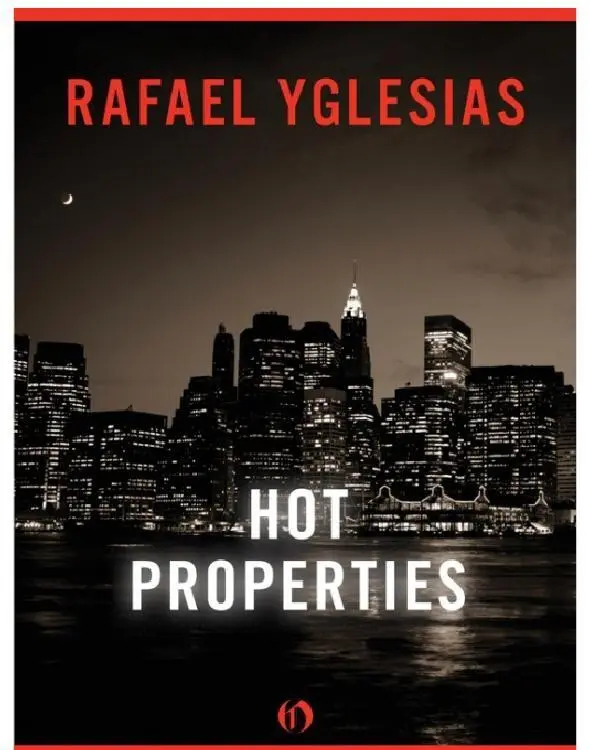
- Название:Hot Properties
- Автор:
- Издательство:Open Road Integrated Media LLC
- Жанр:
- Год:2010
- Город:New York
- ISBN:9781453205082
- Рейтинг книги:3 / 5. Голосов: 1
-
Избранное:Добавить в избранное
- Отзывы:
-
Ваша оценка:
Hot Properties: краткое содержание, описание и аннотация
Предлагаем к чтению аннотацию, описание, краткое содержание или предисловие (зависит от того, что написал сам автор книги «Hot Properties»). Если вы не нашли необходимую информацию о книге — напишите в комментариях, мы постараемся отыскать её.
Rafael Yglesias’s most sharp-tongued satire,
exposes the greed, envy, and backbiting in a media world bloated with money and power.
This ebook features a new illustrated biography of Rafael Yglesias, including rare photos and never-before-seen documents from the author’s personal collection.
Touted by the gossip columns as a roman a clef about the publishing world, Yglesias's fourth novel has definite commercial potential, since there are always people who like to read sordid tales about the media. Focusing on a group of ambitious, opportunistic New York yuppies, each desperate for success, power, fame, money and glamorous sexual partners, Yglesias follows his characters as their aspirations flourish or fade. And even for the one person who comes up with a smashing bestseller, happiness is an elusive emotion, banished by inner fear and self-loathing. The leading players in this fermenting brew are introduced in the book's opening scene, a dinner party so exquisitely awkward that even the reader is embarrassed. Thereafter we watch an aspiring playwright sell out to Hollywood; a sexy blonde discover she can really write, but must use her body to assure publication; a blocked novelist lose his scruples, professional and personal; a journalist at a leading newsmagazine realize that his way to the top has been sabotaged by office intrigue. Yglesias views his characters with cynicism, but he knows how to create the dramatic momentum that will have readers turning the pages. And if his book does become a bestseller, he will have the ironic last laugh.
Copyright 1986 Reed Business Information, Inc.
“
[is] the novel you want in the Hamptons. It lambastes the pretensions of the people you’ve been glaring at on the beach all day, and excoriates the city you’ve left behind.”
— “Sharp, funny, and fresh insight into the American literary world…”
—
From Publishers Weekly
Review
Hot Properties — читать онлайн бесплатно полную книгу (весь текст) целиком
Ниже представлен текст книги, разбитый по страницам. Система сохранения места последней прочитанной страницы, позволяет с удобством читать онлайн бесплатно книгу «Hot Properties», без необходимости каждый раз заново искать на чём Вы остановились. Поставьте закладку, и сможете в любой момент перейти на страницу, на которой закончили чтение.
Интервал:
Закладка:
Fred fell asleep on the couch at six, furious and despondent, resolved to break off with Bart if he suggested any changes, and prepared to demand why he was so abrupt and high-handed on the phone.
But by the time Fred, bleary-eyed, his back aching from sleeping on the soft couch, arrived at the town house in the Village that Bart had bought — the bottom two floors for his office, the top three for living — he felt so worthless, so convinced that his only hope of success lay with the backing of a hot, powerful agent like Bart, that he was ready to throw out the outline and apologize for having handed in such a miserable piece of work.
Fred looked at the beautiful built-in maple shelves that surrounded the marble fireplace in the waiting room. A hundred years ago it had been a fancy parlor room, and Bart’s architects had kept and restored that feeling, except for the Xerox machine that glistened on top of a large oak table near Bart’s secretary’s elegant desk. The shelves were filled with books by clients. Even if Fred had come in cocky, the sight of seven bestsellers within the last two years would have punched it out of him. In his state of mind, it almost felled him to his knees. He felt lucky that Bart’s secretary smiled at him, grateful he had been offered coffee, and terrified of the closed door to Bart’s office.
When it did open, Fred got up quickly, forgetting his cup of coffee was filled to the brim and would spill. It did, most of it going on his best beige pants.
Bart’s secretary exclaimed.
Bart merely stared impassively.
The hot coffee burned into his thigh painfully.
The secretary rushed over with a roll of paper towels from her desk, handed Fred some, and bent down to mop up what had landed on the white rug. She looked up at Fred. “Are you okay? Is that burning you?”
“No,” Fred said angrily.
“Are you sure?”
“Yeah.” He had dabbed at the wet spot on his pants, but that made the burn hurt more, so he stopped and held out the paper towel to the secretary. “Sorry about the rug.”
“Won’t hurt it,” she said. “Maybe you should put some water on the pants. It’ll stain.”
“Nah.” Fred waved his hand as if he usually wore a pair of pants only once and then threw them out. His leg hurt. He got an image of it swelling into an enomous pus-filled blister.
Bart, still standing at the door calmly, said, “Come in, Fred.”
“Sure,” Fred said, now carrying the coffee in both hands.
Bart’s office must have been the dining room. It had tall, elegant windows, a large fireplace, and elegant moldings in the center of the ceiling that once supported a chandelier. There were no books in this room, but there were two large leather couches — distinctly inconsistent with the dominant motif of French country antiques — a large armchair opposite Bart’s desk, and an enormous globe underneath the nearest window. The world was literally at Bart’s fingertips.
Fred winced as he sat in the armchair.
“Are you all right?” Bart asked in a tone suggesting surprise that he could possibly be in pain.
“Oh, yeah.”
“I just got off the phone with Bob Holder at Garlands. We were discussing your outline. I’m sending it to him this afternoon. He’s promised to give an answer in two days, if I give it to him exclusive.”
Bart’s tone was matter-of-fact, so listless that Fred didn’t react. He nodded slowly.
“I think he’s a good choice, don’t you?”
“Uh, Bob Holder?” Fred repeated.
“Yeah, he’s the hot young editor at Garlands. And they’ve really been the aggressive packager of fiction in the last couple years.”
“It’s great.” Fred said in a stunned tone.
“Off an outline I don’t know how big an advance I can get—”
“You think he’ll buy it?”
Bart stared at him. “Why not?”
“You think the outline’s really good?”
“It’s fair. You’re not terrific at writing outlines. But it’s been my experience the best outline writers come out with lousy novels. And vice versa. I told that to Bob. He agreed. He’s had the same experience.”
Fred laughed nervously. Fair. He said the outline was fair. “He knows I haven’t written a novel?”
“If Bob likes the idea, he’ll trust my judgment that you can pull it off. We’ve done very well together.”
Fred nodded, stupefied by this strange conjunction: Bart thought the outline was fair, but he had given it to his big-money editor at one of America’s most prestigious publishers, and was confident he would make a deal. Was Bart that influential? Could this man whose rug Fred had just spilled coffee on really announce to an editor that someone was a good writer and be taken at face value? If so, rather than reassuring Fred, it made him very nervous. He tried to think how he should react: with profuse thanks? Or was that too craven, indicative of a total lack of confidence in himself? But if he took it in stride, mightn’t Bart feel Fred was ungrateful, ignorant of how big a favor Bart had given away?
“This is great,” Fred said, still in the slow speech of a victim of bad news.
“Of course Bob agrees with me that you should make some changes when you get to the actual writing of the novel.”
“I don’t understand. Has Bob read the outline?”
“No. But I told him the story line. We both think the hero shouldn’t be Jewish—”
“But I’m Jewish.”
Bart paused. “Tatter?” he asked.
“My great-grandfather’s name was Teittlebaum. He couldn’t speak English, so the official gave him the name of Tatters. ’Cause of the condition of his clothing. By the time my great-grandfather found out what ‘Tatters’ meant, he had grown fond of it. He dropped the S so people wouldn’t make the connection.”
Usually this story brought a smile to people’s faces. Bart contemplated it rather as if Fred had told him an intriguing and sobering paradox. “Why does that mean your hero has to be Jewish?”
“It doesn’t. Just that for my first book I thought I should …” Fred trailed off. He really didn’t know why. “You know.”
“Do you see this as an autobiographical novel?”
“I guess not.”
“ ’Cause if you do, maybe we could make it nonfiction. A male answer to The Second Sex.”
“No, no. It’s definitely a novel.”
“All right. Bob and I think it’s better if the hero is non-Jewish. There are too many complaining books about Jewish men and sex.”
“You’re right,” Fred agreed, embarrassed. Did the proposal give away how frustrated and inadequate he felt in bed? Just another Jewish boy upset that he doesn’t have a big prick?
“In fact,” Bart continued, “maybe the book shouldn’t take place in New York. Seems to me almost every novel I read is located in New York. You know, I was brought up in Detroit and, uh. New Yorkers think of the rest of America as provincial, but the fact is it’s New York that’s insulated. New York books are too self-conscious. I think readers would be more interested to find out how men feel in the rest of the country. Maybe you could set it in my hometown. Ever been to Detroit?”
“Yeah, sure. I did a couple pieces on the Tigers for Sport.” Detroit’s a shithole, Fred said to himself bitterly, mostly because he couldn’t say it out loud.
“What do think about setting it there?”
Fred swallowed and looked away from Bart’s cold eyes. He felt as if these weren’t merely suggestions. That the timing of this conversation — immediately before submitting the outline to Bob Holder — implied a threat if Fred didn’t go along. Perhaps Bart would use his influence with Holder only if Fred agreed to these plot and character changes. He hated them, though.
Читать дальшеИнтервал:
Закладка:
Похожие книги на «Hot Properties»
Представляем Вашему вниманию похожие книги на «Hot Properties» списком для выбора. Мы отобрали схожую по названию и смыслу литературу в надежде предоставить читателям больше вариантов отыскать новые, интересные, ещё непрочитанные произведения.










Обсуждение, отзывы о книге «Hot Properties» и просто собственные мнения читателей. Оставьте ваши комментарии, напишите, что Вы думаете о произведении, его смысле или главных героях. Укажите что конкретно понравилось, а что нет, и почему Вы так считаете.