Rafael Yglesias - Hot Properties
Здесь есть возможность читать онлайн «Rafael Yglesias - Hot Properties» весь текст электронной книги совершенно бесплатно (целиком полную версию без сокращений). В некоторых случаях можно слушать аудио, скачать через торрент в формате fb2 и присутствует краткое содержание. Город: New York, Год выпуска: 2010, ISBN: 2010, Издательство: Open Road Integrated Media LLC, Жанр: Современная проза, Юмористическая проза, на английском языке. Описание произведения, (предисловие) а так же отзывы посетителей доступны на портале библиотеки ЛибКат.
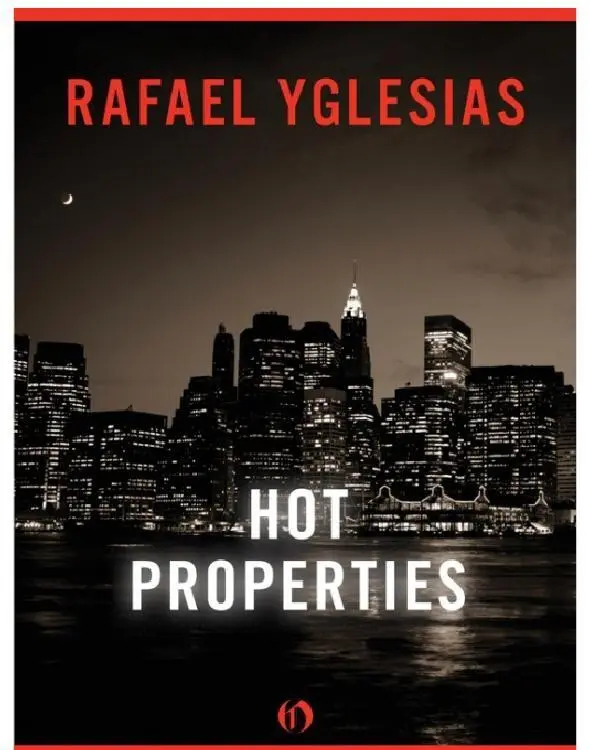
- Название:Hot Properties
- Автор:
- Издательство:Open Road Integrated Media LLC
- Жанр:
- Год:2010
- Город:New York
- ISBN:9781453205082
- Рейтинг книги:3 / 5. Голосов: 1
-
Избранное:Добавить в избранное
- Отзывы:
-
Ваша оценка:
Hot Properties: краткое содержание, описание и аннотация
Предлагаем к чтению аннотацию, описание, краткое содержание или предисловие (зависит от того, что написал сам автор книги «Hot Properties»). Если вы не нашли необходимую информацию о книге — напишите в комментариях, мы постараемся отыскать её.
Rafael Yglesias’s most sharp-tongued satire,
exposes the greed, envy, and backbiting in a media world bloated with money and power.
This ebook features a new illustrated biography of Rafael Yglesias, including rare photos and never-before-seen documents from the author’s personal collection.
Touted by the gossip columns as a roman a clef about the publishing world, Yglesias's fourth novel has definite commercial potential, since there are always people who like to read sordid tales about the media. Focusing on a group of ambitious, opportunistic New York yuppies, each desperate for success, power, fame, money and glamorous sexual partners, Yglesias follows his characters as their aspirations flourish or fade. And even for the one person who comes up with a smashing bestseller, happiness is an elusive emotion, banished by inner fear and self-loathing. The leading players in this fermenting brew are introduced in the book's opening scene, a dinner party so exquisitely awkward that even the reader is embarrassed. Thereafter we watch an aspiring playwright sell out to Hollywood; a sexy blonde discover she can really write, but must use her body to assure publication; a blocked novelist lose his scruples, professional and personal; a journalist at a leading newsmagazine realize that his way to the top has been sabotaged by office intrigue. Yglesias views his characters with cynicism, but he knows how to create the dramatic momentum that will have readers turning the pages. And if his book does become a bestseller, he will have the ironic last laugh.
Copyright 1986 Reed Business Information, Inc.
“
[is] the novel you want in the Hamptons. It lambastes the pretensions of the people you’ve been glaring at on the beach all day, and excoriates the city you’ve left behind.”
— “Sharp, funny, and fresh insight into the American literary world…”
—
From Publishers Weekly
Review
Hot Properties — читать онлайн бесплатно полную книгу (весь текст) целиком
Ниже представлен текст книги, разбитый по страницам. Система сохранения места последней прочитанной страницы, позволяет с удобством читать онлайн бесплатно книгу «Hot Properties», без необходимости каждый раз заново искать на чём Вы остановились. Поставьте закладку, и сможете в любой момент перейти на страницу, на которой закончили чтение.
Интервал:
Закладка:
There was one reason to prolong the foolish chatter. Ending it meant Joe had another opportunity to kiss her. So when his secretary entered with some papers, Patty got to her feet and said, “I’d better go.”
But McGuire was more brazen than she thought. He said when she moved to the door. “What? No good-bye kiss?” winking at his secretary, who looked bored, as if she also knew that he was not only repulsive but also inffectual. McGuire got up, walked to Patty, and when she moved her head to give him her cheek — despite the presence of his secretary — he put his arms around her; and under the guise of giving her a big hug, put his hands on her buttocks and gave them a hard squeeze, allowing a quiet but ridiculously intimate moan to escape his lips.
Patty wriggled out of his arms, saying with lilting cheerfulness — and yes, maybe a hint of promise—“Talk to you tomorrow. Joe.”
Jim Foxx, Tony said to himself with a wave of relief. His name is Jim Foxx. He had slid into the booth with Garth and Foxx after they had transformed their solemn looks into radiant smiles when he appeared, and was now accepting Foxx’s offer of coffee, which he poured himself from a pot on the table. Tony judged from the empty juice glasses, half-empty coffee cups, and full bowls of fruit in front of the actor and the producer that they must have arranged to meet earlier. To discuss Tony? It didn’t matter. At least he had remembered Jim Foxx’s name, though what good it would do him, he couldn’t say.
“How was your flight?” Garth asked. His tone was serious, compassionate almost, with the earnest tone Garth had had in his Academy Award-winning performance about the Legal Aid lawyer who successfully defended an innocent young black farmer accused of raping a white woman.
“Good.” Tony gulped a sip of coffee. “But I guess I don’t travel well. I had terrible insomnia. Got less than an hour’s sleep.”
Foxx nodded. “Happens to me too.”
“You mean you never get over it? I assumed it was because I don’t do much traveling.”
Foxx signaled to a waitress. “First night on the road, can’t sleep. I must travel”—he looked at Garth as if he had the answer—“hundred and fifty thousand miles a year. Probably more. Never get over it.” The waitress reached them. “Do you know what you want, Tony? We’ve already ordered.”
Tony asked for French toast and bacon. “Okay, honey,” the waitress said, which struck Tony as being odd in an expensive restaurant. But it did make him feel more protected, in a strange way, as if she had let him know that he belonged.
“Ah, to be young,” Foxx said about Tony’s order.
“You don’t want any juice or melon?” Garth asked. “They have great melons here.”
“I’ve always heard that about Hollywood. Lotta great melons.”
They all laughed. Foxx, especially, was taken by surprise and enjoyed the joke. He assumes I’m a pretentious playwright, Tony thought to himself.
The waitress hesitated.
“But no, I’m fine.” Tony said to Garth, and she went. He felt slightly baffled but pleased that they treated him like a nephew they were taking out. There was no sense of the truth, or at least what Tony understood the situation to be, namely that this was an audition of sorts. The writer showing off his legs to the big producer and box-office actor.
Garth looked at Foxx expectantly in the pause that followed. Tony, taking the hint, was silent, and also looked to Foxx to say something.
“Did, uh …” Foxx spooned an enormous strawberry out of his bowl and held it near his mouth. “Did Gloria tell you much about the history of this project?” He ate the strawberry.
“No. She said she thought it would be best to leave that to you. All she mentioned was that there had been a script written which you weren’t happy with.”
“Five.” Foxx said. “We’ve been through five drafts and three writers. It’s tough,” Foxx added, looking off philosophically.
“There’s something I wondered about.” Tony said. Both Garth and Foxx seemed surprised and curious that he wondered about anything. Maybe writers aren’t supposed to wonder, Tony wondered, but he pressed on. “How come you didn’t send me the latest script before this meeting?”
“We want to totally throw them out,” Garth said in the tone of a betrayed lover speaking of the mementos of his ruined romance.
“Even if you were to come onto the project,” Foxx said, “we wouldn’t want you to look at the earlier drafts. We’ve had a lot of meetings—”
“Bullshit. All bullshit,” Garth said. His thin shoulders were hunched, his head hanging low, like a fighter’s. He had just taken a sip of coffee. He set his cup down on the saucer with a harsh clatter. He looked Tony in the eyes. It was transfixing to look into them: Tony felt as if he had become a character in a movie; or that he had been sealed in the front row of the theater. They were dark and suspicious. “It’s hard for me to accept, but you gotta leave the writer alone. Every draft, we’ve gone step by step. Giving notes, doing it page by page. Doesn’t work. All we want is to pick a writer we like, tell him — in general — what we want, and then leave him alone. Only thing that makes sense.”
Foxx nodded gravely, but Tony saw that he really wasn’t paying attention to Garth, like a wife who has heard her husband tell a particular anecdote over and over. “Yeah. This is a special idea. It needs originality. And you can’t get originality writing a script by committee.”
“And you can’t get originality from a Hollywood writer.” Garth said. “They’ve spent their lives writing to suit other people. They have no idea how to be their own man. That’s why we wanted a playwright. You know, in the theater you guys have the final say. So”—Garth smiled, and his famous boyishness abruptly took the curse off of his cranky tone— “that’s what we want. Someone who’ll go off, write us a great script while we lie in the sun.” He banged his fist on the table. “No more script conferences until there’s a script to confer about.”
Tony laughed. Garth smiled mischievously. “Okay.” Tony said to him. He felt completely at ease with Garth. He seemed bright, accessible, and reasonable. “So how do I convince you to hire me?” Tony said. He didn’t know if it was too bold a remark. But it was what he wanted to know, and Garth’s honesty made him feel that truth was the best approach.
“You don’t have to,” Foxx said.
“Let me tell you why you’re here,” Garth said. He ran a hand through his straight black hair, another gesture straight out of his roles. “I saw your play last year in New York—”
“Youngsters?”
Garth smirked. “Yeah. Did you have more than one play on that year?”
“Yes,” Tony said quietly.
Garth looked abashed. “You did?”
“I had two one-acters on at the Quest Guild right after Youngsters.”
“I didn’t know that. I wish I’d seen them. I guess I wasn’t in town—”
“You might have been. They were only on for four weeks. It was a limited run.”
“Anyway, I did see Youngsters. You know, I’ve seen a lot of stuff about the sixties, the antiwar movement, the sexual revolution — nobody got it the way you did. There were no preachy monologues, you snuck in the politics painlessly, you made terrible fun of all of us, and then you turned it around beautifully. I cried at her speech …” He turned to Foxx. “You know, the druggie who yells at her kid sister about how it was worth it, no matter how badly they failed.”
Foxx nodded throughout gravely, but again with that abstracted look of someone who has heard it too often.
“Thank you,” Tony said. He was astonished that Garth had been to his play (and surprised that he hadn’t known it; usually the presence of a celebrity in an off-Broadway theater doesn’t go unnoticed) and intensely flattered by Garth’s vivid recall and detailed praise. Why he should so value Garth’s admiration — hadn’t the Times said he was “touched with genius”?—he didn’t know, but he felt himself suffused with a happy warmth.
Читать дальшеИнтервал:
Закладка:
Похожие книги на «Hot Properties»
Представляем Вашему вниманию похожие книги на «Hot Properties» списком для выбора. Мы отобрали схожую по названию и смыслу литературу в надежде предоставить читателям больше вариантов отыскать новые, интересные, ещё непрочитанные произведения.







Обсуждение, отзывы о книге «Hot Properties» и просто собственные мнения читателей. Оставьте ваши комментарии, напишите, что Вы думаете о произведении, его смысле или главных героях. Укажите что конкретно понравилось, а что нет, и почему Вы так считаете.