Alberto Moravia - Two Friends
Здесь есть возможность читать онлайн «Alberto Moravia - Two Friends» весь текст электронной книги совершенно бесплатно (целиком полную версию без сокращений). В некоторых случаях можно слушать аудио, скачать через торрент в формате fb2 и присутствует краткое содержание. Год выпуска: 2011, Издательство: Other Press, Жанр: Современная проза, на английском языке. Описание произведения, (предисловие) а так же отзывы посетителей доступны на портале библиотеки ЛибКат.
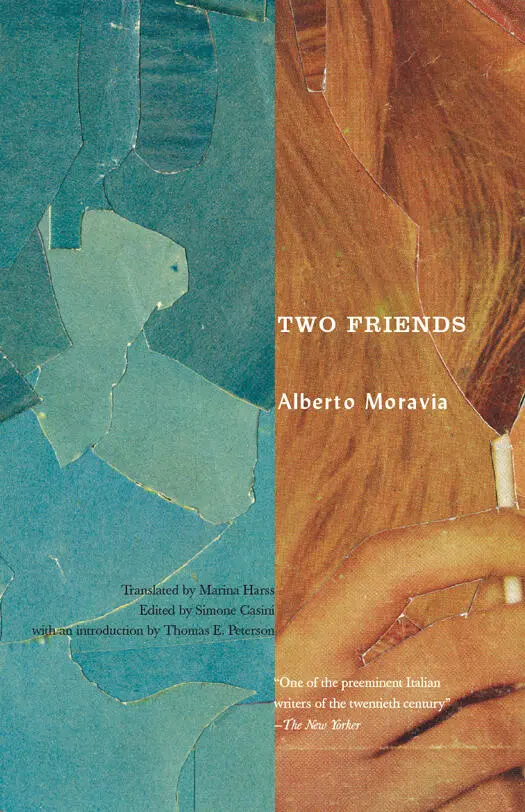
- Название:Two Friends
- Автор:
- Издательство:Other Press
- Жанр:
- Год:2011
- ISBN:нет данных
- Рейтинг книги:3 / 5. Голосов: 1
-
Избранное:Добавить в избранное
- Отзывы:
-
Ваша оценка:
Two Friends: краткое содержание, описание и аннотация
Предлагаем к чтению аннотацию, описание, краткое содержание или предисловие (зависит от того, что написал сам автор книги «Two Friends»). Если вы не нашли необходимую информацию о книге — напишите в комментариях, мы постараемся отыскать её.
Anyone interested in literature will relish the opportunity to watch Moravia at work, tinkering with his story and working at it from three unique perspectives.
Two Friends — читать онлайн бесплатно полную книгу (весь текст) целиком
Ниже представлен текст книги, разбитый по страницам. Система сохранения места последней прочитанной страницы, позволяет с удобством читать онлайн бесплатно книгу «Two Friends», без необходимости каждый раз заново искать на чём Вы остановились. Поставьте закладку, и сможете в любой момент перейти на страницу, на которой закончили чтение.
Интервал:
Закладка:
“?????”
“I will use this knowledge when the time is right … but not now.”
“When the time is right but not now …,” Maurizio repeated, as if reflecting on Sergio’s words. He picked up the bottle. “Would you care for some more whiskey?”
Sergio said no with a firm gesture. “You’ve already given me far too much … You deliberately made me drunk.”
“What do you mean, deliberately?”
“Yes, you made me drink … and Lalla too … Look at her, she’s completely drunk.”
Lalla got up, as if she could take no more of this perilous discussion. “Where is … the bathroom?” she asked casually. “I’d like to powder my nose, as they say.”
“How crass of you, Lalla,” Sergio said languidly, without moving.
She stood up completely. “What do you want me to say, that I need to pee?”
“Nothing, I don’t want you to say anything.”
83
Maurizio also stood up. “Please,” he said, with his usual gentle, relaxed courtesy, “Come with me.” Lalla followed him out of the sitting room.
Now alone, Sergio stood up and stretched his legs. He felt overexcited, drunk, and at the same time amazed at his lack of jealousy, given what he had just seen. It was clear; Maurizio was trying to seduce Lalla, and at that very moment they were probably kissing in some dark corner, perhaps in the bathroom, between the sink and the toilet. He walked briskly to the door through which they had disappeared, and looked out. He did not know whether what he felt was curiosity or jealousy. He saw a wide, dark hallway, with three doors on either side and a glass door at the end. There were elegant carpets and cabinets with bibelots, as well as paintings and arms, all of them immersed in the sumptuous, dusty, somnolent atmosphere of the house. He took a few steps toward the glass door, which he assumed led to the bathroom, but halfway there he discovered a staircase up to the second floor. As soon as he looked upward, he saw Maurizio descending with his light step.
“Are you looking for something?” he asked.
“I’m looking for my argument,” he wanted to say, intoxicated not so much by the wine as by the illusory, almost feverish lucidity he felt. But he said nothing and instead made a vague gesture. Maurizio insisted, with a touch of irony: “Perhaps you too would like to …?” Sergio laughed, putting his hand on Maurizio’s arm. “No, I’m fine. I’m not in the mood to inspect your house today.”
Maurizio did not respond, and they returned to the sitting room together. Without sitting down, Maurizio said, “Sergio, you haven’t convinced me, but we must discuss this again in the future … as soon as possible, in fact.”
His tone was serious and solicitous, but Sergio could not help laughing. Patting his friend on the shoulder, he said: “You don’t give a damn about Communism … You have other things on your mind.”
“What do you mean?”
Maurizio sounded so serious, almost threatening, that Sergio took a step back. “I was just joking … I know that you mean what you say, and that one day you’ll become a good Communist, maybe even a better
84
one than I.”
“That would be impossible.”
Lalla returned, walking toward them. She was clearly drunk, and moved with difficulty, pausing languidly and swaying her hips, which she did not normally do when she was sober.
“Let’s go, Lalla,” Sergio said.
“Yes, let’s go.”
They shook hands in the foyer. “See you soon,” Maurizio said, opening the door.
“See you soon,” Lalla replied.
Sergio said nothing. They traversed the garden and went out into the street, arm in arm.
[III]
They were silent during the bus ride home. Sergio was still drunk but could already feel the alcohol receding little by little. Lalla seemed lost in thought; he couldn’t tell whether she was still drunk. But as they were getting off the bus, she tottered, whispering: “Hold my arm; I really drank too much.”
Sergio took her arm and led her down the crowded sidewalk. “Shall we go to the café?” He too was whispering.
They almost never spent time at home; their rented room was just a place to sleep, and when they weren’t with friends, they were at the café. But she answered: “No, I feel almost sick … let’s go home.”
Sergio said nothing and led her in the direction of the rooming house. The small street where they lived was close by. They walked slowly, and when they reached the door, Sergio asked, “Don’t you want some dinner?”
“I told you I feel sick … and it’s a good thing too. That way we can save some money.”
Sergio noticed that as soon as they were alone, Lalla gave up her worldly, flirtatious attitude and adopted the disappointed, bitter, and irritating tone he knew
85
so well. Annoyed by her constant complaints about their poverty, he decided to tell her that he had seen everything: the hand-holding and the rest of it. They climbed the stairs and went into their room. Without removing her coat, Lalla walked over to the bed and lay down.
Sergio watched her for a moment and then lit a cigarette as he settled into his usual armchair, by the window. From there he could see the whole room: the screen concealing the washstand, which was decorated with little red circles, each of which contained a tiny black devil; the table in the middle of the room, made out of crude wood, with four round legs, beneath a lamp with a white shade; the low, wide bed in the corner with its iron headboard decorated with curlicues and knobs; the chest at the foot of the bed, made out of the same crude wood as the table, with a marble top; the tall, narrow armoire in the other corner, which, because of the meagerness of their wardrobe, contained more than a few empty hangers. The room was large but cold and depressing as a tomb despite the central heating. It was the furniture, Sergio reflected, that emanated this coldness; the furnishings were dead, their souls departed long ago in the warehouse of some secondhand dealer. Lying on the bed, amid all this dead furniture, Lalla projected an irreducible, aggrieved vitality, a silent but steady protest against the poverty and penury that surrounded them. She lay on her side without moving, and the round mass of her raised hip seemed to conceal the rest of her body, which was invisible from where Sergio sat. He focused his gaze on this part of her body, so prominently displayed. After a moment, he asked: “What’s wrong? Can you please tell me what’s wrong?”
“I don’t feel well. I drank too much,” the hip responded.
Quickly, as if bringing up an inconsequential subject, he said, “I saw you holding hands with Maurizio … Don’t think I didn’t see you.”
There was a brief pause. Then: “I wasn’t holding
86
his hand; he grabbed my hand and held it tightly, against my will,” the hip said.
“I don’t believe you.”
“Fine, don’t believe me,” the hip answered, indifferently.
As his mind cleared, Sergio began to feel the first pangs of jealousy. It was almost painful, like what a man might feel if he possessed only one thing in the world and feared he might lose it. Lalla’s indifference was proof that she no longer loved him, and that she was in love with Maurizio. Unable to control himself, he asked: “Are you … do you like Maurizio?” He could tell that his voice was strained and anguished.
“I do like him.”
“Do you love him?”
“No”
“You’re lying.”
The hip did not respond. Sergio waited a moment and then said in an exasperated voice: “If you love Maurizio and you want to be with him, don’t hesitate … go …”
The hip responded hesitantly, slowly: “You’ve taken leave of your senses.”
Читать дальшеИнтервал:
Закладка:
Похожие книги на «Two Friends»
Представляем Вашему вниманию похожие книги на «Two Friends» списком для выбора. Мы отобрали схожую по названию и смыслу литературу в надежде предоставить читателям больше вариантов отыскать новые, интересные, ещё непрочитанные произведения.






Обсуждение, отзывы о книге «Two Friends» и просто собственные мнения читателей. Оставьте ваши комментарии, напишите, что Вы думаете о произведении, его смысле или главных героях. Укажите что конкретно понравилось, а что нет, и почему Вы так считаете.