Alberto Moravia - Two Friends
Здесь есть возможность читать онлайн «Alberto Moravia - Two Friends» весь текст электронной книги совершенно бесплатно (целиком полную версию без сокращений). В некоторых случаях можно слушать аудио, скачать через торрент в формате fb2 и присутствует краткое содержание. Год выпуска: 2011, Издательство: Other Press, Жанр: Современная проза, на английском языке. Описание произведения, (предисловие) а так же отзывы посетителей доступны на портале библиотеки ЛибКат.
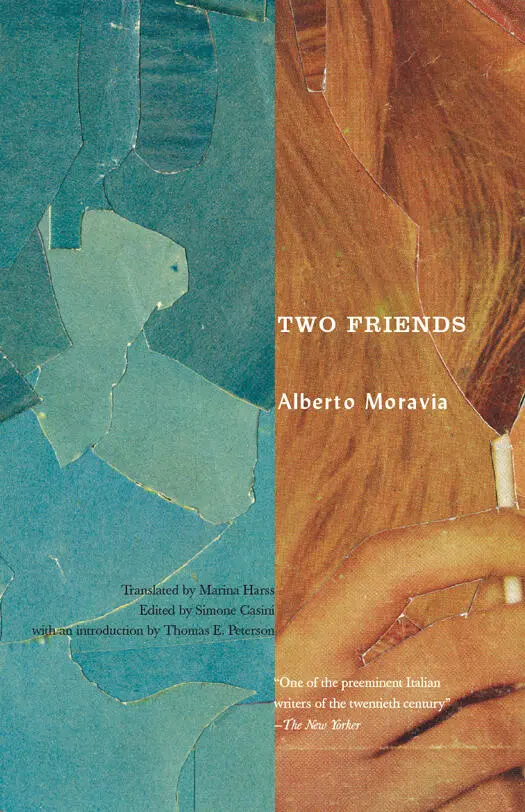
- Название:Two Friends
- Автор:
- Издательство:Other Press
- Жанр:
- Год:2011
- ISBN:нет данных
- Рейтинг книги:3 / 5. Голосов: 1
-
Избранное:Добавить в избранное
- Отзывы:
-
Ваша оценка:
Two Friends: краткое содержание, описание и аннотация
Предлагаем к чтению аннотацию, описание, краткое содержание или предисловие (зависит от того, что написал сам автор книги «Two Friends»). Если вы не нашли необходимую информацию о книге — напишите в комментариях, мы постараемся отыскать её.
Anyone interested in literature will relish the opportunity to watch Moravia at work, tinkering with his story and working at it from three unique perspectives.
Two Friends — читать онлайн бесплатно полную книгу (весь текст) целиком
Ниже представлен текст книги, разбитый по страницам. Система сохранения места последней прочитанной страницы, позволяет с удобством читать онлайн бесплатно книгу «Two Friends», без необходимости каждый раз заново искать на чём Вы остановились. Поставьте закладку, и сможете в любой момент перейти на страницу, на которой закончили чтение.
Интервал:
Закладка:
209
looking at him; the woman seemed to be watching them. Marisa whispered: “Come closer, and I’ll tell you.”
Mechanically, and still peering at the dark shape tucked into the doorway in the half light of the red bulb, Sergio leaned forward slightly. He felt Marisa’s mouth glue itself to his ear with a circular motion of her soft, moist lips, like a suction cup. Marisa’s tongue began to caress his ear, quickly and conscientiously. He felt aroused and at the same time embarrassed. Marisa kissed his ear until she was forced to come up for air. As she leaned back, she whispered breathlessly: “Got it?”
“Yes,” he answered, in a daze, feeling simultaneously embarrassed and aroused.
“So, what do you say?” she asked, boldly.
They heard Maurizio’s voice calling out to them as he returned, carrying a pack of cigarettes. “Marisa, Mamma wants you … She’s afraid you’ll get lost.”
The young woman squeezed Sergio’s hand conspiratorially and said under her breath: “Call me tomorrow.” Then she let go of his arm and went off, exclaiming, “Why on earth would I get lost?” Her footsteps disappeared around the corner.
Maurizio walked over to Sergio: “Did you know that there are lots of little rooms down here where the museum’s masterpieces have been hidden away? I just went into one. There was a Bernini statue in a kind of case.” He lit a cigarette, adding: “Let’s see what’s in here,” walking briskly toward the doorway where the dark, motionless figure stood.
Sergio felt embarrassed, as if the mysterious, dark
210
figure were about to jump out of the shadows and accuse him: “I saw how you let Marisa kiss you.” Maurizio, who was a few steps ahead of him, did not seem to notice the figure who had witnessed Sergio’s embrace, or pretended not to. “It’s so dark in here,” he said, searching in his pocket for a flashlight to light the ground before him. As the beam illuminated the doorway, two small but sturdy feet appeared. They belonged to a woman. They looked like two small, fat doves roosting quietly side by side. Sergio noticed that the feet were clad in simple low-heeled shoes, almost masculine in design, and heavily worn. Then the beam slid up her bare legs, which were not quite fat but not slender either, with white, healthy-looking, hairless skin and a tender, child-like shape. The beam illuminated the edge of a simple red dress; it made the legs appear even more prominent, with their healthy, innocent air, more infantile than womanly. The young woman’s hips were rather wide, Sergio noted, and her waist not particularly slender; like her legs and hips, there was something solid about her. And then her chest: two mounds protruding under the light fabric, high, solid, and at the same time soft. She had a lovely round neck, and a serious face, with a frank, straightforward beauty and a serene forehead hidden by a lock of brown hair. Her eyes were prominent, light-colored, and clearly outlined, and her nose was small and straight, with flared nostrils; she had pale lips like a fruit or a flower. It was a face with classical proportions, almost marmoreal and characterized by a dreamy, dignified serenity. She was a young woman, but could almost have been a prepubescent boy. She observed them with some diffidence; perhaps because of the light, her eyebrows seemed to express worry. Maurizio held the flashlight up to her face a moment longer, then shifted it slightly to the
211
left. In the darkness of the small room, they could see a wooden structure. There, between two pieces of wood, a face was visible. It was very similar to the girl’s, but made out of marble. It was a statue from the museum’s collection, with a serene, pale expression and white eyes that stared out into the darkness. It was surprisingly similar to the real, human face that the flashlight had revealed a moment earlier. Sergio whispered: “Did you notice how much they look alike?”
“Who do you mean?”
“The girl and the statue.”
“Do you know who that is?”
“Pauline Bonaparte,” Sergio said. As if to evaluate Sergio’s powers of observation, Maurizio aimed the beam of light at the face of the young girl and then at the statue, going back and forth until finally the girl called out, in an irritated voice: “Have you finished blinding me with your flashlight?”
For a moment, it seemed to Sergio that the statue, rather than the girl, had spoken. Maurizio beamed his flashlight in the girl’s face once again, holding it there. “Forgive us, but we were noticing the truly extraordinary resemblance between you and the statue.”
“What statue?” she asked. Her voice was neither sweet nor delicate. Like the rest of her, it was on the heavy side, and low, but still affectionate and caressing.
“Pauline Bonaparte,” Sergio repeated.
The girl did not respond, as if she hadn’t heard, or hadn’t caught the reference. A moment later she asked, “Do you think the alarm has passed?”
“Usually there is a signal,” Maurizio said.
The girl observed them with diffidence tempered by a touch of curiosity and a glimmer of hope. Finally she said: “Is the train station far from here?”
“No … why?”
“Do you know this address?”
In the light of the flashlight, she opened a shabby
212
purse and proceeded to hand Sergio a scrap of newspaper. It was an advertisement for a furnished room near the train station. “So you’re not from here,” Sergio commented.
“No,” she answered with a slightly embarrassed tone. “I’m from T.,” a city in central Italy. “I arrived just yesterday.”
“And why did you come to Rome?” Maurizio asked, boldly.
The girl seemed self-conscious: “I’m looking for work.” She was shy, Sergio thought. She avoided looking at Maurizio but answered Sergio’s questions, as if responding to something intimidating in his voice. Maurizio began to laugh: “What a time to be looking for work in Rome.”
“Why, is it difficult to find work?” she asked cautiously, almost fearfully.
“It’s impossible,” he said, harshly.
“That’s not quite true,” Sergio said gently. “What do you know how to do?”
“Nothing, really,” she said, simply, “but I thought …”
They heard voices just beyond the bend in the hallway. They could clearly hear Maurizio’s mother calling out “Maurizio … Maurizio …” Then she appeared, with the small case still tucked under her arm, waving the other arm gaily. “It’s all over … They’ve sounded the all clear. Let’s go, Maurizio.”
Beneath the vaulted ceiling, in the dark, Sergio thought her voice sounded like a ghost calling from the underworld, surrounded by other melancholy, incorporeal spirits. Maurizio, the girl, and Sergio all stared at her in silence. She too was still and silent,
213
the case still under her arm, in the half light of the hallway. Finally, Maurizio said, dreamily, “All right, Mother, let’s go.” She seemed to finally take a breath, as if her son’s words had released her from a spell and she had once again become a sentient being, no longer a ghost, as she had feared. As they walked silently behind her she went on about how frightened she had been, how long the alarm had lasted, and whether any bombs had been dropped. Maurizio walked slowly, as if trying to linger behind with Sergio and the girl. But his mother matched her footsteps to his and finally she took his arm, as if confirming her maternal role. Turning to Sergio, she said: “Of course, Maltese, you must understand the fears of a mother … In moments like these, I think principally of him.” Sergio said nothing and instead gazed at the girl walking beside him with her eyes lowered.
They walked toward the exit with the rest of the people from the shelter, who were moving with the docility and deliberate pace of a multitude emerging from Mass or a cinema. One by one, they climbed the spiraling staircase and emerged into the blinding sunlight, across from the large square surrounded by trees and statues. Maurizio’s mother turned to Sergio and said, in a worldly, detached, and somewhat disdainful tone: “Good-bye, Maltese … I hope to see you again in less extreme circumstances.”
Читать дальшеИнтервал:
Закладка:
Похожие книги на «Two Friends»
Представляем Вашему вниманию похожие книги на «Two Friends» списком для выбора. Мы отобрали схожую по названию и смыслу литературу в надежде предоставить читателям больше вариантов отыскать новые, интересные, ещё непрочитанные произведения.






Обсуждение, отзывы о книге «Two Friends» и просто собственные мнения читателей. Оставьте ваши комментарии, напишите, что Вы думаете о произведении, его смысле или главных героях. Укажите что конкретно понравилось, а что нет, и почему Вы так считаете.