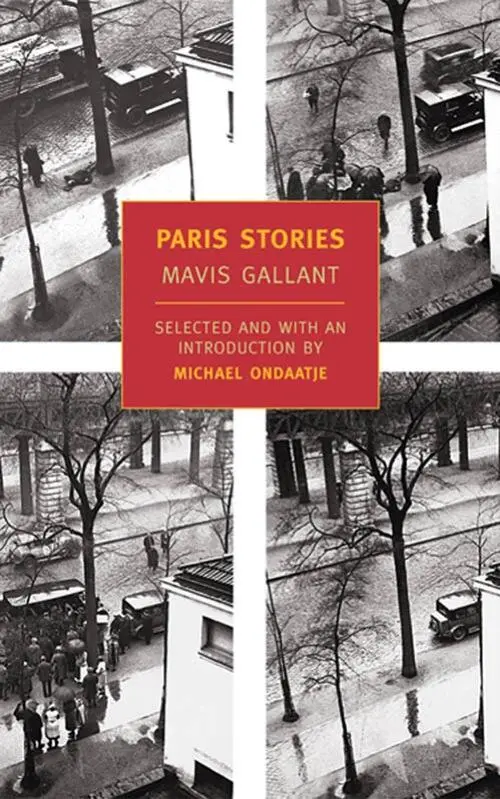
Mavis Gallant - Paris Stories
Здесь есть возможность читать онлайн «Mavis Gallant - Paris Stories» весь текст электронной книги совершенно бесплатно (целиком полную версию без сокращений). В некоторых случаях можно слушать аудио, скачать через торрент в формате fb2 и присутствует краткое содержание. Год выпуска: 2002, Издательство: NYRB Classics, Жанр: Современная проза, на английском языке. Описание произведения, (предисловие) а так же отзывы посетителей доступны на портале библиотеки ЛибКат.
- Название:Paris Stories
- Автор:
- Издательство:NYRB Classics
- Жанр:
- Год:2002
- ISBN:нет данных
- Рейтинг книги:5 / 5. Голосов: 1
-
Избранное:Добавить в избранное
- Отзывы:
-
Ваша оценка:
Paris Stories: краткое содержание, описание и аннотация
Предлагаем к чтению аннотацию, описание, краткое содержание или предисловие (зависит от того, что написал сам автор книги «Paris Stories»). Если вы не нашли необходимую информацию о книге — напишите в комментариях, мы постараемся отыскать её.
Paris Stories — читать онлайн бесплатно полную книгу (весь текст) целиком
Ниже представлен текст книги, разбитый по страницам. Система сохранения места последней прочитанной страницы, позволяет с удобством читать онлайн бесплатно книгу «Paris Stories», без необходимости каждый раз заново искать на чём Вы остановились. Поставьте закладку, и сможете в любой момент перейти на страницу, на которой закончили чтение.
Интервал:
Закладка:
The one anything will be me, Gabriel decided, helping himself to chestnuts. He saw, without Dieter's needing to describe them, the glaring lights, the dogs straining at their leads, the guards running and blowing whistles, the stalled train, a rainstorm, perhaps.
The aristo will be against taking the extra three men along, Dieter said, but the priest will intercede for them. The miner, or perhaps the black-market man, will stay behind to act as decoy for the dogs while the others all get in a rowboat and make for the maquis. The peasant will turn out to be a British intelligence agent named Scott. The Protestant will fall out of the rowboat; the priest will drown trying to save him; the Communist —
“We know all that,” Gabriel interrupted. “Who's there at the end?”
The aristo, said Dieter. The aristo and the aged rabbi will survive twelve episodes and make their way together back to Paris for the Liberation. There they will discover Dieter and his men holed up in the Palais du Luxembourg, standing fast against the local Resistance and a few policemen. The rabbi will die next to the Medici fountain, in the arms of the aristo.
Gabriel thought this did not bode well for the future, but Dieter reassured him: The aristo will now be a changed man. He will storm the Palais and be seen at the end writing MY FRIENDS REMEMBERED on the wall while Dieter and the others file by with their hands up.
“What about the one anything?” said Gabriel. “How long does he last?”
“Dear friend and old comrade,” said Dieter, “don't take offense at this. Ten years ago you would have been the first man chosen. But now you are at the wrong age. Who cares what happens to a man of forty-three? You aren't old enough or young enough to make anyone cry. The fact is — forgive me for saying so — but you are the wrong age to play a Jew. A uniform has no age,” he added, because he was also forty-three. “And no one is expected to cry at the end, but just to be thoughtful and satisfied.”
While Gabriel sat mulling this over, Dieter told him about the helmets the Germans were going to wear. Some were heavy metal, museum pieces; they gave their wearers headaches and left red marks on the brow. A certain number of light plastic helmets would be distributed, but only to officers. The higher one's rank, the lighter the helmet. What Dieter was getting around to was this: He wondered if Gabriel might not care to bridge this stage of his Occupation career by becoming a surrendering officer, seen in the last episode instead of vanishing after the first. He would be a colonel in the Wehrmacht (humane, idealistic, opposed to extreme measures) while Dieter would have to be the S.S. one (not so good). He and Dieter would both have weightless helmets and comfortable, well-cut uniforms.
Gabriel supposed that Dieter was right, in a way. Certainly, he was at a bad age for dangerous antics. It was time for younger men to take their turn at jumping off moving vehicles, diving into ice-cold streams, and dodging blank shot; nor had he reached that time of life when he could die blessing and inspiring those the script had chosen to survive him. As an officer, doomed to defeat, he would at least be sure of his rank and his role and of being in one piece at the end.
Two weeks later Dieter announced to the old-timers that the whole first scene had been changed; there would now be a mass escape from a convoy of lorries, with dozens of men gunned down on the spot. The original cast was reduced, with the Protestant, the Communist, and the miner eliminated completely. This new position caused some argument and recrimination, in which Gabriel did not take part. All he had to wait for now was the right helmet and good weather.
The usual working delays occurred, so that it was not until May that the last of the Baums tried on his new uniform. Dieter adjusted the shoulders of the tunic and set the plastic helmet at a jaunty angle. Gabriel looked at himself. He removed the helmet and put it back on straight. Dieter spoke encouragingly; he seemed to think that Gabriel was troubled about seeming too stout, too bald, too old for his rank.
“There is nothing like a uniform for revealing a man's real age to him,” said Dieter. “But from a distance everyone in uniform looks the same.”
Gabriel in his new uniform seemed not just to be looking at himself in a glass but actually to be walking through it. He moved through a liquid mirror, back and forth. With each crossing his breath came a little shorter.
Dieter said generously, “A lot of soldiers went bald prematurely because the helmets rubbed their hair.”
The surrender was again delayed, this time on account of bad weather. One sodden afternoon, after hanging about in the Luxembourg Gardens for hours, Dieter and Gabriel borrowed capes from a couple of actors who were playing policemen and, their uniforms concealed, went to a post office so that Dieter could make a phone call. His cousin, Helga, destined by both their families to be his bride, had waited a long time; just when it was beginning to look as if she had waited too long for anything, a widower proposed. She was being married the next day. Dieter had to call and explain why he could not be at the wedding; he was held up waiting for the surrender.
Helga talked to Dieter without drawing breath. He listened for a while, then handed the receiver to Gabriel. Helga continued telling Dieter, or Gabriel, that her husband-to-be had a grandchild who could play the accordion. The child was to perform at the wedding party. The accordion was almost as large as the little girl, and twice as heavy.
“You ought to see her fingers on the keyboard,” Helga yelled. “They fly — fast, fast.”
Gabriel gave the telephone to Dieter, who assumed a look of blank concentration. When he had heard enough he beckoned to Gabriel. Gabriel pressed the receiver to his ear and learned that Helga was worried. She had dreamed that she was married and that her husband would not make room for her in his apartment. When she wanted to try the washing machine, he was already washing his own clothes. “What do you think of the dream?” she said to Gabriel. “Can you hear me? I still love you.” Gabriel placed the receiver softly on a shelf under the telephone and waved Dieter in so that he could say good-bye.
They came out of the post office to a drenching rain. Dieter wondered what shape their uniforms would be in by the time they surrendered. Gabriel argued that after the siege of the Palais du Luxembourg the original uniforms must have shown wear. Dieter answered that it was not up to him or Gabriel to decide such things.
Rain fell for another fortnight, but, at last, on a cool shining June day, they were able to surrender. During one of the long periods of inextricable confusion, Dieter and Gabriel walked as far as the Delacroix monument and sat on its rim. Dieter was disappointed in his men. There were no real Germans among them, but Yugoslavs, Turks, North Africans, Portuguese, and some unemployed French. The Resistance forces were not much better, he said. There had been complaints. Gabriel had to agree that they were a bedraggled-looking lot. Dieter recalled how in the sixties there used to be real Frenchmen, real Germans, authentic Jews. The Jews had played deportation the way they had seen it in films, and the Germans had surrendered according to film tradition, too, but there had been this difference: They had at least been doing something their parents had done before them. They had not only the folklore of movies to guide them but — in many cases — firsthand accounts. Now, even if one could assemble a true cast of players, they would be trying to imitate their grandfathers. They were at one remove too many. There was no assurance that a real German, a real Frenchman would be any more plausible now than a Turk.
Читать дальшеИнтервал:
Закладка:
Похожие книги на «Paris Stories»
Представляем Вашему вниманию похожие книги на «Paris Stories» списком для выбора. Мы отобрали схожую по названию и смыслу литературу в надежде предоставить читателям больше вариантов отыскать новые, интересные, ещё непрочитанные произведения.











Обсуждение, отзывы о книге «Paris Stories» и просто собственные мнения читателей. Оставьте ваши комментарии, напишите, что Вы думаете о произведении, его смысле или главных героях. Укажите что конкретно понравилось, а что нет, и почему Вы так считаете.