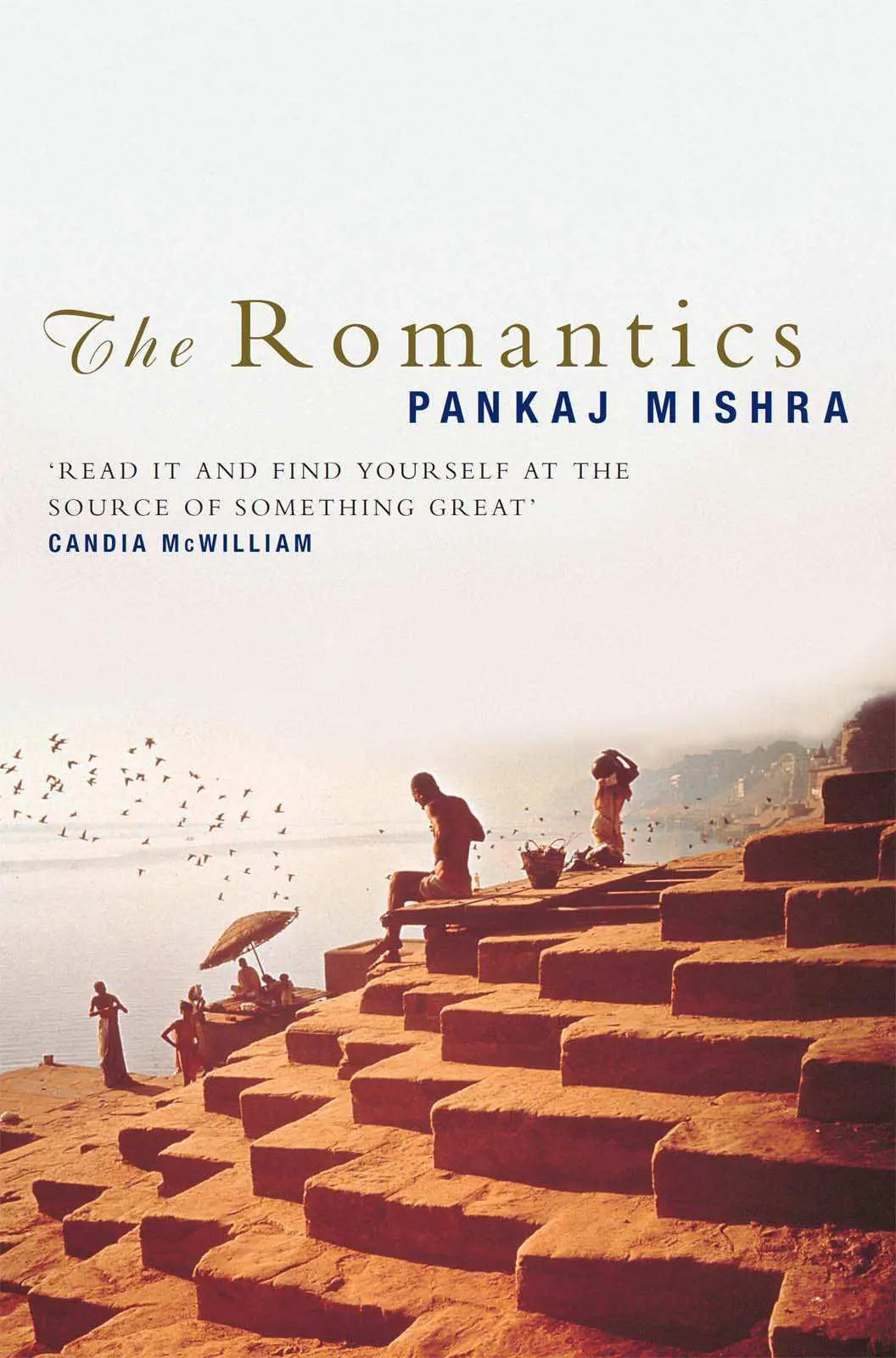
Pankaj Mishra - The Romantics
Здесь есть возможность читать онлайн «Pankaj Mishra - The Romantics» весь текст электронной книги совершенно бесплатно (целиком полную версию без сокращений). В некоторых случаях можно слушать аудио, скачать через торрент в формате fb2 и присутствует краткое содержание. Год выпуска: 2001, Издательство: Anchor Books, Жанр: Современная проза, на английском языке. Описание произведения, (предисловие) а так же отзывы посетителей доступны на портале библиотеки ЛибКат.
- Название:The Romantics
- Автор:
- Издательство:Anchor Books
- Жанр:
- Год:2001
- ISBN:нет данных
- Рейтинг книги:4 / 5. Голосов: 1
-
Избранное:Добавить в избранное
- Отзывы:
-
Ваша оценка:
The Romantics: краткое содержание, описание и аннотация
Предлагаем к чтению аннотацию, описание, краткое содержание или предисловие (зависит от того, что написал сам автор книги «The Romantics»). Если вы не нашли необходимую информацию о книге — напишите в комментариях, мы постараемся отыскать её.
The Romantics — читать онлайн бесплатно полную книгу (весь текст) целиком
Ниже представлен текст книги, разбитый по страницам. Система сохранения места последней прочитанной страницы, позволяет с удобством читать онлайн бесплатно книгу «The Romantics», без необходимости каждый раз заново искать на чём Вы остановились. Поставьте закладку, и сможете в любой момент перейти на страницу, на которой закончили чтение.
Интервал:
Закладка:
And now Mark went on to make a long speech. He said, ‘I don’t know if she’ll be happy again. I was talking to my Hindi teacher the other day and he was giving me his usual line about how everyone in the West thinks about nothing except pleasure and happiness. I was trying to make him realize that there is a different kind of pain attached to this kind of life. It comes with adulthood, like hair on your chest, a pain in the gut like the one your father probably had and it’ll stay with you the rest of your life. Maybe drugs and alcohol and art would relieve it for a little while but it always returns. You could win the academic lottery, get tenure or whatever, but even that won’t knock that pain out. And what I was trying to tell him was just this: that it’s a different kind of pain no more and no less than what you see here. People are people all over the world, in America or anywhere else, and they really all want one thing and little else: love, which is really lacking in life as we live it today.’
This monologue — halfway through which I remembered that I had heard similar things from him, turned out to be the prologue to the plans Mark now disclosed to me, plans for, as he put it, ‘feeling and conveying love’, ‘expressing our common humanity’. He had already given up his research on Ayurvedic medicine; he was now also going to give up his interest in Indian classical music. He was going back to work for a rehabilitation centre for AIDS victims in Berkeley. In the time left over from this demanding work, he would serve as a volunteer for an environmental organization.
All this had been arranged by Rekha, he said, turning back to where she was sitting. But, unnoticed by him, she had quietly left the room some time ago. As he turned back towards me, he mumbled something about getting married to her later in the year.
He continued, ‘I find it hard to believe that I was once a fanatical scholar who cared for nothing apart from his work. But Rekha really has given me the courage to face up to my real self and cut through the bullshit. And made me see what I really want. It was so simple. Like everyone else, I also want to love and be loved. Just that.’
And then, looking up at me with clear confident eyes, he grew unexpectedly wild. ‘There is another thing I realize. It’s that we are made of flesh and bone and this flesh is the most important thing we have. You know, you realize after some time what a load of bullshit’ — he raised his arm and pointed towards the jute bookstand, which I had examined when Rekha was in the kitchen: it was full of books published by presses called Shambhala and Tricycle and Wisdom — ‘all these great religions and philosophies are, this thing about solitude and loneliness being good for your spiritual and artistic growth. So you end up starving yourself in every way, waiting and hoping for this truly awesome spiritual jackpot that never comes, and then one day you are down there all alone on Manikarnika Ghat turning to ashes with not a single soul on the fucking planet who feels sorry for you. .’
*
I left Mark’s house feeling a bit disorientated. It was dark outside; I had forgotten to bring my flashlight, and after stumbling once or twice on the cobblestone path, I began to walk very slowly.
Mark’s words were still ringing in my head, and I couldn’t but feel their alienness. I hadn’t heard anyone speak like that for years now; the vocabulary, the concerns, the themes and the passion all came from another world.
As he spoke, I had begun to recall something Miss West had told me: he wants to get home. . insecure. . As he went on, more memories came to me, including one of the conversation I had overheard the evening of Miss West’s party; and I felt that Mark’s words were meant as much for himself as for me. He needed to convince himself through other people’s approbation; he needed to measure himself in other people’s eyes.
It was how I sought to place Mark. But his words, particularly the second part of his monologue, kept coming back to me, and I couldn’t but be aware of the odd resonance they had. There was also something vaguely threatening about them, about the way in which they forced me to reassess my own life.
For years now, I had lived neutrally, on the surface. I had learned to live without the feeling I’d had for all of my childhood and early adulthood, the quiet certainty that had existed over and above the fear and pain of those years, that something good and precious was growing within me. I no longer felt that way, and now that that sense of inner growth had faded, I didn’t have the same self-doubts. I didn’t miss the old intensity of contradictory hopes and fears, the hopeful blind striving I knew in the days I came to live in Benares, which I often felt was leading me nowhere. Instead, I saw its fading away as a good thing. I thought it meant that I had reached the end of a time of bewilderment.
This placid life I had in Dharamshala was severely judged by many people: my father, my colleagues at the school, whose slightly malicious gossip often reached my ears. But it was all I had. I had tried hard to build it up, using all the means at my disposal, and on more optimistic days I could even think that this detached, eventless life wasn’t very far from matching the old Brahmin idea of retreat, from fulfilling those ancestral obligations my father still wrote to me about.
Mark had asked me to visit them again, but I stayed away. I had gone the first time out of curiosity, but now I was fearful — so much so that once, seeing him hunched over a shelf at the bookshop, I turned and quickly ran down the steps, much to the puzzlement of the boy at the counter.
I now wonder at my extreme reaction. But Mark’s insecurity and self-aggrandizement wasn’t what I, after years of my own private struggles, wanted to be involved with when my own equanimity, the balance I had arrived at in Dharamshala, was so fragile. I did not want it to be threatened — particularly by something that was an echo from my time in Benares.
3
BUT WHEN A PARCEL from Miss West came one cold autumn morning, I thought of Benares again, and the feeling came over me of having left something incomplete and unresolved.
Inside the parcel there was a brown-paper-wrapped packet that looked like a book; there was also a postcard with a picture of Benares, a badly printed generic picture of the ghats, with a few lines scrawled on the back.
It was a very brief letter. But it had something of her bantering manner, and it broke into my placid routine with unexpected power.
I read the lines over and over until they became a meaningless jingle in my head. They said,
Dear Friend,
Just found out from Mark where you have been hiding all this time. Benares isn’t the same without you. Do come for a visit sometime. I’d love to see you again and catch up with your news.
Love,
Diana
PS Lots of new CDs here!
PPS I enclose something for you that someone left here for you ages ago.
Before the postcard came, I had been thinking of what Mark had told me about Miss West. I had once envied her for her great luck, for living her life, as I saw it, in ever-new glamorous settings. But what I had seen as luck had come with its own special burden, its own store of disappointments and frustrations, and now that burden, which Miss West was to carry for the rest of her life, made the luck seem tainted.
I hadn’t realized this, and I wondered again at how much in other people’s lives I had either missed or not been equipped to see at all. While in Benares, I had remained busy with monitoring the many different registers of my own feeling and thinking self, and later, when that phase of my life ended, I became preoccupied with the next one. Other people were reduced to minor figures in this large drama of the self; they ceased to exist for themselves. My vision of them kept shrinking, and some of them, like Rajesh, for instance, had dropped altogether out of memory.
Читать дальшеИнтервал:
Закладка:
Похожие книги на «The Romantics»
Представляем Вашему вниманию похожие книги на «The Romantics» списком для выбора. Мы отобрали схожую по названию и смыслу литературу в надежде предоставить читателям больше вариантов отыскать новые, интересные, ещё непрочитанные произведения.








Обсуждение, отзывы о книге «The Romantics» и просто собственные мнения читателей. Оставьте ваши комментарии, напишите, что Вы думаете о произведении, его смысле или главных героях. Укажите что конкретно понравилось, а что нет, и почему Вы так считаете.