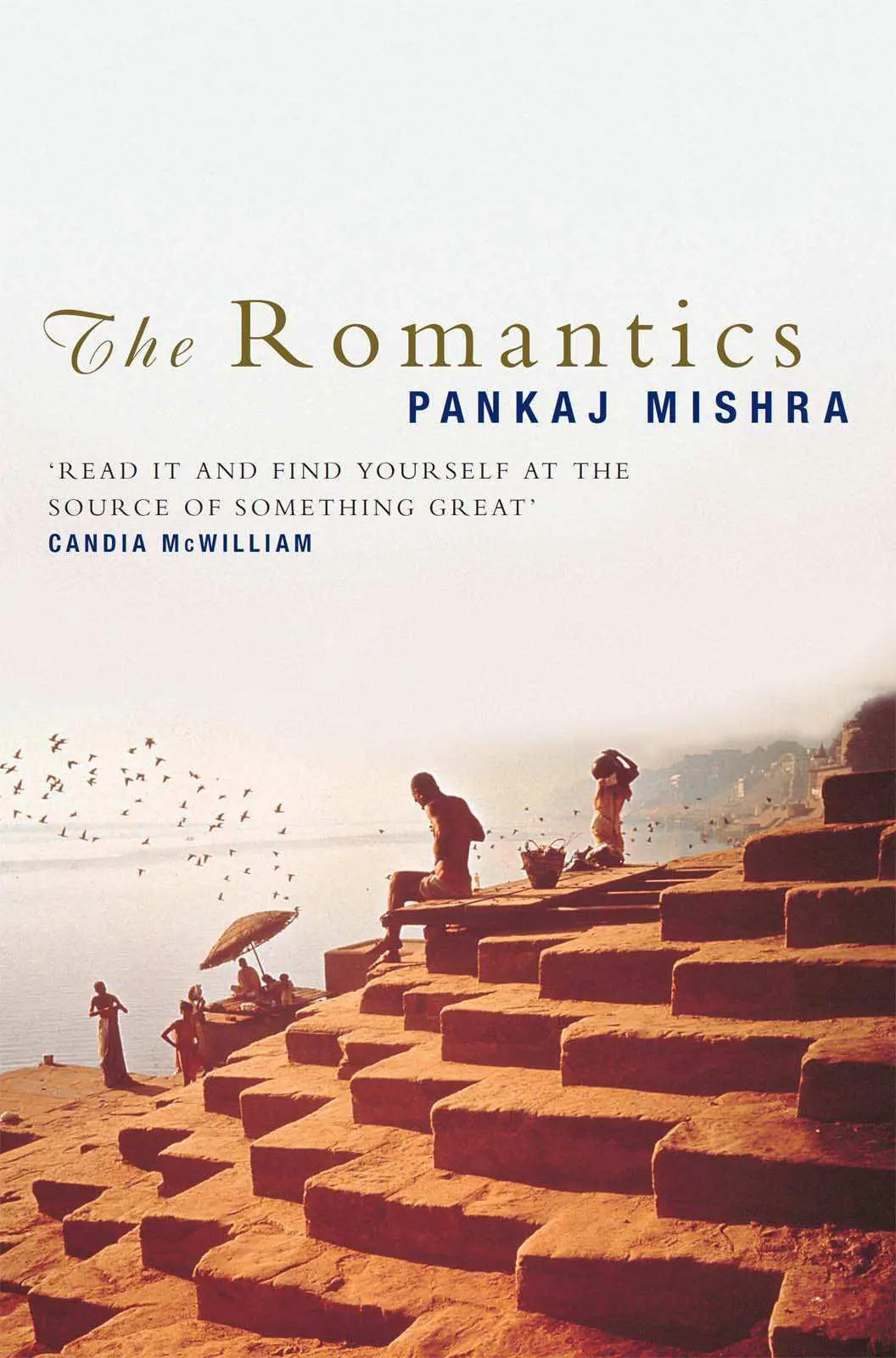
Pankaj Mishra - The Romantics
Здесь есть возможность читать онлайн «Pankaj Mishra - The Romantics» весь текст электронной книги совершенно бесплатно (целиком полную версию без сокращений). В некоторых случаях можно слушать аудио, скачать через торрент в формате fb2 и присутствует краткое содержание. Год выпуска: 2001, Издательство: Anchor Books, Жанр: Современная проза, на английском языке. Описание произведения, (предисловие) а так же отзывы посетителей доступны на портале библиотеки ЛибКат.
- Название:The Romantics
- Автор:
- Издательство:Anchor Books
- Жанр:
- Год:2001
- ISBN:нет данных
- Рейтинг книги:4 / 5. Голосов: 1
-
Избранное:Добавить в избранное
- Отзывы:
-
Ваша оценка:
The Romantics: краткое содержание, описание и аннотация
Предлагаем к чтению аннотацию, описание, краткое содержание или предисловие (зависит от того, что написал сам автор книги «The Romantics»). Если вы не нашли необходимую информацию о книге — напишите в комментариях, мы постараемся отыскать её.
The Romantics — читать онлайн бесплатно полную книгу (весь текст) целиком
Ниже представлен текст книги, разбитый по страницам. Система сохранения места последней прочитанной страницы, позволяет с удобством читать онлайн бесплатно книгу «The Romantics», без необходимости каждый раз заново искать на чём Вы остановились. Поставьте закладку, и сможете в любой момент перейти на страницу, на которой закончили чтение.
Интервал:
Закладка:
Pratap said you asked about my mother. I have sad news to offer. She passed away three years ago. I was with her during the last days of her life. The final rites were in Benares. She often asked me about you. She didn’t have too many visitors at her house, and whenever someone showed up she would remember for years afterwards. After her death, I moved from Benares to Mirzapur. But I am rarely there. I travel a lot and I don’t stay in any place for too long. Pratap said that you would like to meet me. This is awkward for me. Do not misunderstand me when I say that any meeting between us, even if practically possible, would put you in a very difficult position. I wish it was otherwise but the life I have chosen has shut me off from many things I valued in the past. You, who liked reading so much, would be unhappy to know that I don’t read anything apart from newspapers. I have no friends left from my time in Benares.
The city is a foreign place for me now. But I can’t write or think too much about this. After all these years, life is no more than a habit, it is not a subject for reflection. I simply go on. I do not think much about what I do or what I have become. On certain days I remember those lines of Faiz, ‘This is not that long-looked-for break of day/Not that clear dawn in quest of which those comrades/set out. .’ But how many of us can say they have reached that dawn — so, I am not alone, there are millions of us, and this is a source of consolation. I hope you’ll understand and forgive me.
Your elder brother,
Rajesh
I had never seen his handwriting before. He wrote a beautiful Devanagari script, and there was an elegant formality in his prose which I thought would have come to him from the Urdu poetry he read. And that wasn’t the only unexpected thing about the letter. I had imagined him as someone cut off from his old life of ruminative reading, someone inevitably undermined by rough times, by the brutalities of his trade, and I had expected a more direct statement about the unsuitability of our meeting. Such a considered response made me wonder if I had ever really known him.
The bigger revelation still lay in the future.
The letter had confirmed what I already suspected: that no further contact with Rajesh was possible. And it had begun to fade from memory until a few weeks later.
One day I was looking through old files for a missing receipt from the school when I came across the xeroxed copy of Wilson’s essay on Flaubert. I was casually flipping through the pages when I saw some passages underlined in red. I could never bring myself to mark up printed text, out of an old and automatic reverence I had for the printed word. It could only have been Rajesh.
I read the underlined sentences:
Frédéric is only the more refined as well as the more incompetent side of the middle-class mediocrity of which the dubious promoter represents the more flashy and active aspect. And so in the case of the other characters, the journalists and the artists, the members of the nobility, Frédéric finds the same shoddiness and lack of principle which are gradually revealed in himself. .
The passage went on. But I was struck more by the underlining. What had the words said to Rajesh, I wondered?
On another page of the essay, the underlined passage read:
Flaubert’s novel plants deep in our mind an idea which we never quite get rid of: the suspicion that our middle-class society of manufacturers, businessmen and bankers, of people who live on or deal in investments, so far from being redeemed by its culture, have ended by cheapening and invalidating all the departments of culture, political, scientific, artistic and religious, as well as corrupting and weakening the ordinary human relations: love, friendship and loyalty to cause — till the whole civilization seems to dwindle.
Wilson’s denunciation of capitalism here had an old-fashioned Marxist ring. Nevertheless it was a good passage in that it offered a small glimpse of Wilson’s way of finding connections between life and literature. But why had Rajesh underlined it? Again, how had he interpreted it?
I thought of the day I went to visit Rajesh’s village; I had remembered from it only the boy I saw in the mango grove, the boy who came to symbolize my aspirations for a quiet, restful life. Some other memories bubbled up now: the steam-engined train chugging away through stubbly fields, coils of smoke torpid above little huts; his mother’s tiny room, with its calendars of Shiva and Krishna; her conversation about Rajesh’s past; and Rajesh’s own words about Sentimental Education on the journey back to Benares, the coal embers darting past us in the dark, words I had dismissed as exaggeration, the hard, determined look on his face as he said, ‘It is the story of my life. I know these people well. Your hero, Edmund Wilson, he also knows them.’
*
What had he meant by that?
It took some time to decipher these remarks. My mind kept probing them in idle moments, but it was only when — overcoming my fear of novels — I decided to reread Sentimental Education that I began to arrive at some kind of answer.
I eventually saw that there had been purpose behind Rajesh’s invitation to his home, his decision to reveal so frankly his life to me. Even the remarks about Sentimental Education and Wilson on the train: he wanted me to know that not only had he read the novel, he had drawn, with Wilson’s help, his own conclusions from it.
In the hard and mean world he had lived in, first as a child labourer and then as a hired criminal for politicians and businessmen, Rajesh would have come to know well the grimy underside of middle-class society. What became clearer to me now was how quick he had been to recognize that the society Flaubert and Wilson wrote about wasn’t very different from the one he inhabited in Benares.
‘It’s the story of my life,’ he had said. I couldn’t see it then, but in Benares I had been among people who, like Frédéric and his friends, had either disowned or, in many cases, moved away from their provincial origins in order to realize their dreams of success in the bourgeois world. Rajesh was one of them. So was Pratap, and so, in a different way, was I, with all the confused longings I had for a true awakening to the world, for everything I felt lay out of my reach.
But only a handful of these students were able to get anywhere near realizing their dreams of joining the Civil Service. Most of them saw their ambitions dwindle away over the years in successive disappointments, and they knew not only failure but also the degradation of living in a world where self-deception, falsehood, sycophancy and bribery were the rule.
The small, unnoticed tragedies of thwarted hopes and ideals Flaubert wrote about in Sentimental Education were all around us. And this awareness — which, given the meagreness of my means and prospects, was also mine but which I tried to evade all through my time in Benares — this awareness had been Rajesh’s private key to the book. Reading it during the tormented days that followed my return from Kalpi, I had seen only the reflection of a personal neurosis in it; the character of Frédéric seemed to embody perfectly my sense of inadequacy, my severe self-image.
Reading the same book but bringing another kind of experience to it, Rajesh had discovered something else; he had discovered a social and psychological environment similar to the one he lived in. He shared with Flaubert and Wilson — so far away from us in every way — a true, if bitter awareness of its peculiar human ordeals and futility.
‘To fully appreciate the book,’ Wilson had written of Sentimental Education , ‘one must have had time to see something of life.’ Rajesh had exemplified this truth even as he moved into a world where he couldn’t be followed.
Читать дальшеИнтервал:
Закладка:
Похожие книги на «The Romantics»
Представляем Вашему вниманию похожие книги на «The Romantics» списком для выбора. Мы отобрали схожую по названию и смыслу литературу в надежде предоставить читателям больше вариантов отыскать новые, интересные, ещё непрочитанные произведения.











Обсуждение, отзывы о книге «The Romantics» и просто собственные мнения читателей. Оставьте ваши комментарии, напишите, что Вы думаете о произведении, его смысле или главных героях. Укажите что конкретно понравилось, а что нет, и почему Вы так считаете.