Pankaj Mishra - The Romantics
Здесь есть возможность читать онлайн «Pankaj Mishra - The Romantics» весь текст электронной книги совершенно бесплатно (целиком полную версию без сокращений). В некоторых случаях можно слушать аудио, скачать через торрент в формате fb2 и присутствует краткое содержание. Год выпуска: 2001, Издательство: Anchor Books, Жанр: Современная проза, на английском языке. Описание произведения, (предисловие) а так же отзывы посетителей доступны на портале библиотеки ЛибКат.
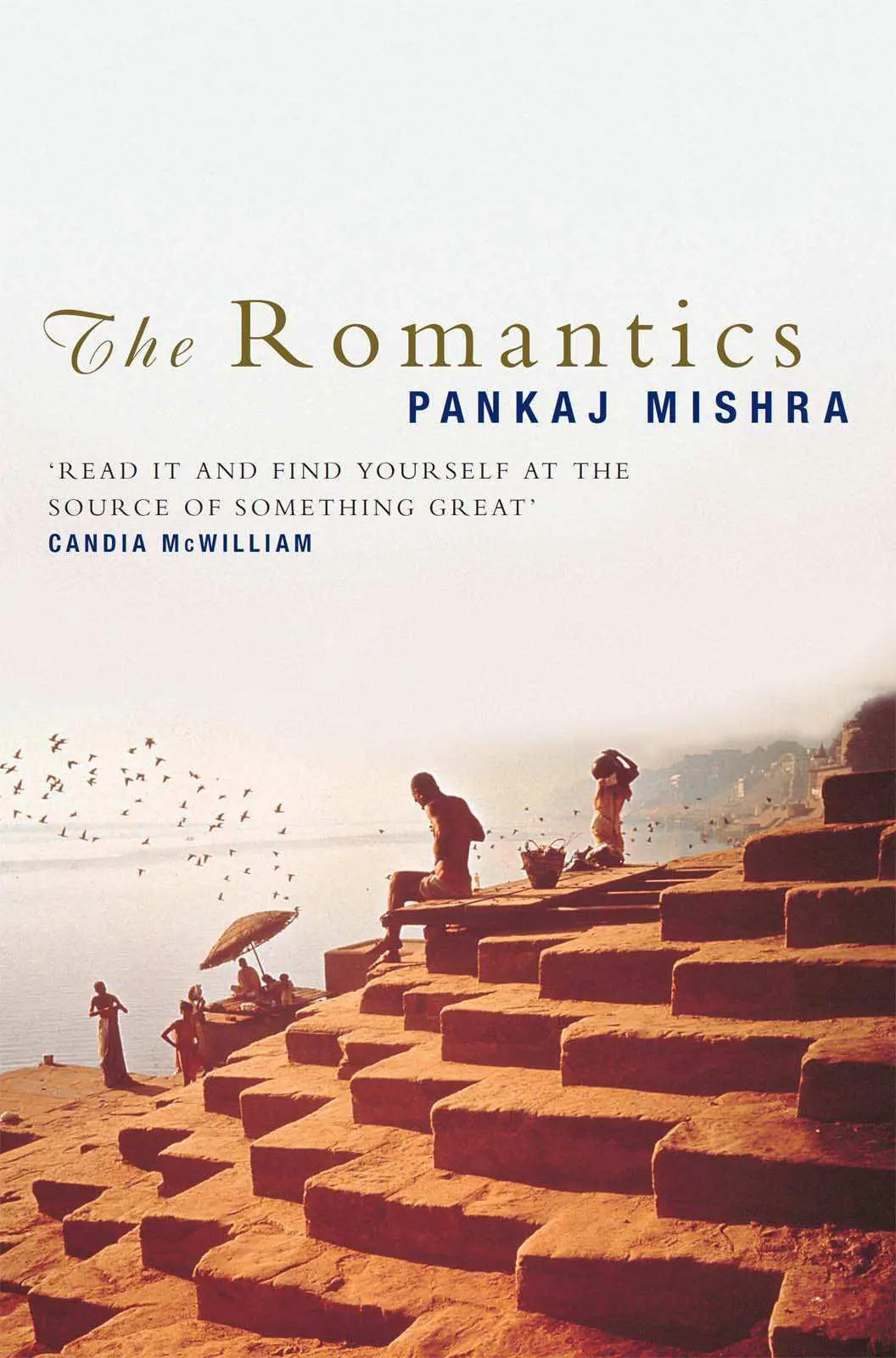
- Название:The Romantics
- Автор:
- Издательство:Anchor Books
- Жанр:
- Год:2001
- ISBN:нет данных
- Рейтинг книги:4 / 5. Голосов: 1
-
Избранное:Добавить в избранное
- Отзывы:
-
Ваша оценка:
The Romantics: краткое содержание, описание и аннотация
Предлагаем к чтению аннотацию, описание, краткое содержание или предисловие (зависит от того, что написал сам автор книги «The Romantics»). Если вы не нашли необходимую информацию о книге — напишите в комментариях, мы постараемся отыскать её.
The Romantics — читать онлайн бесплатно полную книгу (весь текст) целиком
Ниже представлен текст книги, разбитый по страницам. Система сохранения места последней прочитанной страницы, позволяет с удобством читать онлайн бесплатно книгу «The Romantics», без необходимости каждый раз заново искать на чём Вы остановились. Поставьте закладку, и сможете в любой момент перейти на страницу, на которой закончили чтение.
Интервал:
Закладка:
Her sobs intensified as I walked over and squatted beside her chair. I asked her what was wrong, but she wouldn’t reply.
I watched her helplessly waiting for her to speak. But when she did, her speech was so blurred and indistinct that I had to strain hard to hear each individual word.
‘You. . are. . going away, you. . are. . going. . away,’ she said, ‘and I. . and I. .’
Before she could complete the sentence, a fresh wave of emotion convulsed her.
The piteous sight released something in me, in that heart which ached with its own secret burden. Tears sprang to my eyes, and as I was trying to control them, she removed her tiny hands from her face.
Her eyes were swollen red, her cheeks drenched. But now as she looked at me, she noticed the wetness in my own eyes which I was trying to hide, and a strangely beatific expression came over her face.
Once again my mind was somewhere else, but she was not to know this as, looking up at me, her sobs receding, she began to speak, once, twice, choking and sniffling between words, her voice pleading and anxious: ‘Will you. . miss. . me?. . Will. . you. . miss. .’
As if in a farce, I heard a muffled cough behind me.
It was Deepa, framed against the open door, her face dark and unreadable. She wasn’t unexpected. We were to have our last dinner together that evening. Deepa was to accompany us to the dining room.
She walked towards us. Her face appeared in the light. She looked as severe and composed as always. She asked, ‘What’s wrong? What happened to you, Priya? Why are you crying?’
Priya said nothing, and kept sniffling, her head hung low. Deepa said, ‘Please go to your room now and wash. We are going to the dining room in five minutes.’ Stern authority now resonated in her voice.
Priya got up reluctantly, knocking against the leg of the chair, her eyes downcast, with tear trails scored all over her cheeks. Slowly, with almost imperceptible movement, she shuffled out of the room, fear and shame written large in the curve of her back.
Deepa turned to me. I had been trying surreptitiously to wipe my eyes with my shirtsleeve. She said, the sternness in her voice abruptly gone, ‘I feared that this might happen. You should have been more careful. She is an impressionable girl. God knows what kind of romantic rubbish they give her to read in that awful school of hers.’
These were her only words on the subject. Priya didn’t join us for dinner. Deepa went to her room when she failed to emerge after ten minutes and came back saying, ‘She wants to rest, poor girl. I don’t blame her.’
She made no reference to Priya during the dinner. She joined my father in asking me about the travelling I proposed to do. She told me about her friends in Dharamshala.
*
These dinners in the communal dining room had always been brief; it was still early in the evening when I came back to the hotel, after tepid, somewhat formal goodbyes to my father and Deepa.
All through dinner, I had kept worrying about Priya. I had no idea what I would say to her, but I felt it imperative to go up to her room.
I was striding past the reception when I heard the stern-faced woman calling out my name.
‘There was a letter for you this afternoon,’ she said, in her clear gravelly voice. ‘The chokidar has slipped it into your room.’
‘Where. . where?’ I stuttered, stupidly.
‘In your room,’ she repeated, a slight edge of irritation in her voice.
Suppressing the impulse to run, I briskly strode across the dimly lit forecourt with its throng of gleaming bicycles and scooters; then, once out of sight of the reception, I bounded up the steps two at a time, startling an old German with thick white hair coming down with bundles of laundry.
With a pounding heart I reached my room, fumblingly took out the key from my pocket, rammed it into the lock, turned and entered — as always, the curtain on the far, sea-facing window of the room billowed towards me and then, as I shut the door and killed the breeze, was sucked back, outlining the iron bars of the window.
The light switch was a few metres away from the door, but I didn’t bother with it. I looked down; the letter would be on the floor if it had been slipped underneath the door.
I saw, as my eyes adjusted themselves to the dark, a faint glow on the floor and I realized I was standing on part of it.
I picked it up. It was a white envelope, imprinted now with dust from the sole of my shoe, and — a mild twinge of disappointment there — oddly lightweight.
Still standing in the dark, I tore it open with trembling hands and then realized that, while doing so, I might have rendered illegible the return address on the back of the envelope.
I finally reached out and pressed the light switch. But I forgot to switch on the ceiling fan, and it was many hours later in that humid airless room that I discovered that my throat was dry and my body drenched from head to foot in sweat.
Catherine’s spidery handwriting covered the entire length of the one small page of thin airmail paper. Samar , it read:
Two weeks ago, Anand found a letter I was writing to you and everything between us came very suddenly and painfully to the surface. We still haven’t recovered, maybe we will never recover, and this might give you an idea of the violence I did to Anand by having an affair with you. The question before me is: why did I do it? And why did you do it? What was the meaning of this affair in the total economy of our lives, apart from giving me a sense of mischievous adventure and providing instant gratification to both of us? It was a perversion of human emotions, of our humanity. I now see that perversion within myself and feel ashamed. I feel ashamed of your role also. You only encouraged the development of harmful ideas and notions inside me. You told me to detach myself from Anand. What were you aiming for? In all this process, I have destroyed the trust Anand had in me — the trust of the person I love most in my life. I don’t know what you can do to save the situation. Perhaps, nothing. Please don’t write or try to get in touch in any other manner. Please accept this break with dignity and grace if it is possible for you.
Catherine
THREE
1
THE WORLD IS MAYA , illusion: it was one of the very first things my father told me. But it is a meaningless idea to a child, and the peculiar ordeals of adulthood take you even further away from true comprehension. New deprivations and desires continually open up within you, you keep learning new ways of experiencing pain and happiness, and the idea of illusion, never quite grasped, fades.
The world you find yourself in then becomes the supreme reality: the world you have to go on living in, with or without your private griefs.
I left Pondicherry the next day and travelled around the country for several weeks. I had little money and I travelled cheaply, mostly by bus and train. The plan and itinerary I was hoping to draw up, and had postponed formulating while in Pondicherry, hoping to do it in a calmer state of mind, never came into being. My travels came to be ruled by whim and chance; the map traced by them, if I were to draw it today, would resemble the aimless drifting of one of those sadhus you still find travelling in second-class train compartments, people with gaunt blank faces and depthless eyes fixed on the passing scenery.
In some sense, I travelled everywhere and nowhere. The miles clocked up, and there came a point when I could no longer distinguish between the settlements clattering randomly past my jaded eyes — the overpopulated slums with their tottering houses, fetid alleys and exposed gutters, their cooped-up frustrations and festering violence, their hardened ugliness. The small and big towns where I often spent a sleepless night in a tiny bare hotel room all began to merge together. I would often be kept awake by the varied cacophony emanating from the other rooms, where young men of distinctly criminal appearance drank rum and watched jaunty Hindi musicals.
Читать дальшеИнтервал:
Закладка:
Похожие книги на «The Romantics»
Представляем Вашему вниманию похожие книги на «The Romantics» списком для выбора. Мы отобрали схожую по названию и смыслу литературу в надежде предоставить читателям больше вариантов отыскать новые, интересные, ещё непрочитанные произведения.










Обсуждение, отзывы о книге «The Romantics» и просто собственные мнения читателей. Оставьте ваши комментарии, напишите, что Вы думаете о произведении, его смысле или главных героях. Укажите что конкретно понравилось, а что нет, и почему Вы так считаете.