Pankaj Mishra - The Romantics
Здесь есть возможность читать онлайн «Pankaj Mishra - The Romantics» весь текст электронной книги совершенно бесплатно (целиком полную версию без сокращений). В некоторых случаях можно слушать аудио, скачать через торрент в формате fb2 и присутствует краткое содержание. Год выпуска: 2001, Издательство: Anchor Books, Жанр: Современная проза, на английском языке. Описание произведения, (предисловие) а так же отзывы посетителей доступны на портале библиотеки ЛибКат.
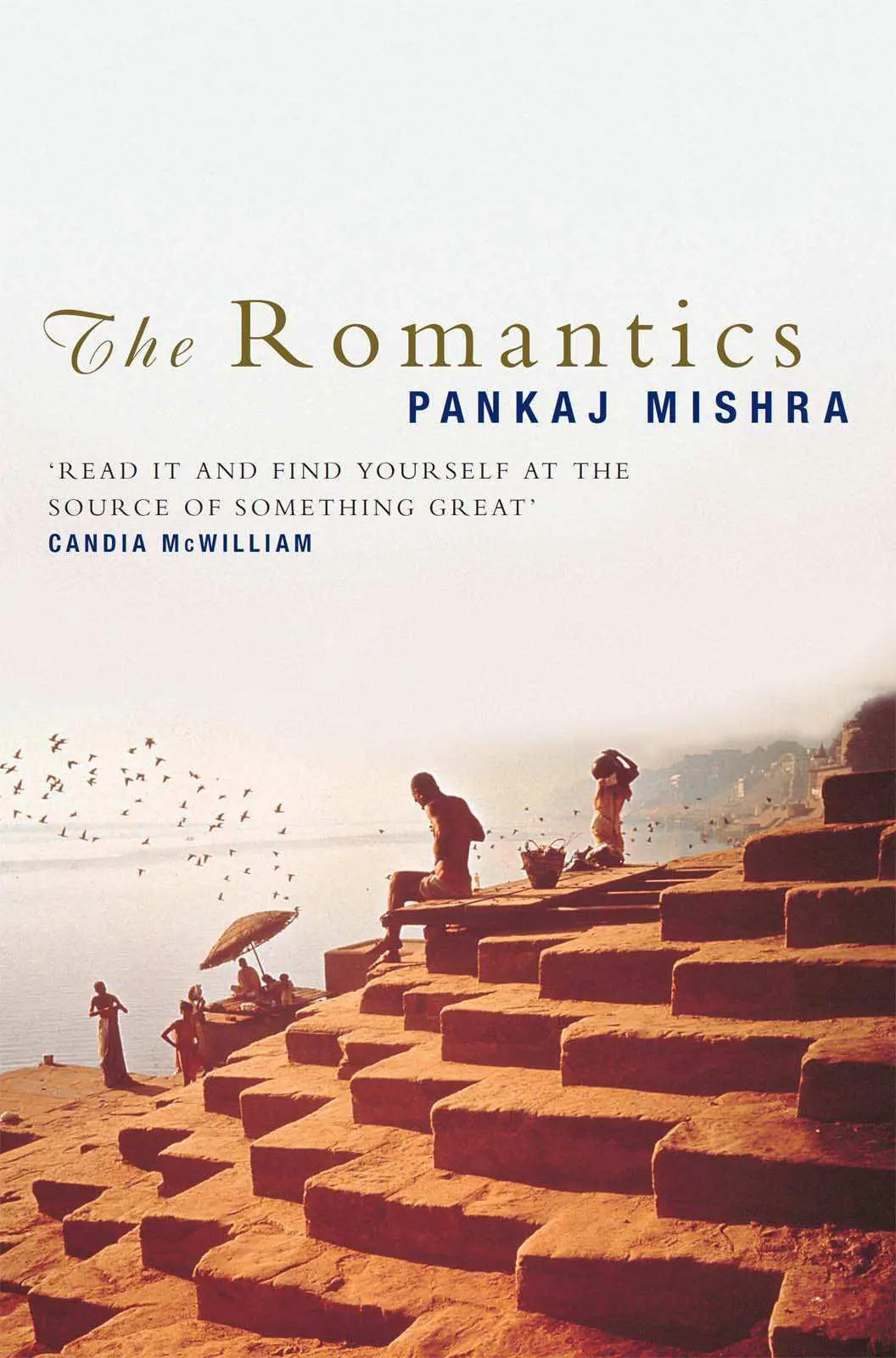
- Название:The Romantics
- Автор:
- Издательство:Anchor Books
- Жанр:
- Год:2001
- ISBN:нет данных
- Рейтинг книги:4 / 5. Голосов: 1
-
Избранное:Добавить в избранное
- Отзывы:
-
Ваша оценка:
The Romantics: краткое содержание, описание и аннотация
Предлагаем к чтению аннотацию, описание, краткое содержание или предисловие (зависит от того, что написал сам автор книги «The Romantics»). Если вы не нашли необходимую информацию о книге — напишите в комментариях, мы постараемся отыскать её.
The Romantics — читать онлайн бесплатно полную книгу (весь текст) целиком
Ниже представлен текст книги, разбитый по страницам. Система сохранения места последней прочитанной страницы, позволяет с удобством читать онлайн бесплатно книгу «The Romantics», без необходимости каждый раз заново искать на чём Вы остановились. Поставьте закладку, и сможете в любой момент перейти на страницу, на которой закончили чтение.
Интервал:
Закладка:
It was from this crowd that Miss West suddenly emerged, in sunglasses and straw hat, wearing a pale yellow kurta over blue jeans, her face flushed with excitement.
It wasn’t just the excitement of the surroundings; she had experienced that too many times. She had more stories of Catherine’s friends. Catherine was too protective of her friends to disclose to me anything more than what was strictly mentionable about their misadventures in India. She did confide them in Miss West, however, who thought them both deliciously funny and sad, and wasn’t slow in relating them to me in full detail.
This was the gossipy side of her. A strange fascination shone from her eyes as she quickly ran through a few of the stories, the crowd flowing past noisily all the time.
Claire, the woman with whom I had the argument about Evelyn Waugh, had returned from Orissa full of bitter complaints about young hooligans who accosted her at every street corner with obscene requests. She also had her camera and Swiss Army knife stolen by her honest-seeming host in Ahmedabad. Pierre — Miss West called him, ‘a troubled young seeker’ — found himself awakened in the middle of the night by his French-speaking Tamil host in Pondicherry, and offered his nubile daughter’s virginity as premarital dowry. Deirdre, an unhappily overweight woman Catherine knew through another friend, had unexpectedly got married to a young importer-exporter in Rajasthan; he could not pronounce her name and so called her Didi. And Danielle, an avowed Thervada Buddhist, had got involved with a Tibetan boy while on a ‘meditation retreat’ at Bodh Gaya, but then fled the scene in some panic when the boy began to speak about the wonderful life they would lead together in France.
From where I was, I could see quite far into the distance. Catherine would, I knew, stand out even in the massive crowd, but there was no sign of her anywhere. As Miss West spoke on, I began mechanically noting things: the hastily erected telephone booth, freshly painted, but without its constitutive instrument; the misspellings and malapropisms on the bright little posters for Keo Karpin hair oil on lamp-posts and the vaguely fluttering banners between them; the paunchy constables lathi-cutting a narrow swathe through the crowds for a VVIP visitor.
More minutes ticked past, and I began to grow slightly impatient. The appointed time came and went. Four, four-ten, four-twenty, half past four. The second hand moved with agonizing sluggishness.
I interrupted Miss West to ask her if she knew why Catherine was late. But she didn’t, and she didn’t seem very concerned as she carried on with her stories.
I began to speculate about what had happened to her. Grotesque visions danced before my eyes: a rickshaw accident, mangled metal and rubber, the indifferent bystanders. All the repetitive horrors and trite headlines of the local papers sprang to mind: broad-daylight kidnapping, rape, murder, absconding criminals. Where was she?
At five the crowds were still coming in, and it was with a kind of choking despair that I watched every fresh wave of cheerful unfamiliar faces roll past.
Miss West still hadn’t finished with Danielle’s story. Her abandoned Tibetan lover had followed her to Kathmandu, along with a crudely carved wooden-handled knife, which he pressed against her neck one morning in her hotel room, demanding suitable recompense for the humiliation and ridicule he had suffered in the eyes of his Tibetan compatriots, to whom he had already promised to send Disney T-shirts and levis from Paris. She had to shell out a lot of money before the knife was removed.
Miss West said, ‘Catherine said there is still a scar on the poor girl’s neck. She must be having a hard time explaining it to people in Paris.’
And then in the same breath she said, ‘Look! There she is! There’s our Catherine.’
She was pointing towards the river. Catherine had come by boat, not on foot as originally planned.
I saw her paying the boatman. There was the usual brief argument and then the boatman turned away, satisfied. Catherine now started in our direction.
Disappearing for a while behind the straw umbrellas, the billowing saris, she reappeared in the middle distance, tall, dark, distinctive, springily striding ahead of the returning throng of bathers, who had wet clothes wrapped around their shoulders and forearms, her white sleeveless kurta all shimmering folds and dimples.
She saw us and waved. Closer, closer, across and up the slushy flower-strewn steps, past the dazzle of the brassware stall, and I saw the pale skin aglow on her bare arms, her curly mop of hair gently bouncing behind her head, her mouth half open, as if in expectation of the apologies and explanations that would soon pour out. She came up the stairs in one last energetic spurt and now finally stood before me, panting and excitedly stuttering and gesticulating, and although I tried to listen, I couldn’t, and only kept nodding weakly in response to her flow of words. It seemed as if somebody had switched off the sound, and the whole of the teeming ghat had dissolved in a watery blur.
As I stood there somewhat helplessly I suddenly noticed Miss West.
She was staring at me and had, in fact, been doing so for some time, her expression alternating between frank curiosity and puzzlement.
She turned away now as our glances met, and it was in profile that I saw the small lopsided smile on her lips: the then unreadable smile that, in retrospect, appears as much bitter as benevolent.
5
RAJESH REAPPEARED at the library one afternoon after an absence of ten days.
These recurring periods of absence from the university struck me as odd, but he never disclosed where he had gone. He had been away, he would say, on urgent work.
What kind of work, I wondered, but the question always stayed with me.
This afternoon, Rajesh said that he was on his way to visit his mother, who lived in a village forty miles west of Benares. He added that I could come with him if I wished to.
It wasn’t like him to make such invitations; and he extended it to me with some shyness. His eyes were turned away as he spoke, and he looked as if he would be relieved if I said no as quickly as possible.
I almost did. I knew little of Rajesh’s background, and in the past many weeks, I had been intermittently curious about it. But my interest in him, as in a lot of other things, had dwindled since I came back from Kalpi. I was preoccupied with different matters altogether, and my first reaction was to decline his invitation.
It was when I was ready to present him with an excuse that the depressing thought came to me of another empty evening on the ghats.
We left one morning from Benares railway station, on the steam-engined and usually empty shuttle that in those days used to run on the narrow-gauge line between Benares and Allahabad. It was unusually cold and foggy for March. The newspaper I bought at the railway station spoke of fresh and unexpected snowfall in the Himalayas, and I thought immediately of Kalpi, imagining it snowbound, the chokidar drinking himself into a stupor in his outbuilding, the sadhu at the temple serenely going on with his small, restricted life.
A chilly wind, gritty with coal dust, blew in through the iron-barred windows as the train puffed and wheezed through an endless flat plain. The loud rattle of wheels made it impossible to talk for more than a few minutes, and we stretched ourselves on hard wooden bunks, wrapped from head to toe in coarse military blankets that Rajesh had brought with him, and gazed out of the window, where stubbly fields stretched to tree-blurred horizons and coils of smoke stood torpid above ragged settlements of mud huts and half-built brick houses.
Читать дальшеИнтервал:
Закладка:
Похожие книги на «The Romantics»
Представляем Вашему вниманию похожие книги на «The Romantics» списком для выбора. Мы отобрали схожую по названию и смыслу литературу в надежде предоставить читателям больше вариантов отыскать новые, интересные, ещё непрочитанные произведения.








Обсуждение, отзывы о книге «The Romantics» и просто собственные мнения читателей. Оставьте ваши комментарии, напишите, что Вы думаете о произведении, его смысле или главных героях. Укажите что конкретно понравилось, а что нет, и почему Вы так считаете.