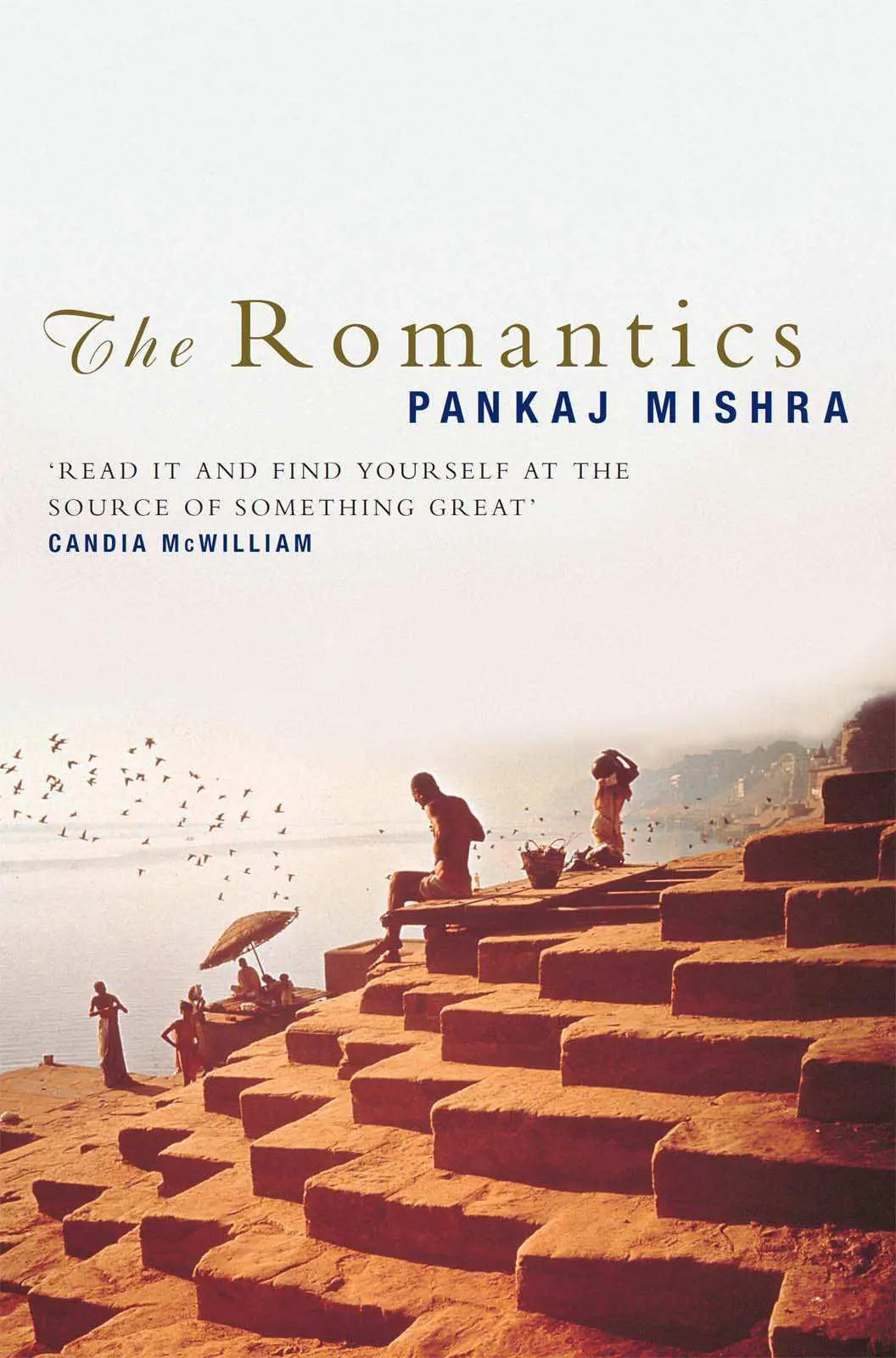
Pankaj Mishra - The Romantics
Здесь есть возможность читать онлайн «Pankaj Mishra - The Romantics» весь текст электронной книги совершенно бесплатно (целиком полную версию без сокращений). В некоторых случаях можно слушать аудио, скачать через торрент в формате fb2 и присутствует краткое содержание. Год выпуска: 2001, Издательство: Anchor Books, Жанр: Современная проза, на английском языке. Описание произведения, (предисловие) а так же отзывы посетителей доступны на портале библиотеки ЛибКат.
- Название:The Romantics
- Автор:
- Издательство:Anchor Books
- Жанр:
- Год:2001
- ISBN:нет данных
- Рейтинг книги:4 / 5. Голосов: 1
-
Избранное:Добавить в избранное
- Отзывы:
-
Ваша оценка:
The Romantics: краткое содержание, описание и аннотация
Предлагаем к чтению аннотацию, описание, краткое содержание или предисловие (зависит от того, что написал сам автор книги «The Romantics»). Если вы не нашли необходимую информацию о книге — напишите в комментариях, мы постараемся отыскать её.
The Romantics — читать онлайн бесплатно полную книгу (весь текст) целиком
Ниже представлен текст книги, разбитый по страницам. Система сохранения места последней прочитанной страницы, позволяет с удобством читать онлайн бесплатно книгу «The Romantics», без необходимости каждый раз заново искать на чём Вы остановились. Поставьте закладку, и сможете в любой момент перейти на страницу, на которой закончили чтение.
Интервал:
Закладка:
Even as I stood there, the first moment of shock wearing off, I was surprised to see how adroitly Catherine handled the situation. Such great reserves of calm she drew upon as she woke Anand up and, as he opened his eyes sulkily and squinted at us, began to ask him why he was still in Benares. Had he gone to Bihar at all, or had he returned early?
She went on with her questions. Anand, still lying on the floor, kept wearily staring out of sleep-blurred eyes at her. I began to notice that he looked distinctly unwell: his hair was rumpled, he hadn’t shaved for some time, there were dark shadows under his eyes and his mouth had a pinched look.
Catherine finally ended the questioning, but with a request: ‘It’s wonderful to see you,’ she said, smiling, and then added, a contrived note of weariness in her voice, ‘but could you make us some tea now? We are both exhausted, totally, completely exhausted.’
Anand seemed to have been waiting for that cue; he got up in an access of fresh energy, kissed Catherine on the cheek and started making tea, apologizing all the time for his inaction of previous days.
Later, the tea made and served, he brought out photographs of Catherine’s friends from their time in Benares. Most of them were fairly innocuous: smiling faces in front of temples, ghats and restaurants. It was the photographs taken at Ramnagar, on the sandy beach across the river, that held my attention. In one of them, Anand appeared in a skimpy bathing suit, his thin hairy body exposed, splashing water over the broad sunburned back of an oblivious Jacques. He seemed so different in these pictures, so free and relaxed; Catherine and her friends seemed to have brought out in him such a childlike enthusiasm for life.
I watched the pictures with growing discomfiture. They made me feel guiltier about Anand. I saw Catherine, her face freshly washed and glowing, exclaim and smile over the photos, and felt even worse.
Within minutes she had slipped into her old role with Anand: here, she was strong-willed and purposeful, hard to recognize as the fragile person I had known in the last few hours.
The small room suddenly felt oppressive. I left soon after finishing my tea. Catherine and Anand came to the top of the stairs to see me off. I had noticed Anand scrutinizing my face, frank curiosity in his eyes; he now looked especially closely at me as I said something to Catherine about meeting soon.
Outside, boredom hung heavy over familiar alleys and shops. The day, only just begun, already seemed stale, the white light dull, the river, glimpsed sporadically from the alleys, torpid.
The sadhu with matted hair did not look up as I passed him. Behind him, a boy attempting to ride a bicycle much bigger than he was tipped over and fell; a veiled woman watching him from the roof suddenly broke into laughter. The vegetable vendor kept on monotonously reciting the prices of tomatoes and cabbage.
Back at the house, Mrs Pandey and Shyam looked up from platters of sliced onion, tomatoes and garlic as I came up the stairs, and then hung their heads again. A shiny new padlock glistened on the door to Miss West’s room. The open-air bathroom was without water, and there was no power in my room. Street sounds — snatches of excited talk, the jangle of rickshaw bells — rushed in through the window I opened; dust swirled in the rays of sunshine that struck the floor; dust rested in a thin film over the books on the table; a new cobweb hung from one of the ceiling beams.
On the floor lay a letter from my father, postmarked Pondicherry; Shyam would have slipped it beneath the door. The letter had come registered. Why the importance and urgency? I wondered as I opened the envelope.
Inside, there was a brief precise note in unfamiliar handwriting that said that my father wasn’t well, the old heart problem, and hoped I would come to Pondicherry soon to see him.
I untied my shoes and lay on the bed and imagined my father in Pondicherry, in a whitewashed house along the coast. I thought of leaving Benares, and there came to me immediately the painful thought of being separated from Catherine.
4
SO BEGAN MY LAST DAYS in Benares — days of gnawing restlessness and gloom.
The weather, so beautifully benign, clashed with my mood. Winter was slowly receding, and though the mornings were still misty and chilly, the afternoons were one long stretch of breezeless sunshine. Scarcely a cloud lingered overhead, and the smell of roasted peanuts hung all over Assi and Lanka. The evenings steadily lengthened.
The violence I had witnessed at the university had had ramifications. The student agitators had eventually organized themselves and declared a general strike. More violence had followed while I was away. Police excesses had become the new rallying point for the strike leaders, whose list of demands grew to include the withdrawal of all policemen from the university. A big crackdown by the authorities was now expected; the talk at chai shops was of more instability and violence, and for a few days after I returned to Benares I kept away from the university.
I stayed in my room all day — it was too hot to sit out in the sun for long stretches — and randomly browsed through books that seemed either to match my mood or to offer a palliative to it.
The thought of my ailing father came occasionally to me, and brought with it fresh pangs of guilt and self-reproach. I hadn’t dared read the note again. It lay next to my bed, and every time I saw it I wondered if I should go to him immediately. But the idea wasn’t allowed to linger long, and was crowded out, as it was, by thoughts of Catherine.
I had stopped going to Catherine’s house. It was her own wish. She said she felt uncomfortable and nervous being with Anand and me under the same roof. She wished to see me separately. I didn’t complain. It was difficult for me as well to see her with Anand. I never had much to say to him and in the couple of times I met him after my return from Kalpi, that inability had turned into self-reproach. I wasn’t able to face him with an unclouded mind; guilt and unease hung over even the most commonplace of conversations between us.
I would see Catherine in one of those modernized sweetshops-cum-cafés that were just beginning to replace the old sooty halwai stalls in Benares. It was she who suggested it. She seemed to imply that there was no question of our meeting in any place more private.
There at the sweetshop we talked for a half-hour or less over cups of milky tea. Catherine was always full of fresh news regarding her plans for France — plans steadily progressing now. Her parents had agreed to help her find a flat; she was to leave soon, in a few weeks if Anand’s passport came through. Each one of these developments infused her with new energy; a seeming nod from her father about anything could make her day.
She would come into the café, beads of perspiration on her forehead, an embroidered bag hanging from her shoulder, and give me a quick furtive kiss on the cheek as the owner, sitting under a profusely garlanded framed photo of his father or grandfather, absent-mindedly swatted the flies whining around the gleaming glass cases, and the underworked waiters, grime-stained hand towels draped over their shoulders, looked out blankly at the bright empty street outside.
These meetings left me weary with unexpressed emotion. I wished nothing less while they lasted than to recapture the intimacy we had known, however briefly, in Kalpi. This desire — which arose fresh and was thwarted every time we met — was only partly physical. Its most compelling aspect was that mysterious affinity I’d known. It was something I had never known before, except as a witness, when I saw, with wonder and curiosity, Catherine and Anand together. In my memory, it had become part of the wonderful strangeness of the time — the bizarre concatenation of events and desires and emotions that, among other things, had made two full-grown adults revert to the long-forgotten language of childhood.
Читать дальшеИнтервал:
Закладка:
Похожие книги на «The Romantics»
Представляем Вашему вниманию похожие книги на «The Romantics» списком для выбора. Мы отобрали схожую по названию и смыслу литературу в надежде предоставить читателям больше вариантов отыскать новые, интересные, ещё непрочитанные произведения.











Обсуждение, отзывы о книге «The Romantics» и просто собственные мнения читателей. Оставьте ваши комментарии, напишите, что Вы думаете о произведении, его смысле или главных героях. Укажите что конкретно понравилось, а что нет, и почему Вы так считаете.