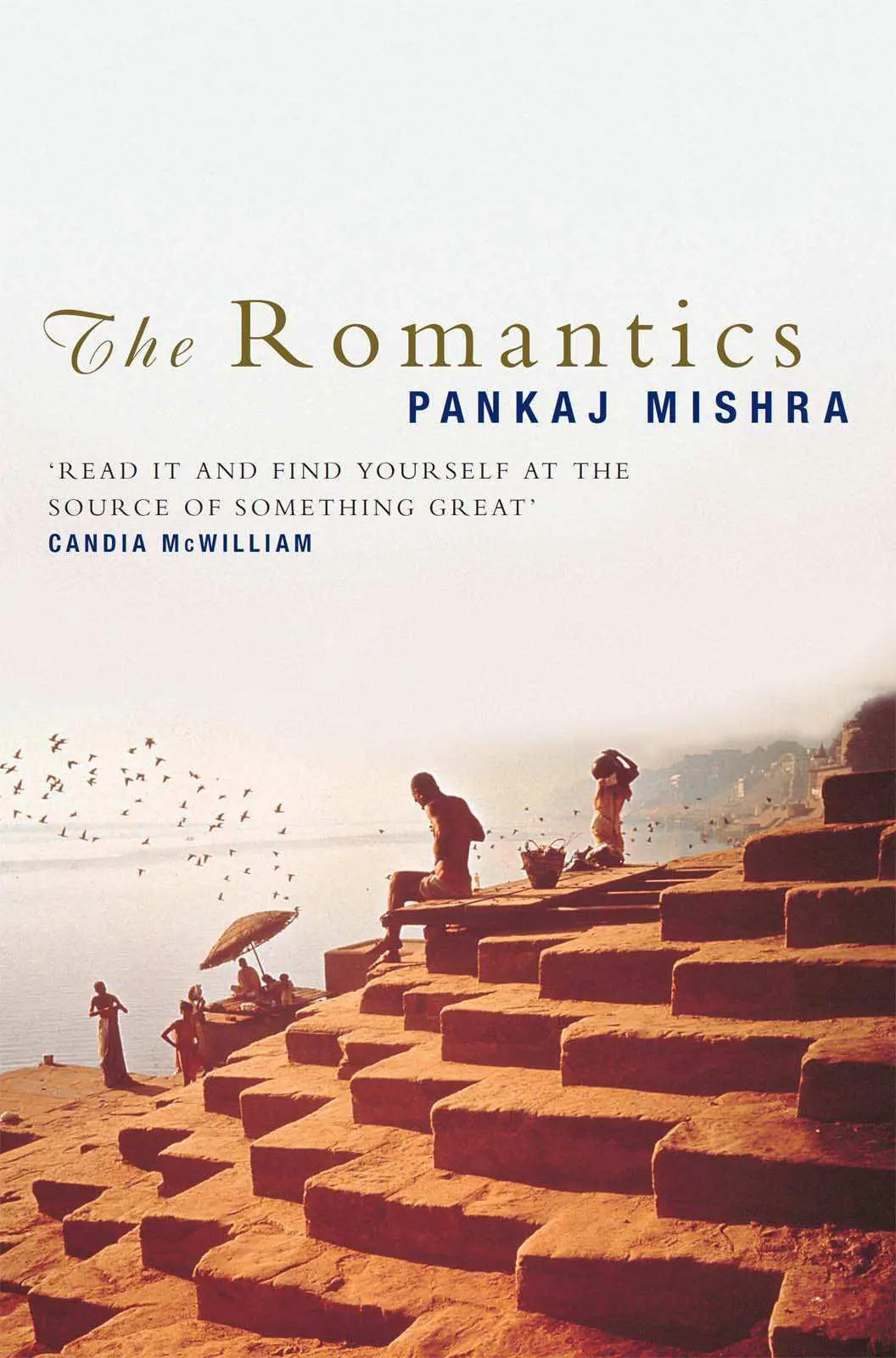
Pankaj Mishra - The Romantics
Здесь есть возможность читать онлайн «Pankaj Mishra - The Romantics» весь текст электронной книги совершенно бесплатно (целиком полную версию без сокращений). В некоторых случаях можно слушать аудио, скачать через торрент в формате fb2 и присутствует краткое содержание. Год выпуска: 2001, Издательство: Anchor Books, Жанр: Современная проза, на английском языке. Описание произведения, (предисловие) а так же отзывы посетителей доступны на портале библиотеки ЛибКат.
- Название:The Romantics
- Автор:
- Издательство:Anchor Books
- Жанр:
- Год:2001
- ISBN:нет данных
- Рейтинг книги:4 / 5. Голосов: 1
-
Избранное:Добавить в избранное
- Отзывы:
-
Ваша оценка:
The Romantics: краткое содержание, описание и аннотация
Предлагаем к чтению аннотацию, описание, краткое содержание или предисловие (зависит от того, что написал сам автор книги «The Romantics»). Если вы не нашли необходимую информацию о книге — напишите в комментариях, мы постараемся отыскать её.
The Romantics — читать онлайн бесплатно полную книгу (весь текст) целиком
Ниже представлен текст книги, разбитый по страницам. Система сохранения места последней прочитанной страницы, позволяет с удобством читать онлайн бесплатно книгу «The Romantics», без необходимости каждый раз заново искать на чём Вы остановились. Поставьте закладку, и сможете в любой момент перейти на страницу, на которой закончили чтение.
Интервал:
Закладка:
These inner dramas dissolved my concentration, and the time when I could sit for long, still afternoons on a straight-backed wooden chair, the lawn outside my window slowly passing into shadow, when an extra minute spent outside with Rajesh and his friends would lead to pangs of guilt, that time became frustratingly hard to retrieve.
Rajesh often showed up at the library, and once when I saw him, he asked me about the trip to Mussoorie. I told him whatever I could. He listened intently. He asked me more questions about the Himalayas, for which he seemed to have a feeling not unlike mine, although, like everything else, he did not express it very clearly. I also told him about Miss West and Catherine, and he was an even more attentive listener. From that point on, he often asked me about them. I felt that he had always been curious about my life outside the university, and the nature of my connection to Miss West and Catherine genuinely intrigued him for being so far from his own experience — the experience of someone who had never met a white person, had never travelled outside the region.
Beyond the library gates where I would have lunch, there were his usual hangers-on, with their talk of politics and large bribes and dowries. Rajesh hadn’t been at the university for the past many days, and didn’t know much about the latest spell of student unrest. But the other students had all the details. It was now known that the student who threw the hand grenade at the policeman had been tortured by the same policeman in custody some time back. The attack had been a planned act of revenge.
I still wondered if Rajesh had had something to do with all that. But the students said nothing that could have hinted at his involvement. He himself gave little cause for suspicion. The next time I visited his room — it was to pick up a xeroxed article I had lost and one of his hanger-ons had found at the library — the bag with the pistols was gone. I suspected he had hidden it somewhere, and looked in his almirah when he was briefly out of the room, but there were only some clothes, a jar of coconut hair oil and a framed and garlanded picture of Hanuman on the bare shelves.
He was more relaxed with me, often asking me about Arjun. His disconcerting habit of creeping up behind me as I sat and read was intact. After surprising me, he would peer at my book, and once again he would say, ‘Edmund Wilson! Why are you reading the same man all the time?’
Slightly fed up with this line, I one day showed him Wilson’s essay on Flaubert’s politics. I said he should read it to find out why I read Wilson. I asked him to get the essay xeroxed at the library photocopying room, and he in turn asked one of his hangers-on to do so. As an afterthought, after covering the frail paperback with brown paper, I gave him Sentimental Education to read. I told him he’d have a better sense of the essay after reading the novel.
I said so, but I really didn’t expect him to read all, or even any, of the material I gave him. He hardly ready anything apart from Faiz and Iqba¯l and the Hindi newspapers scattered around the university’s tea stalls. I didn’t think Flaubert and Wilson were writers he would like or understand.
*
Miss West finally returned to Benares. New, unfamiliar music floated out of her room. I was particularly struck by one haunting melody she played over and over again. Prokofiev’s Fifth Symphony, it was one of the new CDs she had come back with, she said, and I wondered whether the CDs had been sent to her by Christopher, whose picture I now looked at more closely whenever I was in her room.
I now saw her in the light of Catherine’s revelations. I thought I could see dissatisfactions in her bright eyes and offhand manner, neurotic irritations appearing in her brusque speech. I saw the troubled past I had suspected when I first came to Benares appear again as she would sit out on the roof late in the evening, looking over the moonlit river.
But I no longer felt the confusion Catherine’s revelations had induced in Mussoorie, as I sat out under the luminous sky at night. It no longer struck me as strange that a life could be so exclusively dictated by a single passion. That past of Miss West I had wondered about, the past that had seemed to me like a prison, now seemed an essential part of her life, her personality, her sense of humour and malice, and even her love for music, which I now understood better, along with the music itself, when I listened to some of her favourite composers: Brahms, Schubert and Schumann.
She told me about her new connection with Benares. She had earlier mentioned to me a great-aunt of hers who was married briefly to a captain in the British Indian army. Now she had come to know — through old letters discovered and read by a cousin in England — that this great-aunt had visited Benares in 1945 and fallen under the spell of a famous Tantra practitioner. She had stayed with this man for a few months. It was an outrageous thing for a British woman of her time to do. Her marriage to the army captain had broken up soon afterwards and she had returned to England to a series of lovers. She had finally died in Norfolk, alone, a few weeks ago.
‘What a story!’ Miss West said. ‘It’s like Passage to India and Jewel in the Crown all jumbled up together. The letters are to her younger sister and they don’t mention it, but I am quite sure she had an affair with the Tantric. Those Tantrics are great experts on sex, aren’t they? I am sure the men she slept with in England felt themselves blessed.’
A few months ago, I would have been embarrassed to hear her say this. I only smiled this time.
I wondered if she was monitoring changes in my manner. I often made up an excuse when she offered to take me along on her social rounds through the city. I agreed to go with her to a party at Sarah’s house, but then had to feign illness hastily after I came to know that a concert by Anand was scheduled later that evening.
‘You look out of sorts. What’s wrong?’ she often asked as I went up to my room after a long, gloomy evening at the ghats. She was curious about my time in Mussoorie with Catherine: the maharaja, she said, hadn’t mentioned me in his account of our lunch at his hotel. She was especially curious to know about the unscheduled day and night in Kalpi. Was there a hotel there? What kind of room was it? Single or double?
She had, I knew, put somewhat less probing questions to Catherine. Did she suspect something? I couldn’t tell.
But there shortly came Shivratri, when I almost gave myself away.
*
In Benares’s calendar, teeming with festivals, Shivratri occupies a special place. Millions of pilgrims visit the city that day to bathe in the river; and it was to witness their slow exuberant late-afternoon progress through the streets and alleys of the old city that I arranged to meet up with Catherine and Miss West on Dashashvmedh Ghat.
I reached the top of the broad flight of steps a bit before the appointed time. It was, I remember, a day of streaming refulgence, one of those perfect days of March, whose tingly mornings, tenderly azure skies, soft, sun-caressed afternoons and long indigo twilights are the last parting gifts from the gods of spring before they are abruptly deposed in April by the malevolent spirits of the Indian summer. All around me, and in the far distance, swarmed a crowd of pilgrims, with not a patch of uncovered ground to be seen anywhere, pilgrims surging into the main road from all directions, through narrow lanes and maze-like alleys, from between houses leaning into each other; pilgrims holding marigolds and red hibiscuses, brass and steel platters filled with lit diyas and sweets and vermilion powder, pilgrims wearing pink and purple saris, crimson and white turbans, glossy silk and threadbare cotton, pilgrims ochre-robed and naked — ash-smeared, matted-haired Naga sadhus with gleaming tridents, their long penises slackly swinging as they walked towards the ghat — pilgrims everywhere, chanting slogans in praise of Shiva as they went down the steps, past the coconut and flower sellers, the anxious-eyed cows and the fat priests under their tattered straw umbrellas, to the river, throwing rose petals over their heads, up towards where the monkeys balanced on electric poles, quiet and watchful.
Читать дальшеИнтервал:
Закладка:
Похожие книги на «The Romantics»
Представляем Вашему вниманию похожие книги на «The Romantics» списком для выбора. Мы отобрали схожую по названию и смыслу литературу в надежде предоставить читателям больше вариантов отыскать новые, интересные, ещё непрочитанные произведения.






Обсуждение, отзывы о книге «The Romantics» и просто собственные мнения читателей. Оставьте ваши комментарии, напишите, что Вы думаете о произведении, его смысле или главных героях. Укажите что конкретно понравилось, а что нет, и почему Вы так считаете.