Pankaj Mishra - The Romantics
Здесь есть возможность читать онлайн «Pankaj Mishra - The Romantics» весь текст электронной книги совершенно бесплатно (целиком полную версию без сокращений). В некоторых случаях можно слушать аудио, скачать через торрент в формате fb2 и присутствует краткое содержание. Год выпуска: 2001, Издательство: Anchor Books, Жанр: Современная проза, на английском языке. Описание произведения, (предисловие) а так же отзывы посетителей доступны на портале библиотеки ЛибКат.
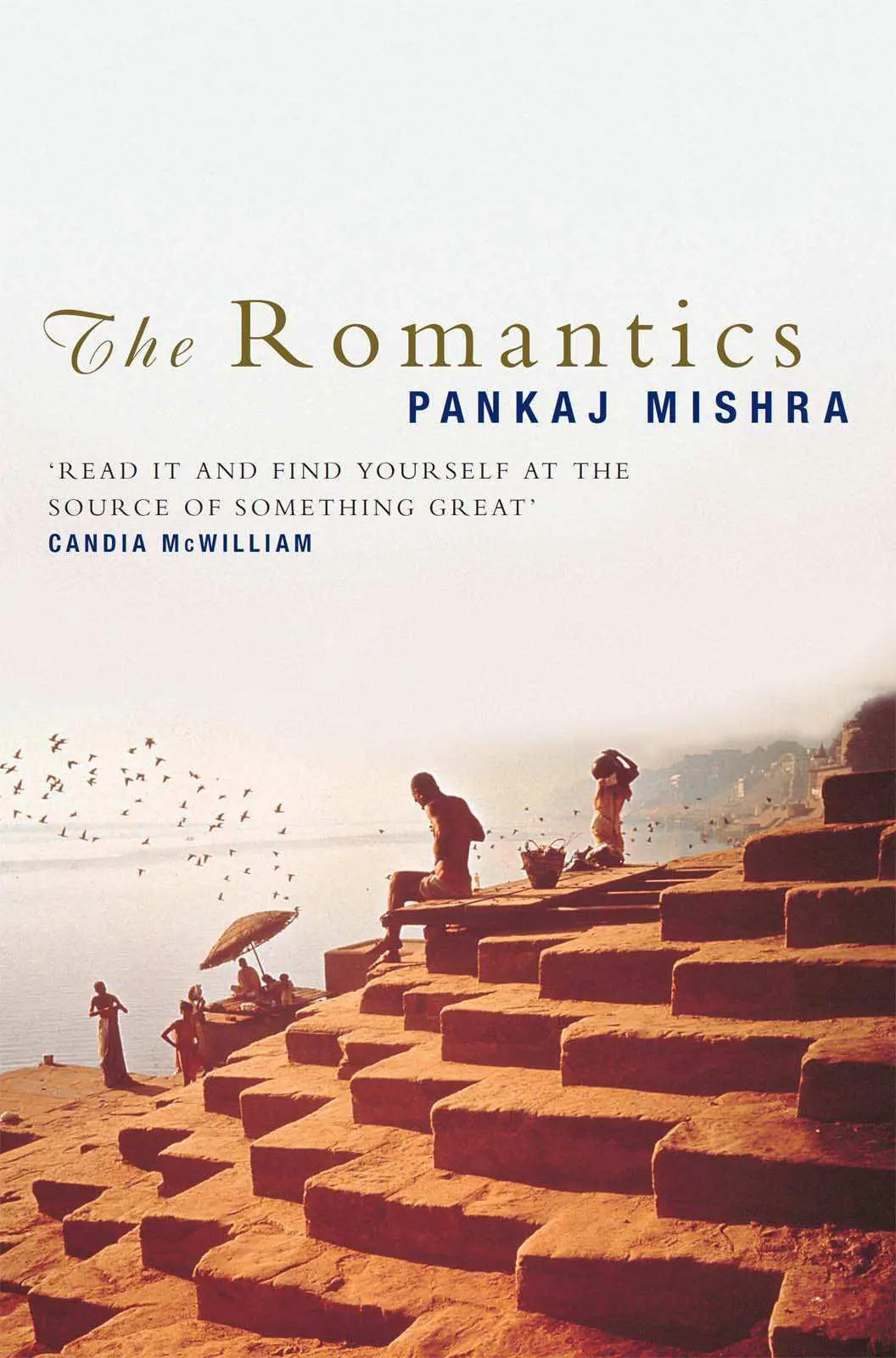
- Название:The Romantics
- Автор:
- Издательство:Anchor Books
- Жанр:
- Год:2001
- ISBN:нет данных
- Рейтинг книги:4 / 5. Голосов: 1
-
Избранное:Добавить в избранное
- Отзывы:
-
Ваша оценка:
The Romantics: краткое содержание, описание и аннотация
Предлагаем к чтению аннотацию, описание, краткое содержание или предисловие (зависит от того, что написал сам автор книги «The Romantics»). Если вы не нашли необходимую информацию о книге — напишите в комментариях, мы постараемся отыскать её.
The Romantics — читать онлайн бесплатно полную книгу (весь текст) целиком
Ниже представлен текст книги, разбитый по страницам. Система сохранения места последней прочитанной страницы, позволяет с удобством читать онлайн бесплатно книгу «The Romantics», без необходимости каждый раз заново искать на чём Вы остановились. Поставьте закладку, и сможете в любой момент перейти на страницу, на которой закончили чтение.
Интервал:
Закладка:
A tea vendor, wearing a monkey cap with flaps that covered his ears, kept walking up and down the corridors. He looked inquiringly at us every time he passed. Rajesh finally summoned him, speaking in a local dialect I had never before heard from him, but the cardamom-scented tea seemed to turn cold the moment he lifted the kettle off his tiny coal stove and poured it into glass tumblers.
Rajesh sat up and hurriedly put on his tennis sneakers as the train clanked and rattled to a stop at a station that resembled one of the many small stops we had passed. The platform was deserted; the station building had a red-tiled roof and, unexpectedly, bougainvillea curling out of hanging wood baskets. Outside, on a concourse littered with horse dung, three tongas stood waiting, a couple of emaciated, mangy dogs staggering around the still horses.
Rajesh said that it was another half-hour tonga ride from there.
The view cleared as soon as the tonga left the concourse, the horse’s hooves clattering loudly against the cement surface, his long brushy tail swaying and flicking against his hind legs. On both sides sprawled mustard fields, divided into compact squares by muddy ledges on which peasants, diminished against the surrounding vast flatness, walked in orderly rows. Water gushed out in thick jets from tubewells, and raced and gurgled through narrow drains to the fields. The narrow tarmac road was corroded at the edges, as if infested by termites, and the tonga lurched ominously each time a bigger, faster vehicle — usually a snot-nosed tempo — forced it into the dusty rutted roadside. From under the hooded roof at the back, we watched as the tempo receded whimperingly down the tree-lined road and dust swirled up slowly from the ground, to be caught and illuminated in hundreds of criss-crossing sunbeams.
*
Mango groves appeared on both sides, the dust thick on the leaves of the trees closer to the road; then, in small clearings, a few buildings: box-shaped houses of naked brick and mud huts with large courtyards where men slumbered on string cots; cold-storage warehouses; tiny shuttered shops. Swarthy blouseless women squatted on the ground before thatched huts, slapping together cakes of cow dung, little igloos of which lined the road. A few half-naked children with distended bellies ran around screaming at the tops of their voices.
Finally, at the end of a row of identical buildings, there was Rajesh’s mother’s house, one room, the walls undistempered, with the brick showing through. The children went very quiet as the tonga slowed to a stop, and then as we got down, they crowded around us in a little mob, their mouths open and eyes wide with frank curiosity.
Their hair had turned rust-blond from malnutrition. The mucus from their running noses was white against the dark skin. I looked at Rajesh for a reaction of some sort, but his face was expressionless as we walked up to the house. The children followed us. One of them reached out a hand and caressed my khadi kurta. I looked down to see curiosity and fear alternating wildly in his eyes.
The door, its wooden frame warped and chipped, was opened by Rajesh’s mother, a tiny, shrunken, fair-skinned woman in a widow’s white sari, one end of which she wore over her head as a kind of veil. There was a restless quality about her wizened face, which spoke of continuing struggles. In this first moment of meeting her, I didn’t notice much resemblance between mother and son; it was a little while later that I saw that Rajesh had inherited her eyes, so full of uncertainty and now, on seeing me and the children behind us, puzzlement.
But when Rajesh introduced me as a friend from the university she suddenly grew very welcoming, and invited me into the room with an old-fashioned gracious gesture of her hands.
After the early-morning light, it was dark and damp inside the high-ceilinged room. There was a solitary window, but it was closed. In one corner, partitioned off by a flimsy hand-loomed sari, was the kitchen. The wall there was a sooty black, and on the wet floor a few brass utensils gave off a dull gleam. In another corner lay a string cot, under which was a tin trunk, leprous with rust. On the walls were garishly coloured religious calendars: a benign Shiva, Ram with lips painted bright red and at his feet Hanuman, hands clasped and head bowed in his usual pose of devotion.
It was unsettling: the half-naked screaming children outside and the bareness of the room. I hadn’t been prepared for this; the poverty these surroundings spoke of wasn’t immediately apparent in Rajesh’s life in Benares. I could have guessed previously that he wasn’t well off, but one could have said the same of almost all students at the university.
Rajesh, who since the morning had become increasingly silent, left the room as his mother busied herself with breakfast. I sat stiffly in a straight-backed wicker chair and tried to make some conversation. Both of us had to speak very loudly to make ourselves heard above the fierce hiss of the kerosene stove.
It wasn’t easy to express sympathy in that high-pitched voice, and sympathy was what was required of me as she began to tell me stories from her past.
She had been widowed fifteen years ago when Rajesh was still a child, and soon afterwards her wealthy feudal in-laws had started to harass her. The house in which she had lived with her husband was taken away from her, and her in-laws also refused to return the little dowry she had brought with her. Her parents were dead; her brothers too poor to support her. There was only Rajesh, who’d had his own struggles: he had worked since he was thirteen, first in the maize fields, and then at a carpet factory in Benares, where he had gone to evening school and done well enough to enter the university.
The years had somehow passed in overcoming all these different obstacles. But now she was worried. Rajesh, she feared, had reached a dead end. There were no more openings for him. All the government jobs these days were going to low-caste people, and not only did Rajesh have the wrong kind of caste, he had no connections anywhere. He also had too much self-respect to work for low-caste shopkeepers and businessmen.
Disdain entered her voice as she said this. I had encountered it before. It came from an exalted sense of being Brahmin, of being marked and set above people from other castes, races. Rajesh himself possessed some of that feeling, which in his case was also an awareness of not having lived up to old standards. ‘I am a Brahmin,’ I had heard him say, ‘but I have done things no Brahmin would ever do.’
But I didn’t think of this then. I was shocked by what Rajesh’s mother had told me about his life. How little of his past I had known! Of the childhood spent in maize fields and carpet factories, I had known nothing at all. I did know a bit about these factories. They had been in the papers after some human rights organizations petitioned the government to prohibit them from using child labour. There had been pictures of large-eyed, frightened-looking children in dimly lit halls, framed against their exquisite handiworks. I had read the accompanying articles and then I had forgotten about them.
To think of Rajesh as one of those children was to shrink the usual distance I kept from these things — the cruelties of rural India, occasionally reported in the papers and then buried under reports of similar cruelties. It was to have, however briefly, a disturbing new sense of the harsh world around me.
Rajesh himself changed in my eyes when he came back into the room. Behind his unreadable handsome face, I now saw tormenting private memories of childhood. The instability I had noticed and feared on more than one occasion appeared as a natural consequence of his past.
But the moment soon passed. Rajesh set out small wooden seats on the ground and his mother served out hot steaming parathas with mango pickles in large brass thalis.
Читать дальшеИнтервал:
Закладка:
Похожие книги на «The Romantics»
Представляем Вашему вниманию похожие книги на «The Romantics» списком для выбора. Мы отобрали схожую по названию и смыслу литературу в надежде предоставить читателям больше вариантов отыскать новые, интересные, ещё непрочитанные произведения.











Обсуждение, отзывы о книге «The Romantics» и просто собственные мнения читателей. Оставьте ваши комментарии, напишите, что Вы думаете о произведении, его смысле или главных героях. Укажите что конкретно понравилось, а что нет, и почему Вы так считаете.