Evan Hunter - Streets of Gold
Здесь есть возможность читать онлайн «Evan Hunter - Streets of Gold» весь текст электронной книги совершенно бесплатно (целиком полную версию без сокращений). В некоторых случаях можно слушать аудио, скачать через торрент в формате fb2 и присутствует краткое содержание. Город: New York, Год выпуска: 1975, ISBN: 1975, Издательство: Ballantine Books, Жанр: Современная проза, на английском языке. Описание произведения, (предисловие) а так же отзывы посетителей доступны на портале библиотеки ЛибКат.
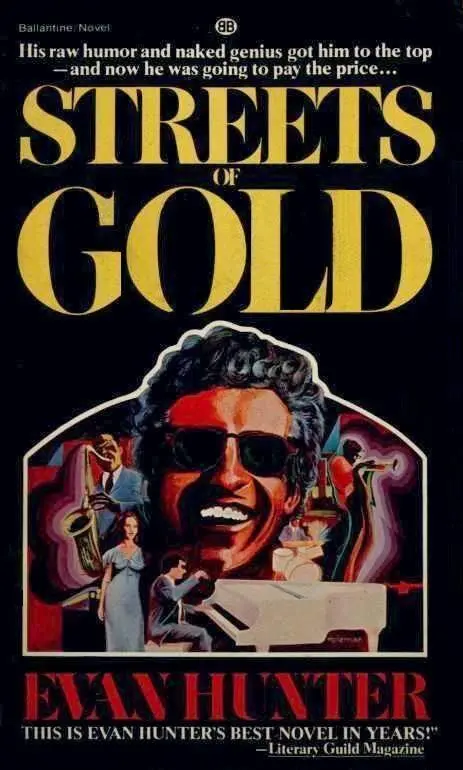
- Название:Streets of Gold
- Автор:
- Издательство:Ballantine Books
- Жанр:
- Год:1975
- Город:New York
- ISBN:978-0-345-24631-8
- Рейтинг книги:4 / 5. Голосов: 1
-
Избранное:Добавить в избранное
- Отзывы:
-
Ваша оценка:
Streets of Gold: краткое содержание, описание и аннотация
Предлагаем к чтению аннотацию, описание, краткое содержание или предисловие (зависит от того, что написал сам автор книги «Streets of Gold»). Если вы не нашли необходимую информацию о книге — напишите в комментариях, мы постараемся отыскать её.
Streets of Gold — читать онлайн бесплатно полную книгу (весь текст) целиком
Ниже представлен текст книги, разбитый по страницам. Система сохранения места последней прочитанной страницы, позволяет с удобством читать онлайн бесплатно книгу «Streets of Gold», без необходимости каждый раз заново искать на чём Вы остановились. Поставьте закладку, и сможете в любой момент перейти на страницу, на которой закончили чтение.
Интервал:
Закладка:
Which brings us to what my mother thinks about piano players.
It was along about this same time, just before the move to the Grand Concourse, while my mother was still ranting and raving about all that junk on the sun porch, that she made a remark I consider classic. We were lingering over coffee (as they say in novels) at the dinner table in the new house Rebecca and I had built in Talmadge. My mother, in her characteristically compromising fashion, said, “If you don’t get somebody to take that stuff away, Jimmy, I’m going to throw it in the garbage.”
“Aw, come on, Stella,” he said.
“Come on, Mom,” I said. “That’s his hobby.”
“That’s right, Stella, it’s my hobby.”
“Your hobby?” my mother said. “If you need a hobby, why don’t you get one that doesn’t clutter up the whole house?”
“Like what?” my father asked.
(Are you ready?)
“Like your son’s,” my mother answered. “Playing piano.”
I had earned close to four hundred thousand dollars playing piano that year, what with record albums and sheet music and personal appearances and the lot. I owned a department store in Dallas (for the depreciation value) and interests in oil wells (one of which had actually come in), and my tax lawyer had told me I would become a millionaire within the next three years, provided things continued to go well for me. But to good old Stella, piano playing was a hobby, and my success was a freak.
She was right. It was.
Here’s what happened.
In 1955, I changed everybody’s name. Rebecca Baumgarten Di Palermo became Rebecca Jamison, and I became Dwight Jamison, and my three sons became, respectively and respectfully, Andrew, Michael, and David Jamison. Actually, when we named the boys, who were separately born in 1949, 1951, and 1953, we were trying to find names that sounded good with Di Palermo. Andrew, Michael, and David sounded fine to us — and American besides. We changed the Di Palermo, finally, because we got tired of people asking us how we were going to raise the children. (That was the good reason; I still don’t know what the real reason was.) When you change your name, the Department of Health will send you, at your request, a pink birth certificate with the new name on it. There is no indication on this certificate that your name once was Merton Luftfenster. It merely states that Lance Wasp was born in the city of New York on such and such a date. It looks exactly like the birth certificate that might have been issued way back then when you first drew breath. Not a soul can tell the difference, and it saves you the trouble of producing your court order every time you apply for a passport or a driver’s license or an insurance policy or anything requiring proof of age and birthplace. New York City is very accommodating in this respect. But that is only natural since New York perhaps best represents the spirit of constant change that is America.
Marian McPartland once said to me, “Drummers are always disappearing, Ike, have you ever noticed that? I wonder where they go all the time.”
Marian . .. people are always disappearing.
Ignazio Silvio Di Palermo disappeared in 1955, when my lawyer went before a judge to petition for the name change. He said it was for professional reasons, a blatant lie since by then I was known as Blind Ike, and was in fact playing under that name at a club on the East Side. The judge signed a court order, and told my lawyer that the order had to be published in a newspaper of the court’s choice within twenty days, just in case anyone had any objections whatever to my becoming more American than I already was. No one objected, and we all became Jamisons. It only remained to send two bucks to the Board of Health for each of those brand-new pink certificates. How simple it is to disappear from the face of the earth, unless (like me) you are plagued by memories.
Everybody (except my grandfather) continued calling me Ike, of course — they had, after all, been calling me that for almost a decade. But I was now Dwight Jamison. As a boy at the Blind School, I had learned to write my own name in longhand, using a sheet of raised letters, and a board with sunken letters, and writing paper embossed with guidelines a half inch apart. I would feel the raised letters with my fingertips, touching each until I thought I knew each curlicue, tail, and dot. Then I would fit my pencil into the sunken letters on the board, learning how to manually recreate each letter by tracing it over and over again, the pencil tip caught in the grooves. And finally, I would practice my signature on the paper, feeling the raised lines and knowing the upper and lower limits of the defining space. I did not know what my handwriting looked like. My mother said I wrote like a Chink. She should only have known how long and how hard I practiced my signature.
I had to practice another signature when I became Dwight Jamison.
I changed my name just in the nick, as it turned out, because I was on the verge of becoming a big success, ma’am, and think of what might have happened to Kirk Douglas if he’d still been Issur Danielovitch Demsky when he made Champion . Talent notwithstanding, my success was pure unadulterated chance, the result of a series of accidents, cause and effect mating to produce an inescapable conclusion. My quintet consisted of five musicians (what else? eight?). Cappy Kaplan, from the original Auntie’s trio, had been killed in the Korean War, but Stu Holman was still with me on bass. As drummer, I was using another black man, a kid named Peter Dodds, who succumbed to drugs before we opened at Birdland the following year; he sent us a congratulatory telegram from Lexington, Kentucky, where he was trying to kick the habit. On trumpet, I had a white man named Hank D’Allessio (who had not changed his name for professional reasons) and on vibes another white man named Larry Kimberly. The quintet was what is known in the trade as a “salt and pepper band.” But tell me, does the instrumentation strike a familiar note, ring a reminiscent bell? Here’s your clue: the vibraphone. In 1955, before I became a big success by accident, I was mostly being “influenced” by George Shearing, who had begun winning all those % Down Beat polls back in 1949, and who had single-handedly buried solo piano in a grave so deep that resurrection was impossible. There are some piano players who instantly generate excitement among other piano players, and Shearing was one of them. I had first heard him on a record he had cut for Savoy, and later caught him at the Three Deuces, where he was busting the joint wide open with what was then a trio. By 1950, every piano player in the country was trying to copy him, and I was no exception. The same thing had happened in the thirties, incidentally, when a then-current musician’s accolade — “Tatum, no one can overrate ’im” — was coupled with the warning: “Tatum, no one can imitate ’im.” I was unabashedly imitating George Shearing in 1955, right down to the incidental blindness and the almost identical instrumentation — I was using a trumpet in place of the guitar George had in his quintet.
When I accidentally tripped over the hairy unwashed body of success, the quintet (mine, not George’s) was playing at a fairly decent club on the East Side, pulling down respectable loot (twelve bills a week) and enjoying some sort of recognition in a profession not noted for its charity. On a Thursday night, Larry Kimberly, my vibes player, got sick. (He said he was sick; I think he was on a bender. No matter.) I called Mark Aronowitz, who had begun managing me six months earlier, and who had in fact come up with the East Side gig, and told him I needed a vibes player to fill in for the weekend. Mark said he’d get right to work on it; he called me back late Friday afternoon.
Читать дальшеИнтервал:
Закладка:
Похожие книги на «Streets of Gold»
Представляем Вашему вниманию похожие книги на «Streets of Gold» списком для выбора. Мы отобрали схожую по названию и смыслу литературу в надежде предоставить читателям больше вариантов отыскать новые, интересные, ещё непрочитанные произведения.

Обсуждение, отзывы о книге «Streets of Gold» и просто собственные мнения читателей. Оставьте ваши комментарии, напишите, что Вы думаете о произведении, его смысле или главных героях. Укажите что конкретно понравилось, а что нет, и почему Вы так считаете.