Evan Hunter - Streets of Gold
Здесь есть возможность читать онлайн «Evan Hunter - Streets of Gold» весь текст электронной книги совершенно бесплатно (целиком полную версию без сокращений). В некоторых случаях можно слушать аудио, скачать через торрент в формате fb2 и присутствует краткое содержание. Город: New York, Год выпуска: 1975, ISBN: 1975, Издательство: Ballantine Books, Жанр: Современная проза, на английском языке. Описание произведения, (предисловие) а так же отзывы посетителей доступны на портале библиотеки ЛибКат.
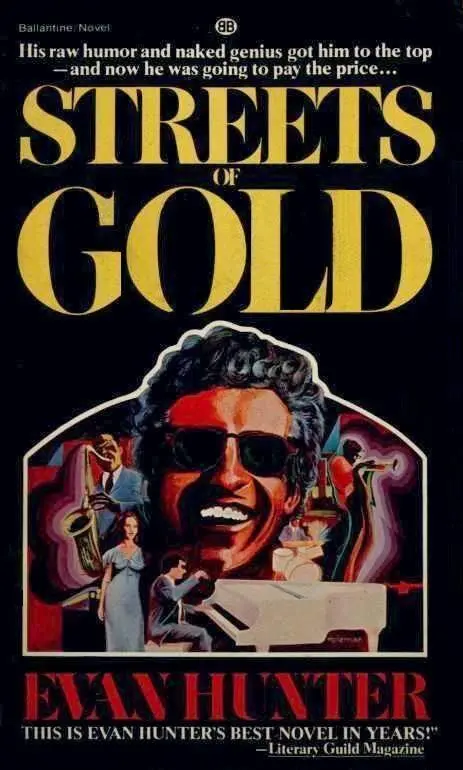
- Название:Streets of Gold
- Автор:
- Издательство:Ballantine Books
- Жанр:
- Год:1975
- Город:New York
- ISBN:978-0-345-24631-8
- Рейтинг книги:4 / 5. Голосов: 1
-
Избранное:Добавить в избранное
- Отзывы:
-
Ваша оценка:
Streets of Gold: краткое содержание, описание и аннотация
Предлагаем к чтению аннотацию, описание, краткое содержание или предисловие (зависит от того, что написал сам автор книги «Streets of Gold»). Если вы не нашли необходимую информацию о книге — напишите в комментариях, мы постараемся отыскать её.
Streets of Gold — читать онлайн бесплатно полную книгу (весь текст) целиком
Ниже представлен текст книги, разбитый по страницам. Система сохранения места последней прочитанной страницы, позволяет с удобством читать онлайн бесплатно книгу «Streets of Gold», без необходимости каждый раз заново искать на чём Вы остановились. Поставьте закладку, и сможете в любой момент перейти на страницу, на которой закончили чтение.
Интервал:
Закладка:
“Well,” he said, “I’ve got a flute player for you.”
“A what ?” I said.
“A flute player.”
“What the hell am I going to do with a flute player?”
“This is a very fine flute player. He played with the Boston Symphony.”
“Mark,” I said, “I need a vibes player.”
“No vibes players,” he said.
“What do you mean, no vibes players?”
“None. Noplace. I called 802, I called every agent and manager I know, I even called Benny up in Connecticut, and asked him for Hamp’s number on the off chance he might know somebody. But Hamp’s out of town, and there is not a single fucking vibes player in the entire city of New York this weekend, and that is that.”
“That’s impossible,” I said. “There must be thousands of vibes players looking for work.”
“Yeah?” Mark said. “Where are they?”
“I don’t want a flute player,” I said.
“What do you want? A tenor sax? A trombone? Name it. The only thing I can’t get is a vibes player. I thought a flute sounded a lot like a vibraphone.”
“Mark, it doesn’t sound anything like a vibraphone.”
“Silvery, you know? This guy is a fine musician, Ike. Take him, try him out. Just for the weekend. I’m not asking you to marry him.”
“What’s his name?” I asked.
His name was Orion (I swear to God) Burke, and he was the first link in the chain of events that led to the success of the Dwight Jamison Quintet. The second link was a singer named Gerri Pryce. You’ve never heard of her; she didn’t grow up to be Petula Clark or anybody. She was a girl of nineteen who was also on Mark’s list of “artists,” as he chose to call us. He had been grooming her (and probably fucking her) since she was seventeen, and he had miraculously arranged a recording date for her on the Thursday following the night Orion Burke joined the band. I did not like the way the band sounded with a flute substituting for the vibes — which shows how much I know. But Orry was indeed a fine musician (who insisted on calling himself a “flautist,” by the way, pish-posh) and he got on to what we were laying down after a quick Friday rehearsal, and the weekend went by without incident or fanfare. That is to say, nobody came up to the stand to tell us they missed the vibes, but neither did anyone tell us how extraordinary we sounded with a flute in there. Monday was our night off, and on Tuesday Mark called to say he wanted us to back Gerri Pryce on her record date.
“Who’s Gerri Pryce?” I asked.
“Nobody you know yet,” he said. “She’s going to be a big star.”
“How much is the gig paying?” I asked.
“Minimum,” he said. “This is a very small record company, an independent, but when Gerri hits it big with this single, I’ll be able to go back to them and remind them who was on the gig with her.”
“Why do I always end up with all the shit gigs?” I asked Mark.
“Oh?” he said. “Oh? Is the gig you’re playing now a shit gig? I didn’t realize twelve bills a week was shit. You’re taking home more than three hundred for yourself each and every week, Ike, and that puts a lot of meat and potatoes on the table, and that is not shit , Ike, that is good hard American currency on my block. Now perhaps you consider it an imposition to be asked by your manager to play for somebody who’s going to be a singing sensation as soon as this single is released, and who is giving you his sacred word of honor...”
“All right, Mark.”
“. . . that once this record takes off, I’ll go back to the company and be in a position to negotiate a contract for the quintet, on terms more acceptable...”
“All right, already.”
“Three o’clock Thursday, Nola Studios,” Mark said, and hung up.
In 1955, it cost thirty dollars an hour to rent space at Nola Studios, and the company cutting Gerri Pryce’s first Big Hit Single (or so Mark hoped) had reserved the facilities for three hours of rehearsal and recording time. In addition, they had paid Gerri a five-hundred-dollar advance against royalties, and they were paying the quintet scale, which came to $41.25 for each sideman and double that for the leader. According to union regulations, this permitted them to utilize our talents for a maximum of three hours, in which time they were entitled to cut four ten-inch masters, each side running no longer than three and a half minutes. The A&R man and the sound technician were the company’s own, and on salary. Still, the session was going to cost $837.50, which was a considerable amount for a small independent to be shelling out. There was an air of confidence in the studio when we assembled at 3 P.M. Since we were there to rehearse and record only two sides, the three hours should have been more than enough time to ensure a professional job.
But Gerri Pryce, at the age of nineteen, already considered herself a star, even though she had never cut a record, and even though her singing engagements to date had been exclusively limited to a series of toilets on Long Island’s Sunrise Highway. She walked into the studio an hour and twenty minutes late, by which time the A&R man — whose name was Rudy Hirsch — was ready to climb the walls. She was accompanied by an entourage consisting of a weight lifter from San Diego, whom she introduced as her chauffeur (his motorcycle was probably parked illegally downstairs), and who grunted “Groovy” when he shook my hand; a fluttery old woman named Mabel, who knocked over Hank D’Allessio’s music stand and tittered endlessly while precious seconds were frittering away (she was Gerri’s hairdresser, though Christ alone knew why a hairdresser was necessary on a recording date); and Gerri’s uncle, a dyspeptic forty-two-year-old Pole (Gerri had changed her name from Przybora) who was there to make sure his niece’s innocence remained unsullied; he had heard a lot about musicians, old Uncle Stanislaw. I later heard from Mark (but this may be gossip) that young Gerri had taken on the entire marching band of a high school in Secaucus when she was but a fourteen-year-old cheerleader. But there she was at nineteen, chauffeured, coiffed, cloistered, and an hour and twenty minutes late. She nonetheless insisted, rightfully, that we rehearse the two tunes she was about to record. She had written one of these tunes herself, and this was to be the Big Hit side of the record. The tune was called “Mooning,” and the lyric, if I recall it correctly, went something like this:
Mooning,
Mooning for you.
Tuning my heartstrings,
Tearing in two
Love letters written
When we were a duo.
Mooning for you.
Do you, oh, do you, oh,
Moon for me, too?
The chart was the very one I had tried to explain to Susan Koenig on the day she introduced me to the mysteries and delights of blind passion, with that selfsame overworked, I, VI, II, V in the first two bars.
“Terrific, ain’t it?” Mark Aronowitz said to me as we ran down the chords.
“Bound to be a smash,” I said.
We spent close to forty minutes rehearsing the tune, and we were ready to record the first take when Gerri announced that she had to go to the ladies’, and swept out of the studio followed by her tittering hairdresser, The boys and I sat waiting for her to come back. Rudy Hirsch was pacing nervously. Five minutes went by. Ten minutes. Rudy said, “Mark, will you for Christ’s sake go find her?” Mark went out of the studio, and Orry began blowing a twelve-bar blues, and we all picked up on him and jammed for the next ten minutes, and still no Gerri, and now no Mark either.
“Shut up, you guys,” Rudy said. “Where are they?” he asked Uncle Stanislaw, who replied, “Kto wie?”
Читать дальшеИнтервал:
Закладка:
Похожие книги на «Streets of Gold»
Представляем Вашему вниманию похожие книги на «Streets of Gold» списком для выбора. Мы отобрали схожую по названию и смыслу литературу в надежде предоставить читателям больше вариантов отыскать новые, интересные, ещё непрочитанные произведения.






Обсуждение, отзывы о книге «Streets of Gold» и просто собственные мнения читателей. Оставьте ваши комментарии, напишите, что Вы думаете о произведении, его смысле или главных героях. Укажите что конкретно понравилось, а что нет, и почему Вы так считаете.