Evan Hunter - Streets of Gold
Здесь есть возможность читать онлайн «Evan Hunter - Streets of Gold» весь текст электронной книги совершенно бесплатно (целиком полную версию без сокращений). В некоторых случаях можно слушать аудио, скачать через торрент в формате fb2 и присутствует краткое содержание. Город: New York, Год выпуска: 1975, ISBN: 1975, Издательство: Ballantine Books, Жанр: Современная проза, на английском языке. Описание произведения, (предисловие) а так же отзывы посетителей доступны на портале библиотеки ЛибКат.
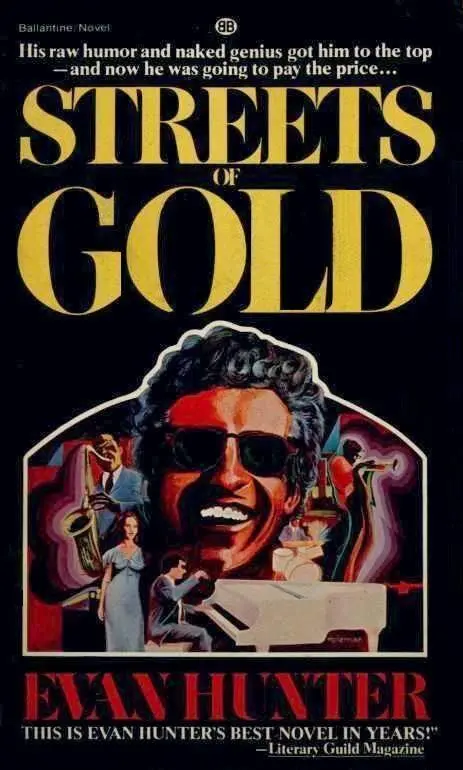
- Название:Streets of Gold
- Автор:
- Издательство:Ballantine Books
- Жанр:
- Год:1975
- Город:New York
- ISBN:978-0-345-24631-8
- Рейтинг книги:4 / 5. Голосов: 1
-
Избранное:Добавить в избранное
- Отзывы:
-
Ваша оценка:
Streets of Gold: краткое содержание, описание и аннотация
Предлагаем к чтению аннотацию, описание, краткое содержание или предисловие (зависит от того, что написал сам автор книги «Streets of Gold»). Если вы не нашли необходимую информацию о книге — напишите в комментариях, мы постараемся отыскать её.
Streets of Gold — читать онлайн бесплатно полную книгу (весь текст) целиком
Ниже представлен текст книги, разбитый по страницам. Система сохранения места последней прочитанной страницы, позволяет с удобством читать онлайн бесплатно книгу «Streets of Gold», без необходимости каждый раз заново искать на чём Вы остановились. Поставьте закладку, и сможете в любой момент перейти на страницу, на которой закончили чтение.
Интервал:
Закладка:
“Peter Pan,” I say.
“Yes,” Rebecca says, and I wonder if she is looking at me.
In the apartment we move to on Ninety-seventh and West End, Andrew has his own bedroom, and Michael shares a room with his new brother. I have started another band. We rehearse in the huge, sparsely furnished living room because we cannot afford studio space. Rebecca constantly tells me that if I’m trying to break the lease, I’m well on the way to success. She no longer believes the other success is possible. She has been married to me for almost six years, this is the fall of 1954, and we are virtually standing still except for our boundless capacity to produce big, beautiful children. She is beginning to have doubts, and so am I. What if I don’t make it? What if I am one of those who never make it? (“He’s got to make it first, you understand. Lots of guys never make it.”) This is America, and I am talented and industrious and ambitious, but even in America two bills a week don’t go very far when you’re trying to raise a family. That is what I am earning with the quintet. Two hundred dollars a week. More or less. Some weeks. Rebecca counts out the money as grudgingly as a miser, putting aside so much for rent, so much for gas and electricity, so much for food and clothing, so much for entertainment. There is not much for entertainment, but then again there is rarely time for entertainment, either. I work six nights a week (when I’m working), and because baby-sitters cost more than we can afford, and because Rebecca has learned to hate sitting around smoky toilets while I play piano, and because some of the jobs are out on the Island or over in New Jersey or, once in a blue moon, up in Schenectady or Newburgh, I rarely see Rebecca on any night of the week but Monday. During the day, I either sleep or rehearse. I am pursuing success, certain I can track and trap that hairy beast. I am American.
My family is a new family. It consists of Rebecca and the children, my parents, and Sophie and Davina. (I do not consider Davina’s recently acquired husband a part of the family; I never ask him to pour the wine.) I see my grandfather only on holidays, though I try to call him at least once a week. I beg him to move out of Harlem; he has been having trouble lately with Puerto Rican street gangs who come into the shop demanding protection money. He is seventy-four years old, and though I can remember in exact detail the courageous stand he took in 1937, I am now truly fearful for his life. He belittles my concern “ È niente,” he tells me. “Non ti preoccupare, Ignazio” The Italian words almost move me to tears. I do not know why. I have begun to learn a great many Yiddish expressions. Rebecca’s friends tell me I’m more Jewish than she is. “You’re a bigger Jew than any of us,” they say, and I take pride in this, certain it means they approve of me. They are calling me a white nigger, but I do not realize it.
In bed, in our spacious bedroom overlooking Ninety-seventh Street, in an apartment we are beginning to think we cannot afford, I sometimes wonder who is under the covers with Rebecca and me. It is surely not the two of us alone, grappling with this sweaty antagonist who yields so grudgingly. Is Tina in the closet wriggling her ass on these rumpled sheets, is Basilio in the locker room squirming against a Palumbo cock now become my own? It cannot be the two of us alone, laboring in tangled enterprise gone stale. I never know when she desires me now; she gives me not the faintest clue. I sometimes lie engorged beside her, certain she can sense my heat, yet reluctant to make an overture that will be either rebuffed or ridiculed. Where once I was the Blind Shaygets, all of me, all five feet eleven inches of me (a title I wore proudly because it defined her father’s own blind prejudice), the appellation has now been applied by Rebecca to three or four or five or seven inches of me instead — my one-eyed cock rising in blind expectation against her flesh. “Ooops, here comes the Blind Shaygets,” she says, and sometimes seizes me in both hands, and shakes me, and says in mock (I think) anger, “Don’t you ever sleep, shaygets ? What do you want to do, knock me up again?” She is terrified of having another baby. She sometimes stands before the mirror examining the stretch marks on her belly, and says (although she knows I cannot see), “Look what you did to me.” So I lie beside her waiting for a move that never comes, waiting for her to reach for me and murmur, “Do you want to make love?” Sometimes, she encircles the Blind Shaygets with her hand, and gently teases it till I am quaking with desire, and then her hand stops, and I wait. And wait. And wait. And then realize she has drifted off to sleep with a hard-on in her fist.
When we do make love, she tells me I must learn to control what is surely premature ejaculation. If I complain that Susan Koenig never seemed to find my orgasms too swift for her pleasure, she tells me Susan Koenig was a fucking sex fiend, and besides, she doesn’t want to hear about Susan Koenig or Michelle whatever-her-name-was with the big tits. So I learn to control my premature ejaculations. While pumping diligently away, Rebecca supervising the work on our construction site (“That’s it, a little faster, no , goddamnit, don’t stop what you’re doing”), I allow my mind to consider the conformation of bicycle wheels or roller skates, lemon peels or stale pizza crusts, anything to keep from spurting too soon into that lubricated vault stuffed with diaphragm and diagrams. And when at last she grudgingly releases what she has been hoarding, expiring on a single exhalation of breath, tumbling from the spire of the Chrysler Building or the top of the Brooklyn Bridge or whatever architectural wonder we have wrought together, only then do I allow myself to consider Michelle’s swollen breasts or Susan’s grinding hips or thirsting mouth, and come inside Rebecca.
“Those are very nice snapshots,” Tante Raizel says.
IV
Would you like to know how I became a big success?
By accident.
And overnight, of course. This is America, and all successes here happen overnight. Ten years of studying classical music, and eleven years of learning to play jazz — the nights are longer here, especially now that we’re on daylight-saving time all year round.
My mother still can’t believe a grown man can earn a living playing piano. If I were not blind, I’m sure she’d insist I find a good civil service job. Even being blind, I should be able to do something else, no? (Like what, Mom? Watch repairing?) Did I mention that my father collects all sorts of things? Anal, I’m sure. Coins, stamps, first-day covers, matchbooks, cigar bands, and of course clippings about his famous son, Dwight Jamison. Didn’t I mention it? Time is running out, this is the last thirty-two bars, and I have the feeling there are many things I haven’t mentioned yet. He’s a collector, Pop is. He is especially proud of his coin collection; he has left it to my youngest son David in his will. I know because my lawyer prepared the will. First let me tell you about that coin collection, and then I’ll tell you about my mother’s attitude toward piano players in general and me in particular. If I forget anything, just nudge me.
My manager, Mark Aronowitz, also collects coins. With him, it’s an investment. (Everything with Mark is an investment, which is why he doesn’t call me much anymore.) Well, in 1961, 1962, I’m not sure which, the baker decided to sell the house on 217th Street because “the neighborhood was changing.” This meant the neighborhood was becoming black. My parents found a new apartment on the Grand Concourse. Ironically, they chose this location because it was close to where Sophie and Abe were living. By that time, they had become fast friends with the Baumgartens, played poker with them every Sunday night, became members of their Family Circle, went to Broadway musicals and kosher restaurants with them, the whole megillah. Anyway, my mother insisted that my father clear out all that junk on the sun porch before they moved. She was referring to his collection of coins, stamps, matchbooks, and so on. I suggested to my father that if he was thinking of selling the coins, my manager might be happy to take them off his hands. “Well, I don’t know if he can afford them,” my father said. “They’re worth a fortune.” (Are you ahead of me? You can never anticipate me at the piano because while you’re listening to Bar 10, I’m already working on Bar 11 in my head — but this ain’t a piano, ma’am.) My father lugged his precious coins down to Broadway and Forty-seventh, and Mark looked them over and called me that very afternoon. “Ike,” he said, “what am I supposed to tell your father? The stuff is worth face value; there isn’t a rare or even slightly hard-to-find coin in the lot.” I handled it by telling my father a lie. I told him he was right, Mark simply couldn’t afford the collection, he’d probably do better taking it to a dealer. My father never took it to a dealer. “The hell with it,” he said, “I’ll leave it to the kids.” So when he dies, David will inherit from him something worth maybe five hundred dollars, if that much. It’s the thought that counts.
Читать дальшеИнтервал:
Закладка:
Похожие книги на «Streets of Gold»
Представляем Вашему вниманию похожие книги на «Streets of Gold» списком для выбора. Мы отобрали схожую по названию и смыслу литературу в надежде предоставить читателям больше вариантов отыскать новые, интересные, ещё непрочитанные произведения.

Обсуждение, отзывы о книге «Streets of Gold» и просто собственные мнения читателей. Оставьте ваши комментарии, напишите, что Вы думаете о произведении, его смысле или главных героях. Укажите что конкретно понравилось, а что нет, и почему Вы так считаете.