Evan Hunter - Streets of Gold
Здесь есть возможность читать онлайн «Evan Hunter - Streets of Gold» весь текст электронной книги совершенно бесплатно (целиком полную версию без сокращений). В некоторых случаях можно слушать аудио, скачать через торрент в формате fb2 и присутствует краткое содержание. Город: New York, Год выпуска: 1975, ISBN: 1975, Издательство: Ballantine Books, Жанр: Современная проза, на английском языке. Описание произведения, (предисловие) а так же отзывы посетителей доступны на портале библиотеки ЛибКат.
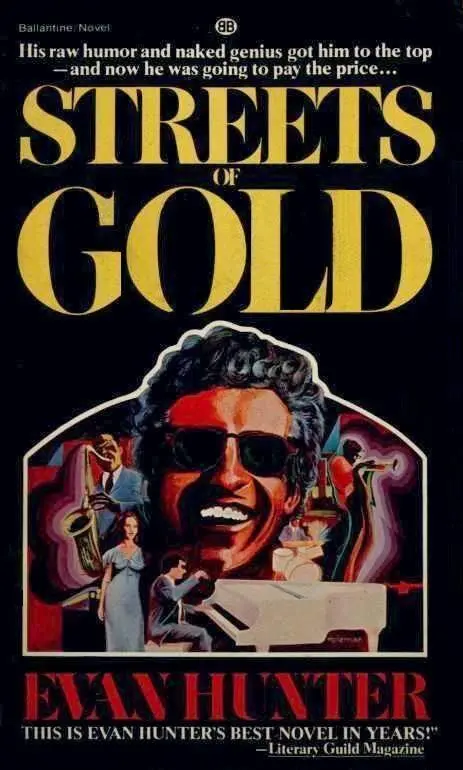
- Название:Streets of Gold
- Автор:
- Издательство:Ballantine Books
- Жанр:
- Год:1975
- Город:New York
- ISBN:978-0-345-24631-8
- Рейтинг книги:4 / 5. Голосов: 1
-
Избранное:Добавить в избранное
- Отзывы:
-
Ваша оценка:
Streets of Gold: краткое содержание, описание и аннотация
Предлагаем к чтению аннотацию, описание, краткое содержание или предисловие (зависит от того, что написал сам автор книги «Streets of Gold»). Если вы не нашли необходимую информацию о книге — напишите в комментариях, мы постараемся отыскать её.
Streets of Gold — читать онлайн бесплатно полную книгу (весь текст) целиком
Ниже представлен текст книги, разбитый по страницам. Система сохранения места последней прочитанной страницы, позволяет с удобством читать онлайн бесплатно книгу «Streets of Gold», без необходимости каждый раз заново искать на чём Вы остановились. Поставьте закладку, и сможете в любой момент перейти на страницу, на которой закончили чтение.
Интервал:
Закладка:
I told him how kind you were, and how generous, how sometimes we’d be walking along together and a panhandler would approach, and you’d catch your breath and stop in the middle of the sidewalk as though someone had suddenly slapped you, and I would hear you opening your pocketbook, and after you gave the man a coin, you would say to me, “We’re so lucky, Ike,” even though I was blind. My blindness never mattered to you. I told him how concerned you were about all the people of the world, Rebecca, not just the ones in your own family, and not just your close friends (I told him about your unswerving loyalty to Shirley Ackerman, too), but also people in faraway lands you’d never seen. I told him about the argument we’d had the time I was reminiscing about my boyhood and mentioned that my mother was always telling me to eat what was on my plate because the people in China were starving, and I admitted I didn’t care if the people in China were starving and you hit the ceiling, Rebecca, and wanted to know how I , of all people, could be so cruel and callous to those less fortunate. (“Well, Ignazio,” my grandfather said, “it isn’t funny, the people in China starving.”) I told him you’d call me sometimes late at night and read poetry to me on the telephone, I told him you’d taken me to the Museum of Modern Art and described your favorite paintings in meticulous detail, I told him you’d begun advising me on how to dress, I told him you played piano very badly (by your own admission, Becks), but that you’d always wanted to marry someone creative, and that you’d said marrying me would be the most important event in your life. I told him how much I loved you, Rebecca. I told him all the things there were to love about you, and they were myriad.
And then I told him you were Jewish.
And I said to him, I said, “Grandpa, that’s important too.” And I explained what it meant to me to be in love with a Jewish girl, and to want to marry a Jewish girl, and I explained what it meant to you, my being Italian, and I told him we had talked about it in great detail, and that none of it mattered to us. “She’s not religious,” I said, “and I’m not religious, either, Grandpa. Please don’t be hurt by that, but honest, I haven’t been anywhere near a church for five years now. We love each other, and that’s all that matters.”
I put it to him that simply, but it was much more complicated.
We were, Rebecca and I, the realization of the American myth, which both of us had been living for as long as we could remember. And in that myth the melting pot existed only so that fresh new alloys could be poured from its crucible. If I was copper, then Rebecca was zinc, and together we would create a brass band that marched noisily down the middle of Fifth Avenue playing “America the Beautiful.” Her father’s objections to our relationship seemed absurd, reactionary, and frankly unpatriotic. We met in secret, we made love in secret, we formulated our plans for getting married in secret, and secretly and privately and proudly, we each glowed with the knowledge that we were fulfilling our separate destinies and moving in the only direction possible for anyone who considered himself American.
We were wrong, Rebecca darling.
But we were both so young.
We had planned the wedding for months, inviting only my parents and grandparents, Rebecca’s mother and sister, and some close friends like Stu Holman, Cappy Kaplan, and Shirley Ackerman. Rebecca’s mother declined the invitation for Davina and herself, not because she objected to the marriage (she liked me very much, in fact, and gave us two thousand dollars of her personal savings as a wedding gift), but only because she had to live with Honest Abe for the rest of her life, and knew her attendance at our wedding would be considered rank betrayal. On November 17, 1948, two days before Rebecca and I were to be married, my grandfather went to visit Honest Abe at his Oldsmobile agency in the Bronx — and was somewhat baffled by the reception he received. Nor was Honest Abe any less baffled (or at least he seemed to be) by the old man’s appearance at his palais d’auto .
The first inkling we had of my grandfather’s visit came from Honest Abe himself. At the Baumgarten dinner table that Wednesday night, on one of his rare personal appearances with the family (being otherwise and usually occupied with his euphemistic poker games), Abe told the story of the mysterious appearance of an old guinea dressed in black and smoking a foul-smelling cigar. “I never turn any of them away,” he said. “ Shvartzers , wops, Irishers, they’re all the same to me. If they got money to buy the car, I’ll sell it to them. So when he walks in the showroom, I personally go up to him and I say, ‘Good afternoon, sir, may I help you?’ and he sticks out his hand and grins, and says, ‘Frank Di Lorenzo,’ in an accent you can cut with a butcher knife. Do you know anybody named Frank Di Lorenzo, Becky?”
“No, Daddy,” Rebecca said, while her mother and sister busied themselves with the pot roast on their plates.
“You’re not still seeing that blind shaygets , are you?” her father asked.
“Oh, no, Daddy,” Rebecca said. She had been seeing me for the past two and a half years, and after Friday she would be seeing me for the rest of her life — or so we both thought at the time.
“He said he came up to the Bronx to tell me how happy he was.”
“Who?” Rebecca asked.
“This old wop, this Di Lorenzo with the cigar clamped in his mouth.”
“Well,” Rebecca said, very carefully spearing some sliced carrots and boiled potatoes with her fork, “it’s very possible that a happy Italian came into your showroom, but that doesn’t mean I know him.”
“What was that goy’s name that time?” Abe asked.
“Ike, do you mean? Ike Di Palermo.”
“Um, well this was Di Lorenzo . At least, I think that’s what he said; I could hardly understand him. You get these people, they’re here in America for sixty years, they still don’t know how to talk right.”
“Like Grandpa,” Rebecca said, trying to change the subject.
“Grandpa talks fine,” Abe said. “I understand him fine. Anyway, this old wop is slapping me on the back and grinning from ear to ear and telling me he’ll see me Friday, and I have to come to his house sometime, maybe for his name day... I think he said his name day; what the hell’s a name day? I figured I had myself a prime bedbug right there in the showroom, telling me what a fine man I am, and how happy he is to meet me, a nut plain and simple. You know what I think?”
“No, Daddy, what do you think?” Rebecca asked, and held her breath.
Abe thought about what he thought. Then he said, “I’ll bet that shaygets ... what was his name?”
“Ike Di Palermo.”
“Yeah. I’ll bet he’s going around telling people he’s still dating you.”
“Why would he do that, Daddy?”
“Why not? A blind piano player? Nothing he’d like better than to have people thinking he’s dating a Jewish girl.”
“What’s so special about Jewish girls?” Davina asked.
“You’re both my special darlings,” Abe said, and smiled at his two darling daughters, but patted only Davina’s hand.
“Well, whatever Ike does is his own business,” Rebecca said. “I haven’t seen him since that day he came up here, and I couldn’t care less what he’s telling people.”
“That’s a good girl,” Abe said. “But still, I’ll bet that’s it.”
“So what did you say to him?”
“Who, the wop? Nothing.”
“I mean... how did you leave it?”
Читать дальшеИнтервал:
Закладка:
Похожие книги на «Streets of Gold»
Представляем Вашему вниманию похожие книги на «Streets of Gold» списком для выбора. Мы отобрали схожую по названию и смыслу литературу в надежде предоставить читателям больше вариантов отыскать новые, интересные, ещё непрочитанные произведения.
Обсуждение, отзывы о книге «Streets of Gold» и просто собственные мнения читателей. Оставьте ваши комментарии, напишите, что Вы думаете о произведении, его смысле или главных героях. Укажите что конкретно понравилось, а что нет, и почему Вы так считаете.