Evan Hunter - Streets of Gold
Здесь есть возможность читать онлайн «Evan Hunter - Streets of Gold» весь текст электронной книги совершенно бесплатно (целиком полную версию без сокращений). В некоторых случаях можно слушать аудио, скачать через торрент в формате fb2 и присутствует краткое содержание. Город: New York, Год выпуска: 1975, ISBN: 1975, Издательство: Ballantine Books, Жанр: Современная проза, на английском языке. Описание произведения, (предисловие) а так же отзывы посетителей доступны на портале библиотеки ЛибКат.
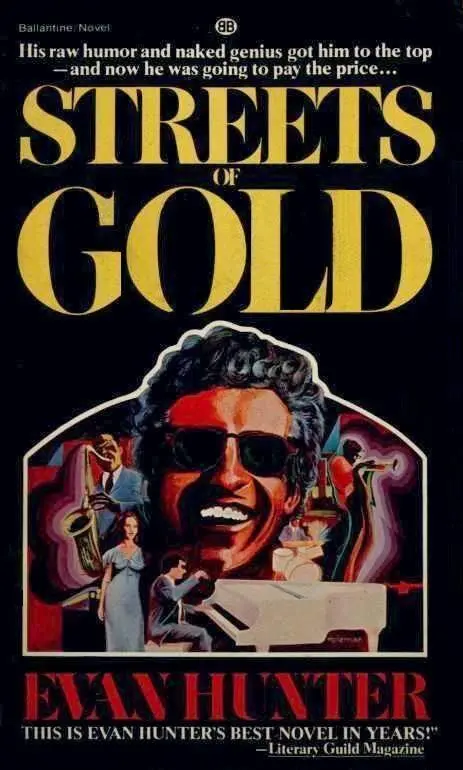
- Название:Streets of Gold
- Автор:
- Издательство:Ballantine Books
- Жанр:
- Год:1975
- Город:New York
- ISBN:978-0-345-24631-8
- Рейтинг книги:4 / 5. Голосов: 1
-
Избранное:Добавить в избранное
- Отзывы:
-
Ваша оценка:
Streets of Gold: краткое содержание, описание и аннотация
Предлагаем к чтению аннотацию, описание, краткое содержание или предисловие (зависит от того, что написал сам автор книги «Streets of Gold»). Если вы не нашли необходимую информацию о книге — напишите в комментариях, мы постараемся отыскать её.
Streets of Gold — читать онлайн бесплатно полную книгу (весь текст) целиком
Ниже представлен текст книги, разбитый по страницам. Система сохранения места последней прочитанной страницы, позволяет с удобством читать онлайн бесплатно книгу «Streets of Gold», без необходимости каждый раз заново искать на чём Вы остановились. Поставьте закладку, и сможете в любой момент перейти на страницу, на которой закончили чтение.
Интервал:
Закладка:
She does not finish the book, it is much too difficult for her, but she has gathered from it precious ammunition to use against her sister.
“I’m in a book,” she tells her.
“So am I,” Davina says.
“You are not!” Rebecca says.
“I am so .”
“Where? What book?”
“In a book Mommy has in her room. It’s Davina’s Baby Book, and it tells all about me. How much I weighed and things I said when I was little, and everything about me.”
Rebecca does not have a baby book. She takes Ivanhoe back to the library and tells the librarian it was lousy. In 1939, when she is eleven years old and enters junior high school, she is jubilant because it means she can escape little Shirley Temple for at least the length of the school day. In the seventh grade, there is a big fat girl named Rosalie, who becomes fast friends with Rebecca — perhaps because Rebecca is the only one in the class who doesn’t call her Fat Stuff, after one of the cartoon characters in Smilin’ Jack . One day, when Rebecca is telling Rosalie about what a pain her little sister is, Rosalie says, “Why don’t you just kill her?”
“Always singing and tap-dancing,” Rebecca says.
“Yeah, kill her,” Rosalie says. “Drown her in the bathtub.”
“You could go to jail for that,” Rebecca says.
“No, they don’t send little girls to jail,” Rosalie assures her.
Rebecca considers the idea. She and Rosalie talk about it often and seriously, concocting new methods of murder each time, some of them quite bizarre. Sitting on the front stoop of their tenement, picking their noses, they talk about hanging little Davina, or poisoning her (Yeah, but where would we get the poison? The man in the drugstore would remember us), or throwing her off the roof, or — and this causes both of them to burst into hysterical laughter — holding her head in the toilet bowl. Sophie Baumgarten heartily disapproves of the relationship with Rosalie, even though she knows nothing of these dire plans for murdering her regular Shirley Temple. She disapproves of Rosalie only because she is fat.
“Fat,” she says, “disgusting,” she says, and spits on the extended forefinger and middle finger of her right hand. “Ptoo, ptoo!”
“What’s wrong with fat?” Rebecca says. “And anyway, she isn’t fat.”
“She’s fat as a horse,” Sophie says.
“Well,” Rebecca says, “she’s my friend.”
“Some friend.”
“She’s my best friend.”
“Better you should find yourself a Goodyear blimp,” Sophie says.
In school, whenever the friends are together, the other kids begin to chant, “Fat and Skinny had a race/All around the pillowcase/Fat fell down and broke his face/Skinny won the race.”
“Yaaaaaah,” Rebecca says, and sticks out her tongue.
In the fall, when her father buys the Oldsmobile agency, they move to the Bronx. She misses Rosalie dreadfully, and at her new school she is very wary of making friends. Around the house, she is quiet and unresponsive. She reads now more than she did in Manhattan. Sometimes she memorizes long passages from the encyclopedia. Her mother tells her she must take piano lessons. She begins these when she is thirteen. She hates the piano, and she plays badly. Once, in the kitchen of their apartment, her father’s friend Seymour asks, “How old is she now, Abe?” and her father looks at her as though discovering her for the first time, and is silent for a moment, and then says, “Gee, I don’t know. How old are you, Becky? Eleven? Twelve?” He knows exactly how old Davina is. Davina is nine years, two months, and seven days old. She was born on July 12, 1932. Her father knows the date by heart. “Sunshine was born that day,” he says, smiling. “My little sunshine. Sing ‘My Little Sunshine’ for me, baby.” Davina no longer sings “On the Good Ship Lollipop,” thank God. Nor, at the age of nine, does she any longer sport those Shirley Temple curls Rebecca once found so distasteful. Instead, she combs her hair the way Veronica Lake does, hanging over one eye. Rebecca thinks her sister is too young to be imitating a sex-pot movie star, and she tells this to her mother. Her mother says, “Look who’s talking.”
Whenever a Veronica Lake movie is playing at the Tuxedo on Jerome Avenue, Rebecca stays away from it. But she goes to the movies every Saturday, and sometimes on Wednesday nights with her mother. Except for Veronica Lake, she loves the movies. She loves the way people meet in the movies. At the movies, she learns to identify all the families of the various studios; just name the studio and she will reel off the names of the contract players. She tries this phenomenal feat of memory on her father one night. She tells him that MGM, that’s Leo the Lion, has the biggest family in the bunch, with grandpas like Lionel Barrymore and Lewis Stone and C. Aubrey Smith and Guy Kibbee and Charles Winninger; and grandmas like Edna May Oliver and Fay Bainter and Marjorie Main; mothers and fathers like Greer Garson and Spencer Tracy and Margaret Sullavan and Herbert Marshall; uncles like William Powell and Robert Taylor and Franchot Tone; aunts like Joan Crawford and Laraine Day and Hedy Lamarr; cousins like Mickey Rooney and Judy Garland and Freddie Bartholomew, and landsleit from Far Rockaway, like Ruth Hussey, Nelson Eddy, Gladys George, Ann Sothern, and George Murphy.
The Warner Brothers family (she tells her father) is Humphrey Bogart, George Brent, Bette Davis, Olivia De Havilland, Errol Flynn, Ann Sheridan, Edward G. Robinson, Pat O’Brien, Donald Crisp, Priscilla Lane, Ida Lupino, James Cagney, and Ronald Reagan, whom she adores. And then there’s the Twentieth Century-Fox family with Alice Faye and Don Ameche and Linda Darnell and Tyrone Power and Henry Fonda and Cesar Romero and Warner Baxter and Sonja Henie and Shirley Temple (she passes over this name very quickly). The Paramount family is Betty Grable and Gary Cooper and Dorothy Lamour and Fred MacMurray and Claudette Colbert and Bob Hope and Bing Crosby on the road to everywhere, and sometimes people from the Columbia family or the Republic family pop up in a picture with one of the other studio families, and then it’s like one big family, Daddy, it’s really terrific, Daddy, she says, and grins at him.
“Daddy?” she says.
He does not answer.
“Daddy?”
Her father is asleep in his chair.
“Well,” she says, and goes to her room.
She is not permitted to date until she is seventeen years old, not that any boys are banging down the door. It is Davina, at thirteen, who is the undisputed beauty of the family, with cupcake breasts almost as large as Rebecca’s own, and wide hips, and a smile Rebecca considers suggestive. Whenever a boy comes to the house to pick up Rebecca, her sister magically appears in the living room, and extends her hand, and says in a low and studied voice (she is now imitating Lizabeth Scott), “Nice to meet you.” The boys invariably ask Rebecca how old her sister is. When she says “Thirteen,” they seem disappointed. It is only when she begins going steady with Marvin Feldman that she feels free enough to ask, “Do you think I’m prettier than Davina?”
“Yes,” he says.
“Do you think I have a big nose?”
“No,” he says.
“I sometimes think I ought to get my nose fixed.”
“What for?” he says. “It’s an okay nose,” and he kisses the tip of it.
From the bedroom, Sophie Baumgarten calls, “Rebecca?”
“Yes, Mama,” Rebecca says. She knows what is coming next.
“What time is it, Rebecca?” Sophie asks.
“A little past one, Mama.”
“Already?” Sophie says.
In December of 1945, just before Chanukah, her grandfather Itzik dies. The last word he utters is “Rivke.” Though Rebecca knows this was also her grandmother’s name, she chooses to believe the old man’s dying breath was drawn for her alone. They bury him on a bleak gray afternoon, and that night Rebecca walks over to the small park near their apartment. Snow is on the ground. She sits on one of the benches with her hands in her coat pockets. The park is empty. She sits alone on the bench until she is shivering from the cold. Then, slowly, she walks back to the apartment.
Читать дальшеИнтервал:
Закладка:
Похожие книги на «Streets of Gold»
Представляем Вашему вниманию похожие книги на «Streets of Gold» списком для выбора. Мы отобрали схожую по названию и смыслу литературу в надежде предоставить читателям больше вариантов отыскать новые, интересные, ещё непрочитанные произведения.

Обсуждение, отзывы о книге «Streets of Gold» и просто собственные мнения читателей. Оставьте ваши комментарии, напишите, что Вы думаете о произведении, его смысле или главных героях. Укажите что конкретно понравилось, а что нет, и почему Вы так считаете.