Evan Hunter - Streets of Gold
Здесь есть возможность читать онлайн «Evan Hunter - Streets of Gold» весь текст электронной книги совершенно бесплатно (целиком полную версию без сокращений). В некоторых случаях можно слушать аудио, скачать через торрент в формате fb2 и присутствует краткое содержание. Город: New York, Год выпуска: 1975, ISBN: 1975, Издательство: Ballantine Books, Жанр: Современная проза, на английском языке. Описание произведения, (предисловие) а так же отзывы посетителей доступны на портале библиотеки ЛибКат.
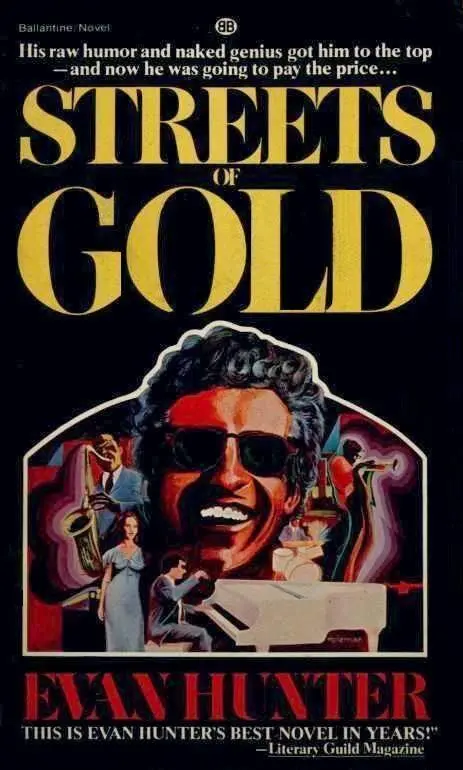
- Название:Streets of Gold
- Автор:
- Издательство:Ballantine Books
- Жанр:
- Год:1975
- Город:New York
- ISBN:978-0-345-24631-8
- Рейтинг книги:4 / 5. Голосов: 1
-
Избранное:Добавить в избранное
- Отзывы:
-
Ваша оценка:
Streets of Gold: краткое содержание, описание и аннотация
Предлагаем к чтению аннотацию, описание, краткое содержание или предисловие (зависит от того, что написал сам автор книги «Streets of Gold»). Если вы не нашли необходимую информацию о книге — напишите в комментариях, мы постараемся отыскать её.
Streets of Gold — читать онлайн бесплатно полную книгу (весь текст) целиком
Ниже представлен текст книги, разбитый по страницам. Система сохранения места последней прочитанной страницы, позволяет с удобством читать онлайн бесплатно книгу «Streets of Gold», без необходимости каждый раз заново искать на чём Вы остановились. Поставьте закладку, и сможете в любой момент перейти на страницу, на которой закончили чтение.
Интервал:
Закладка:
Davina is listening to the radio.
“Hi,” she says.
Rebecca does not answer. In the hallway, she takes off her coat and her muffler, and hangs them in the closet.
“Where were you?” Davina asks.
“In the park.”
“Doing what?”
“Sitting.”
“That was something, huh? The funeral?”
On the radio, they are advertising gasoline. Davina sits in the big easy chair that is their father’s whenever he is home, her shapely legs tucked under her, her loafers on the floor, and she tells Rebecca what she thought of the funeral, how it was despicable of a rabbi who didn’t even know Grandpa Itzik to go on and on about him as if they were bosom buddies, and Tante Raizel wailing like a banshee when they lowered the coffin into the earth, Davina had never seen anything so horrible in her life. But her voice trails when the commercial ends and the comic comes on again. He tells a joke, and Davina bursts out laughing.
In her room, Rebecca takes off her clothes and gets into bed. She feels very much alone. Except for Marvin, she feels she is now alone in the world. There is only Marvin now to tell her that her nose is an okay nose. (“What is that , a nose job?” her grandfather had said. “There’s nothing wrong with your nose. That’s your grandmother Rivke’s nose. That’s a beautiful nose.”) It is not such a beautiful nose, she thinks. Grandpa, it really is not such a beautiful nose, Grandpa, I love you, Grandpa. Thank you, Grandpa. Thank you, Grandpa. I love you, Grandpa. She cries herself to sleep that night, and dreams that Marvin is making love to her. She screams in the dream, she tries to scream but no sound comes from her mouth. Stop, Marvin, she tries to scream, but Marvin will not, please, she screams, she tries to scream, Marvin, please, no, please, no, you promised! — and. she sits up straight in bed, her green eyes wide, breathing heavily as she stares into the blackness of the room.
“You promised,” she whispers, but she has already forgotten the dream.
In April, Marvin takes her for a walk in the park and tells her he’s met a singer, and tells her he is going to marry the singer, and tells her he is sorry. Jonquils are blooming everywhere around them, the small grassy slopes are running wild with jonquils.
“That’s okay, Marvin,” Rebecca tells him. “Really, it’s okay.”
It is Marvin who bursts into tears.
I loved you, Rebecca.
I loved everything about you.
I knew you were beautiful because Cappy Kaplan, my drummer, described you to me in detail, not that I needed any physical description. “She’s a very zaftig person,” Cappy said, “about five-six or seven, I can’t say for sure, and very nicely stacked, as if you didn’t know. Not melons or cantaloupes, Ike, just very nice, well, grapefruits, I would say, very nice. And wide hips, she’s very curvy, she looks like a peasant from the old country, you know, with the wide hips for childbearing. Her hair ain’t red exactly, it’s sort of rust-colored, I guess you’d call it, though maybe she gives it a little help. Her nose is nothing to write home about, a Jewish nose, it’s my cousin Carol’s nose exactly. Her mouth is okay, lips a little thin maybe, but she’s got good teeth. I’m sure she brushes them regular. She dresses good, too. I got to tell you the truth, Ike: standing next to her, you look like a slob.”
That was Cappy’s description of Rebecca Baumgarten.
My grandfather said, after their first meeting, “Ha sembrato una settentrionale,” meaning he thought she looked like a northern Italian. Years later, in Rome, the city of redheads, Rebecca was always being mistaken for Italian. And, of course, being pinched on the ass by Italian men. That is not a myth. Even Rebecca’s green death ray could not dissuade those hot-blooded Mediterraneans from trying to cop a feel. La mano morta is not a branch of the Mafia, even though it translates literally as “the dead hand.” The expression describes a hand hanging limply at the end of a male Italian wrist, seemingly deceased, most certainly detached from its owner, who claims no responsibility for whatever it might be doing while he stands on a comer reading his copy of the morning paper. What the hand is doing is simply none of his business. If a woman recoils from la mano morta with a small surprised gasp, the man to whom the dead hand is attached will look at her ( and it) in surprise equal to the woman’s own. La mano morta. “Fucking sex fiends is what they are,” Rebecca said whenever we were in Rome. She also said that in London.
It was Rebecca’s guess that her father the Mad Oldsmobile Dealer was approximately as religious as my mother, and objected to me only because I was blind. I did not believe this for a minute. Not once had he expressed any concern about how a blind man might support his daughter, or protect her from harm, or keep her happy and secure. I flatly told Rebecca she was wrong. If I’d been a blind Jew , Abe would have welcomed me into the family, perhaps not without qualms and doubts, but certainly without enmity. “Well, then,” Rebecca said, “he must be doing it for Baumgarten Frocks.”
“Baumgarten Frocks” was Abe’s father, a dyspeptic old cloakie who lived in the back room of their Mosholu Parkway apartment, and made ugly noises in the bathroom each morning. Rebecca hated him as much as she had loved old Itzik. His real name was Moishe Baumgarten, but Rebecca alternately called him Baumgarten Frocks and Moishe Pipik. When she and I first started getting serious about each other, she sounded Moishe on the remote possibility of marrying an Italian musician. The sly old fox knew all about me by then, of course, had in fact received gleeful reports from Honest Abe on the demolition of the blind goy in his kitchen that hot August afternoon. He listened to Rebecca and then began nodding his head in his best daven ing manner, and, as though he were reciting the shachris , the minchah , and the mairev (not to mention the Nina , the Pinta , and the Santa Maria ), said to his granddaughter, “Ahhh, Rivke, Rivke, how can you even con sid eh such a peth for yourself? Ah pianeh playeh? Ah shaygets ? Rivke, Rivke,” wagging that fine old prejudice-riddled head, “you could merry vun day ah doctuh,” he said, “ah lawyeh,” he said, and leaving the finest profession of all for last, triumphantly concluded, “ah biz nessmen!” When Rebecca told me this story, I told her old Baumgarten Frocks could go frock himself.
That’s the way we felt about all of them, in fact.
I think if my own grandfather had raised the slightest objection to my marrying Rebecca, I’d have kissed him off, too. I mean that. I loved you, Rebecca, and it had nothing to do with descriptions of you. I knew you were beautiful long before anyone told me. Anyway, you’d told me so yourself, hadn’t you? “I’m gorgeous,” you said, “what do you think?” You were gorgeous, Rebecca. I loved everything about you. It’s too easy now to remember only the bad times, of which there were many. But there were good times, too — at least as many, and perhaps more — and I loved you thoroughly and completely for more years than I care to count.
How did I love thee, Becks? Let me count the ways.
I had told my grandfather all about you long before I took you to the tailor shop to meet him. I was taking no chances. I enumerated for him all the things I am about to enumerate now, all the reasons for loving you, and he listened patiently, and sometimes made pleased little sounds, encouraging me to go on. I told him first that you were beautiful, and then I told him you were the smartest person I’d ever met, that you could read through a book in an hour, sometimes two, but never longer than that, and retain what you had read, and reel off to me long passages you had memorized from just that single reading. I told him you knew impossibly ridiculous things, facts no one was expected to know, and which you probably wouldn’t have known if it weren’t for a memory that was almost photographic. I told him you could recite statistics on the area and population of Chile, for example, or list in order all the rulers of France since Pepin the Short; I told him you knew what to call the male, female, and baby animals in any of the animal families — as for instance, a drake, a duck, and a duckling; or a ram, a ewe, and a lamb; or, more exotically, a cob, a pen, and a cygnet. I told him you could, for God’s sake, name the methods of execution in every state of the Union — lethal gas in Arizona, hanging in Montana, electrocution in South Dakota, and so on. I told him (I had not yet told him you were Jewish) that you could even name all the popes in order, starting with Saint Peter and coming all the way up to Pius XII, who was the then-reigning pontiff. I was amazed by your knowledge, I told him, and I bet him that when you finally met, you’d be able to tell him the average yearly rainfall in every province of Italy. (“Even Potenza?” he asked, undoubtedly impressed.)
Читать дальшеИнтервал:
Закладка:
Похожие книги на «Streets of Gold»
Представляем Вашему вниманию похожие книги на «Streets of Gold» списком для выбора. Мы отобрали схожую по названию и смыслу литературу в надежде предоставить читателям больше вариантов отыскать новые, интересные, ещё непрочитанные произведения.
Обсуждение, отзывы о книге «Streets of Gold» и просто собственные мнения читателей. Оставьте ваши комментарии, напишите, что Вы думаете о произведении, его смысле или главных героях. Укажите что конкретно понравилось, а что нет, и почему Вы так считаете.