Evan Hunter - Streets of Gold
Здесь есть возможность читать онлайн «Evan Hunter - Streets of Gold» весь текст электронной книги совершенно бесплатно (целиком полную версию без сокращений). В некоторых случаях можно слушать аудио, скачать через торрент в формате fb2 и присутствует краткое содержание. Город: New York, Год выпуска: 1975, ISBN: 1975, Издательство: Ballantine Books, Жанр: Современная проза, на английском языке. Описание произведения, (предисловие) а так же отзывы посетителей доступны на портале библиотеки ЛибКат.
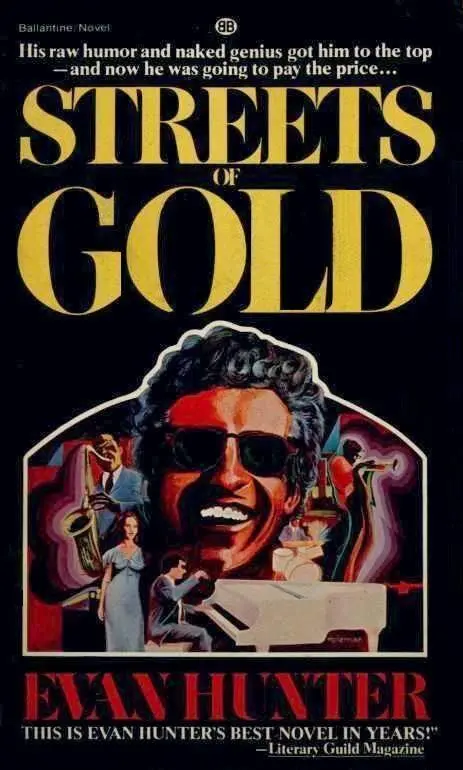
- Название:Streets of Gold
- Автор:
- Издательство:Ballantine Books
- Жанр:
- Год:1975
- Город:New York
- ISBN:978-0-345-24631-8
- Рейтинг книги:4 / 5. Голосов: 1
-
Избранное:Добавить в избранное
- Отзывы:
-
Ваша оценка:
Streets of Gold: краткое содержание, описание и аннотация
Предлагаем к чтению аннотацию, описание, краткое содержание или предисловие (зависит от того, что написал сам автор книги «Streets of Gold»). Если вы не нашли необходимую информацию о книге — напишите в комментариях, мы постараемся отыскать её.
Streets of Gold — читать онлайн бесплатно полную книгу (весь текст) целиком
Ниже представлен текст книги, разбитый по страницам. Система сохранения места последней прочитанной страницы, позволяет с удобством читать онлайн бесплатно книгу «Streets of Gold», без необходимости каждый раз заново искать на чём Вы остановились. Поставьте закладку, и сможете в любой момент перейти на страницу, на которой закончили чтение.
Интервал:
Закладка:
“Leave what? He said he’d be seeing me Friday, so Friday I’ll look for him. Who knows? He’ll maybe end up buying a car.”
Immediately after dinner, Rebecca ran downstairs to the candy store, and phoned me. I listened breathlessly, and then called my grandfather in an effort to determine exactly how much he had told the Mad Oldsmobile Dealer.
In his broken English, my grandfather said:
“I go in the store, he come up, I know he’s the fath, I see in the eyes, the face, the look. I say, ‘How you do, I’ma Frank Di Lorenzo.’ He saysa, ‘How you do?’ I looka him, he looka me. I tell him, ‘I’m Ignazio’s granfath,’ and he says, ‘Attsa nize.’ I tell him I come to meet him so he no be stranger the wedding, so he feelsa home, eh? He saysa, ‘What wedding?’ I tell him Friday, the wedding, whattsa matta he forgets the wedding? He saysa, ‘You wanna buy car, or what?’ I say to him, ‘What car? I’ma talk about how happ I am to marry with you daughter my granson.’ He saysa, ‘You craze.’ I say, ‘Hey, you , I’ma Frank Di Lorenzo, capisce ? It’sa my grandson who’sa marry you daught, whattsa matta you? I’ma come alia way the Bronx to say hello, I make a mistake? You no Abe-a Baumgart?’ He saysa, ‘I’m Abe-a Baumgart, you wanna buy a car, or no?’ Ma , Ignazio, ho veramente creduto ch’era pazzo! I try one more time. I say, ‘Look, you gotta nize daught, I gotta nize granson, we be nize-a v family, you come have supper, you come my name day, I buy pasticcerie , we drinka wine, it’sa nize, okay?’ He says, ‘I get somebody to heppa you.’ An he goes away, he leaves me standa there like a dope. What I do, Ignazio? I do someting wrong?”
As planned, we were married on the nineteenth of November. All through the brief civil ceremony, I expected Abe to come barging in with a minyan of Jewish hoods, all of them standing six feet four inches tall and weighing 220 pounds, as did my imminent father-in-law. Calling upon Jewish tradition, they would place my head upon the floor, and then all ten of them would smash it under a tented napkin. Not even Uncle Matt would be able to save me. But nobody arrived to interrupt the wedding. Afterward, we herded the small group of somewhat cheerless celebrants to a restaurant in Mount Vernon, where Rebecca and I were wined and dined and toasted (three times by my grandfather alone!). We then took a taxi to Pennsylvania Station, where we sent off a telegram and boarded the train to Mount Pocono. At fifteen minutes past midnight, we found ourselves in a deserted, milk-stop railroad station that had no lights and a single phone booth with a broken door. I located the booth in the familiar dark, and Rebecca struck a match (and then another) and dialed the telephone number on the advertising brochure, and handed the phone to me. I told the owner of the lodge we were Mr. and Mrs. Di Palermo (How strange that sounded! Mr. and Mrs. Di Palermo were my parents!) and we were here, but there weren’t any taxis, and could he please send a car for us?
Lying in bed together, we tried again to understand her father’s reaction to what had happened that afternoon two days before. Was it possible he really hadn’t understood what was being said to him? My grandfather’s English was atrocious, true, but he generally managed to make himself at least comprehensible. Could Honest Abe honestly have missed the purpose of the visit? Had he really not understood that a wedding was to take place on Friday afternoon, and that the principals to be united in matrimony were none other than a Blind Shaygets and a Jewish Princess from Mosholu Parkway? We reached the conclusion that Abe had understood perfectly and had decided to look the other way. He must have realized there was nothing he could do to stop the wedding, short of breaking both his daughter’s legs and sending her to Paris, France, in plaster casts. She had been seeing me against his explicit wishes for more than two years, and it was too late now. He could either pretend he knew nothing about any of it, or else take a futile last stand that would accomplish nothing anyway. And so he’d professed ignorance and innocence; whatever his daughter chose to do was on her own head. The telegram we’d sent, addressed to Mr. and Mrs. Baumgarten, to circumvent any later recriminations hurled at poor, bewildered Sophie, read:
DEAR MOTHER AND DADDY .
WE WERE MARRIED TODAY AT 3 P.M. WE ARE
SORRY YOU CAN’T SEE THIS OUR WAY, BUT WE
HOPE IN TIME TO HAVE YOUR BLESSINGS. ALL
OUR LOVE.
REBECCA AND IKEIt is a Saturday afternoon in 1955. Sophie has brought her sister to visit us in our apartment on Ninety-seventh and West End Avenue. Sophie visits often; she has an arrangement with Honest Abe. His eldest daughter is dead, he has turned her pictures to the wall — but his wife may visit the grave whenever she chooses. Today she has brought Tante Raizel to meet the blind shaygets , and Rebecca is showing snapshots I cannot see.
My own snapshots are up here, in my head.
September of 1950. A sleazy nightclub in Jersey City. We have been married for almost two years. Rebecca tells a joke to my drummer. “A six-year-old boy is banging pots and pans in the kitchen,” she says, “and a five-year-old girl comes in and asks him what he’s doing. He answers, ‘Shhh, can’t you see? I’m a drummer.’ The little girl grabs him by the hand, and drags him into the bedroom, and tosses up her skirts, and pulls down her panties, and says, ‘If you’re a drummer, kiss me on the wee-wee.’ And the little boys says, ‘Oh, I’m not a real drummer.’ ” My real drummer does not find the joke comical. I suddenly wonder whether Rebecca told it only to annoy him. I am beginning to feel she purposely says the wrong things to my musicians. She does not enjoy nightclubs anymore; it is not the way it was before we got married, when each new gig was a circus. Our son will be a year old at the end of the month. He was conceived in December of 1948, a month after we were married. Rebecca is pregnant again, she bears huge babies, she is already swollen to bursting in her fourth month. I suspect she is angry with me for having knocked her up a second time (though she faithfully wears a diaphragm each and every time we make love), angry with me for not making more money, angry with me, too (may God forgive me), for being blind.
“This is when we were still living on 174th Street,” Rebecca says to her aunt. “I was pregnant with Michael at the time. God, look at me, I’m a horse!”
“You look very healthy,” Tante Raizel says.
“She had a terrible time with Michael,” Sophie says. “She went into shock right after the delivery. From losing all that weight so fast. Michael weighed almost ten pounds. Do you remember, Becky?”
“I remember,” Rebecca says.
She is nursing the new baby when I come home at three in the morning. She sits in an easy chair near the side of our bed, and I hear Michael’s sucking sounds as I undress. We are living on the sixth floor of a housing project two blocks from Westchester Avenue. I commute by subway each night to a club in the Village, where I am the intermission pianist; it is difficult to keep bands together unless you can provide work for them. I am earning eighty dollars a week, and we now have two children, and $340 in the bank. Rebecca carries the baby into the room he shares with his older brother, Andrew. I am in bed when she returns. I hear her snapping out the light. We talk for a while. My hand rests lightly on her hip. When I lapse into silence, Rebecca asks, suddenly and unexpectedly, “Do you plan to make love?”
“Would you like to?”
Читать дальшеИнтервал:
Закладка:
Похожие книги на «Streets of Gold»
Представляем Вашему вниманию похожие книги на «Streets of Gold» списком для выбора. Мы отобрали схожую по названию и смыслу литературу в надежде предоставить читателям больше вариантов отыскать новые, интересные, ещё непрочитанные произведения.

Обсуждение, отзывы о книге «Streets of Gold» и просто собственные мнения читателей. Оставьте ваши комментарии, напишите, что Вы думаете о произведении, его смысле или главных героях. Укажите что конкретно понравилось, а что нет, и почему Вы так считаете.