Evan Hunter - Streets of Gold
Здесь есть возможность читать онлайн «Evan Hunter - Streets of Gold» весь текст электронной книги совершенно бесплатно (целиком полную версию без сокращений). В некоторых случаях можно слушать аудио, скачать через торрент в формате fb2 и присутствует краткое содержание. Город: New York, Год выпуска: 1975, ISBN: 1975, Издательство: Ballantine Books, Жанр: Современная проза, на английском языке. Описание произведения, (предисловие) а так же отзывы посетителей доступны на портале библиотеки ЛибКат.
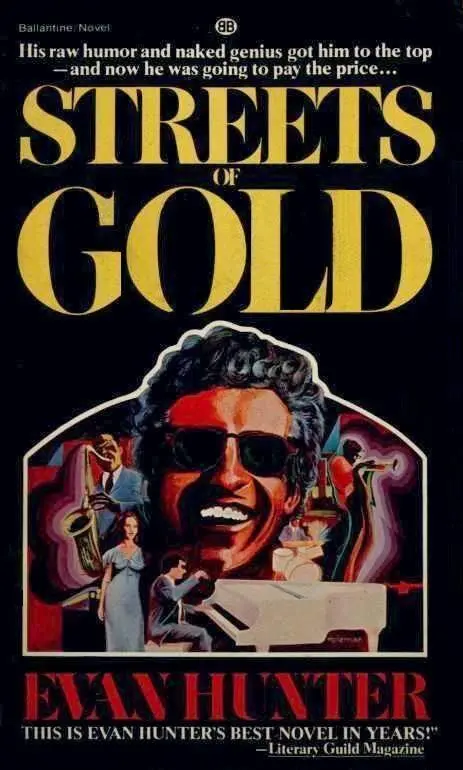
- Название:Streets of Gold
- Автор:
- Издательство:Ballantine Books
- Жанр:
- Год:1975
- Город:New York
- ISBN:978-0-345-24631-8
- Рейтинг книги:4 / 5. Голосов: 1
-
Избранное:Добавить в избранное
- Отзывы:
-
Ваша оценка:
Streets of Gold: краткое содержание, описание и аннотация
Предлагаем к чтению аннотацию, описание, краткое содержание или предисловие (зависит от того, что написал сам автор книги «Streets of Gold»). Если вы не нашли необходимую информацию о книге — напишите в комментариях, мы постараемся отыскать её.
Streets of Gold — читать онлайн бесплатно полную книгу (весь текст) целиком
Ниже представлен текст книги, разбитый по страницам. Система сохранения места последней прочитанной страницы, позволяет с удобством читать онлайн бесплатно книгу «Streets of Gold», без необходимости каждый раз заново искать на чём Вы остановились. Поставьте закладку, и сможете в любой момент перейти на страницу, на которой закончили чтение.
Интервал:
Закладка:
I still believe we achieved that smoothly rehearsed ensemble effect only because we were trying to prove to Rudy that a group of highly trained musicians did not have to be told how to blow or at what speed. I think Hank and Peter were angry all through the three minutes and forty-four seconds it took us to cut the side. If you listen closely to the record, you can hear a heated understatement from the trumpet and drums, as though they are trying to push through the imposed restraints — the straight mute in the horn, the brushes on the top cymbals. Listening, you can hear rage seething in the background, vibrating beneath the diamond-hard (also somewhat angry) piano, and the silvery-cool tones of the flute. (Mark was later to take credit for the flute; it had been his inspiration, he said.)
But in addition to the anger, and perhaps as a result of it, the sound also has that quality of reckless freedom one usually associates with a jam session. We were all of us quite relaxed, despite Rudy’s hysteria. Frankly, none of us gave a good goddamn about his problems, nor did we for a moment believe the record would ever be released. We figured Rudy was simply protecting his job. He must have felt fairly certain that Mark would return the five-hundred-dollar advance paid to Gerri Pryce, the unknown disappearing singing star. But he had agreed to pay us for three hours at scale, and we were still there, we had not walked out, we had not had our periods, we had in fact already done three takes on an undistinguished “Night in Tunisia,” and he would have to pay us in full whether we cut the second side of the record or not. The way we figured it, the two sides were Rudy’s insurance policy. He could not go back to his boss with nothing to show for the company’s cash outlay. If his boss didn’t like the sides, well, there was no accounting for taste, right? Into the ashcan, and better luck next time; Rudy had done his job, he had delivered a viable record. Meanwhile, all we were getting was scale, and for scale you do not bust your ass. For scale, you relax — especially when the session is going to be over and done with in less than four minutes. We were all very relaxed.
My piano playing on “Man” is almost a put-on, in fact, a combination of clumpy Dave Brubeck, bluesy-funky Horace Silver, and pyrotechnic Oscar Peterson. Orry, too, is more frivolous on this side than on the “Tunisia” cut, perhaps because he was sensing my own devil-may-care, what-the-hell attitude. Our head chorus, possibly the only display of real musicianship on the record, is a small miracle of precision, considering we’d never rehearsed any of the figures we played spontaneously and in unison. (They may have been bop figures we’d both heard before, I’m sure I don’t know; they sound fresh and improvisational to me, even now.) The lead-in Orry gives to my piano solo is a corny, overworked bop riff, a series of eighth-note triplets, which he restates at the end of my two choruses and uses as a springboard for his own thoroughly uninspired solo. Eight bars into Orry’s solo, Peter and Hank suddenly stop playing, and Stu Holman begins walking the chart on bass, with me tossing right-hand sprinkles haphazardly into the mix (it sounds a little like a stout man walking ponderously on glass, which shatters with each footfall) until we go into the head and home with the full ensemble. Hank takes out the straight mute before we wrap it up, and Peter drops a bass-drum bomb that comes like an unexpected belch, Orry and I repeating the same figures we played at the top, this time more knowledgeably. That last single-string strum on the bass is because Stu Holman somehow thought we were going into another chorus. It promises something that never comes because that’s where the record ends. When I later asked Peter and Hank why they’d stopped playing eight bars into Orry’s flute solo, they told me he was boring them out of their minds, and they just quit.
That was the record that ensured almost ten years of popularity.
The quintet has probably played “The Man I Love” twenty thousand times since 1955. The musicians come and go, they are replaced, they leave to form groups of their own (as did Orry), they become hopeless addicts (as did Peter), or they simply quit the music business (as did Hank D’Allessio, who is now a real estate agent in Santa Monica). The only one of the original quintet who is still with me when we play infrequent club dates is Stu Holman. But wherever and whenever we play, “The Man I Love” is always requested, and if we deviate by so much as a thirty-second note from the way we played it on that ancient disk, the crowd begins to grumble. We are supposed to reproduce the record note by note, without variation, a demand anathema to jazz musicians. (I knew exactly how Bobby Darin felt, may God rest his soul, when I caught him in Vegas years after his initial success, and he was singing up a storm, better than he’d ever sung in his life, and all the audience wanted to hear was “Mack the Knife.”) I’m a better musician now than I was in 1955. I know for certain that any one of my quintets, on occasions too numerous to recall, has played “The Man I Love” better than the original quintet did on that September Thursday in 1955. In fact, when the original quintet (minus Peter, who was in Lexington) opened at Birdland the next year, we jammed on “Man” for a full twenty minutes, and Christ, we were beautiful that night, we put to shame the record that had launched us into the big time.
But who can argue with success?
As Biff had prophesied, we had somehow made the right music in the right time and the right place. By the beginning of 1956, there was not a jazz buff in the United States of America who did not know of the Dwight Jamison Quintet. Rudy Hirsch was jubilant. His boss, Harry Arnberg, offered us a long-term recording contract. In gratitude for the splendid job Harry had done with our first record, Mark Aronowitz promptly signed the quintet with RCA Victor.
That’s show biz.
He had turned her pictures to the wall, he had told everyone his eldest daughter was dead. She had married a blind shaygets , a wop entertainer, she was dead. But he comes around in 1956, after eight years of silence. Coincidentally, this is after I’ve opened at Birdland to resounding critical cheers, and am no longer a blind shaygets to Honest Abe; I have become his “son-in-law the jazz artist.” He has three grandchildren to discover. They distinguish him from “Papa Jimmy,” their other grandfather, by calling him “Papa Abe.” There is a lot of catching up to do. To facilitate the osmosis of Papa Abe into the family bloodstream, Rebecca puts the “big one” on the turntable. We are living at the time on Park and Eighty-first, in an apartment we’ve sublet from a saxophone player who is in Paris. The windows are open, a balmy New York spring flirts with the stench of cigar smoke (my father’s and Abe’s) in the living room twelve stories above the street.
“This is the one that did it,” Rebecca says.
“Daddy got a hit with it,” Andrew says proudly.
“Well, well,” Abe says. “Well, well. What record was that?”
“ ‘The Man I Love,’ ” Andrew says. “ Everybody knows that.”
I listen to the record. I have not yet grown weary of listening to it. At Sophie’s insistence, Rebecca is breaking out the photo album again. “Show him the pictures of when you were in Florida,” Sophie says. “Show him the pictures, darling.”
“That’s a very nice record,” Abe says. “I think I heard it on the radio. Very nice.”
Success at last. Approval from the Mad Oldsmobile Dealer.
For our perseverance and our courage, and to prove that only good things come to those of us who have the integrity to stand up for our convictions (ours being that only in America can a Jew and a Gentile, working side by side in the same double bed, construct Rockefeller Center), Rebecca and I have been rewarded with S*U*C*C*E*S*S! We have obediently learned the American myth, and faithfully adhered to its precepts, and we can now live in the luxury of its full realization, while simultaneously serving as prime examples of its validity. “Look at your father,” Stella tells my children. “He was raised in Harlem; see what can happen in America?” Stella believes it. Rebecca believes it. I believe it.
Читать дальшеИнтервал:
Закладка:
Похожие книги на «Streets of Gold»
Представляем Вашему вниманию похожие книги на «Streets of Gold» списком для выбора. Мы отобрали схожую по названию и смыслу литературу в надежде предоставить читателям больше вариантов отыскать новые, интересные, ещё непрочитанные произведения.

Обсуждение, отзывы о книге «Streets of Gold» и просто собственные мнения читателей. Оставьте ваши комментарии, напишите, что Вы думаете о произведении, его смысле или главных героях. Укажите что конкретно понравилось, а что нет, и почему Вы так считаете.