Evan Hunter - Streets of Gold
Здесь есть возможность читать онлайн «Evan Hunter - Streets of Gold» весь текст электронной книги совершенно бесплатно (целиком полную версию без сокращений). В некоторых случаях можно слушать аудио, скачать через торрент в формате fb2 и присутствует краткое содержание. Город: New York, Год выпуска: 1975, ISBN: 1975, Издательство: Ballantine Books, Жанр: Современная проза, на английском языке. Описание произведения, (предисловие) а так же отзывы посетителей доступны на портале библиотеки ЛибКат.
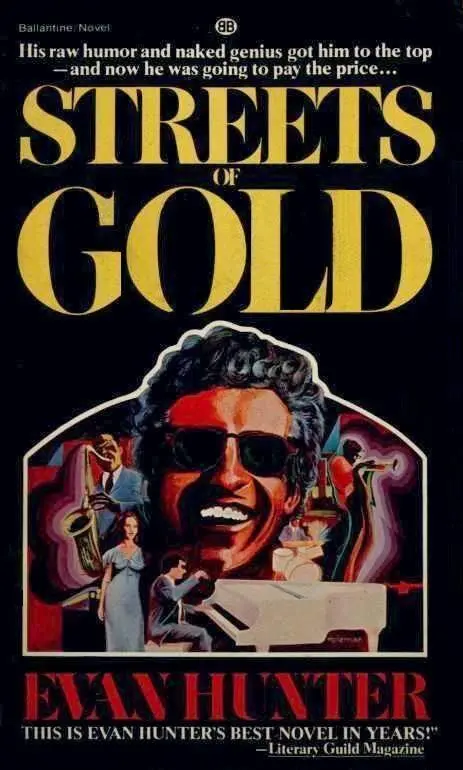
- Название:Streets of Gold
- Автор:
- Издательство:Ballantine Books
- Жанр:
- Год:1975
- Город:New York
- ISBN:978-0-345-24631-8
- Рейтинг книги:4 / 5. Голосов: 1
-
Избранное:Добавить в избранное
- Отзывы:
-
Ваша оценка:
Streets of Gold: краткое содержание, описание и аннотация
Предлагаем к чтению аннотацию, описание, краткое содержание или предисловие (зависит от того, что написал сам автор книги «Streets of Gold»). Если вы не нашли необходимую информацию о книге — напишите в комментариях, мы постараемся отыскать её.
Streets of Gold — читать онлайн бесплатно полную книгу (весь текст) целиком
Ниже представлен текст книги, разбитый по страницам. Система сохранения места последней прочитанной страницы, позволяет с удобством читать онлайн бесплатно книгу «Streets of Gold», без необходимости каждый раз заново искать на чём Вы остановились. Поставьте закладку, и сможете в любой момент перейти на страницу, на которой закончили чтение.
Интервал:
Закладка:
“This’s a union club,” Herbie mumbled. “You union?”
“No,” I said. “But I can join.”
“Costs more’n a bill to join,” Herbie said. The barber must’ve taken off the towel; I could suddenly understand him. “Gig don’t pay but seventy-five a week.”
“How long you booked for?” Biff asked.
“Just a week. Hardly be worth the kid makin’ that kind of investment.”
“He got to join the union sooner or later,” Biff said. “Might’s well be now.”
“How old’re you?” Herbie asked.
“I’ll be nineteen in October.”
“Your folks goan fuss ’bout you playin’ a club way out on Staten Island?”
“Don’t worry about that,” I said.
“How you goan git there, man?” Cooper said.
“I don’t know,” I said. “How’re you gonna get there?”
“I got a car,” Herbie said. “Where you live, man?”
“In the Bronx.”
“I ain’t goan way to the Bronx to pick up no piano player. I can git me a piano man lives right aroun’ the corner here, an’ he damn good, too, used to play with Lunceford.”
“If he used to play with Lunceford,” Biff said, “he ain’t goan take no fuckin’ job in a Staten Island toilet for seventy-five a week. How much you gettin’ as leader, Herb?”
“I don’t see as that’s rightly your business,” Herbie said.
“Give the kid a break,” Biff said. “You got my word he’s a good man. What the hell more you need?”
“ You goan pick him up in the Bronx, man? I need a blind piano player like I need a fuckin’ hole in the head.”
“I’ll come to Harlem,” I said. “If you’ll give me a ride from here, that’ll be fine.”
“Gig starts this Saturday. You goan be able to join the union an’ all by then?”
“I’ll do it tomorrow,” I said.
“We all colored in this band,” Herbie said as his final defense.
“I’m blind,” I said, as mine.
“Well, you go join the fuckin’ union, an’ git back to me by Friday. I ain’t heard from you by then, I git me another piano man.”
“I’ll call you soon as everything’s set,” I told him.
“Fuckin’ kid better be good,” Herbie said to Biff.
Which is how I happened to be playing piano in a bar on Staten Island on the night of July 18, 1945, when a girl standing near the piano said, “That’s a nice Erroll Garner imitation.”
This was my first paying job. I had started on Saturday night, and this was Wednesday, and whereas no bedazzled teenager had yet come up to the bandstand and requested a plaster cast of my cock, I was nonetheless learning that simply being up there, and visible, and making music was somehow attractive to certain types of girls. There are, I’m sure, countless theories to explain why some girls will go to bed with musicians after no more formal an introduction than a single chorus of “Stardust.” (“Stardust,” by the way, is a joke tune to jazz musicians. Whenever anyone says, “Let’s play ‘Stardust,’ ” the whole band breaks up. It has a good melody, but a totally dumb white chart.) I have never been able to understand the groupie phenomenon. I have never been able to understand the telephone, either, but that hasn’t prevented me from using it over the years. After I hit it big in 1955, it was not uncommon for girls to come to the piano, and, without preamble, whisper, “Let’s ball, Ike.”
This girl standing at the piano was Jewish. I knew that voice. For those of you who are not familiar with it, I refer you to the other Barbra Streisand. There are two Barbra Streisands. One of them sings. The other one talks. The singer enunciates each and every word clearly and meticulously; you cannot find a vocalist anywhere in the world who has more respect for lyrics. The talker is a Jewish girl from the Bronx (or Brooklyn — the difference is slight). I am not for one moment suggesting that Barbra Streisand goes to bed with blind jazz musicians; I have certainly never had the pleasure myself. (Please don’t call me, Barbra, I’ve got enough problems right now.) But you don’t grow up in Harlem and later an Italian section of the Bronx without learning that all Jewish girls put out. The girl at the piano was Jewish, and she had just delivered a perfectly acceptable opening line — “That’s a nice Erroll Garner imitation” — and just as my grandfather had entertained high hopes of ‘na bella chiavata the night he and Pino dated those two “American” girls back in 1901, I now assumed I was on the verge of terminating the celibacy imposed by the return of Susan Koenig’s brother. I waited till we finished the set. The girl was still standing there. I turned to her and smiled.
“How do you know he isn’t imitating me? ” I said.
“I meant it as a compliment,” she said.
“Well, thanks,” I said. “I like him a lot.”
“So do I. Marvin took me to hear him a few weeks ago.”
“Marvin?” (Mild foreboding.)
“My boyfriend.”
“Oh. I take it he likes jazz.”
“Oh, yeah, he digs it even more than I do.”
“He digs it, huh?” (Defensive sarcasm.) “Well, well, well.”
“Yes. He was the one who suggested we come all the way out here tonight. We came over on the ferry.”
“That’s nice,” I said. (What does she want? Why’d she come up here to the piano?)
“Well,” she said, “I’ve got to go now.”
“Is that it ?” I asked.
“Huh?”
“I mean, is that why you came up here? To tell me it was a nice Garner imitation, and your boyfriend is Marvin, and you came over on the ferry?”
“Yeah. What’d you think?”
“Well...” (Desperate fumbling.) “Some people come up with requests or...”
“No.”
“Okay.”
“It was a nice Garner imitation.”
“Thank you.” (Hope springs eternal.) “What’s your name?”
“Rebecca. What’s yours?”
“Iggie.”
“Iggier?”
“That’s short for Ignazio.”
“Oh. Well, Iggie, thanks again. Marvin and I really enjoyed...”
“You’re not leaving right this minute, are you?”
“Yes, it’s late. We’ve got a long ride back to the Bronx.”
“What’s your phone number?”
“Why?”
“I’d like to call you.”
“Why?”
“Well. . .” (To fuck you, why do you think? You’re Jewish, aren’t you?) “To talk about... uh... jazz and... uh... Garner and... uh...” (Uh, shit !)
“We don’t have a phone.”
“Well, how does Marvin get in touch with you? Like when he wants to go ‘dig’ jazz someplace, how does he let you know? Does he send a carrier pigeon?”
“He calls Shirley.”
“And takes her instead?”
“No.” (A suppressed laugh at my devastating wit?) “We don’t have a phone yet because we just moved into a new apartment. Shirley lives across the hall.”
“What’s her last name?”
“Ackerman. But don’t call her.”
“Why not?”
“Well, what’s the sense?” she said.
“Why’d you come up here?” I asked.
“I wanted to see what you looked like up close.”
“What did I look like far away?”
“Okay.” (A shrug in her voice?)
“What do I look like up close?”
“Okay.” (Another shrug?)
“So?” I said.
“So?”
“Let me call you.”
“I’d rather you didn’t.”
“Is the phone listed in Shirley’s name?”
“No.”
“What’s her father’s name?”
“Don’t call, okay? I mean it.”
“Okay,” I said.
“I mean it.”
“I said okay. What color are your eyes, Rebecca?”
Читать дальшеИнтервал:
Закладка:
Похожие книги на «Streets of Gold»
Представляем Вашему вниманию похожие книги на «Streets of Gold» списком для выбора. Мы отобрали схожую по названию и смыслу литературу в надежде предоставить читателям больше вариантов отыскать новые, интересные, ещё непрочитанные произведения.





Обсуждение, отзывы о книге «Streets of Gold» и просто собственные мнения читателей. Оставьте ваши комментарии, напишите, что Вы думаете о произведении, его смысле или главных героях. Укажите что конкретно понравилось, а что нет, и почему Вы так считаете.