Evan Hunter - Streets of Gold
Здесь есть возможность читать онлайн «Evan Hunter - Streets of Gold» весь текст электронной книги совершенно бесплатно (целиком полную версию без сокращений). В некоторых случаях можно слушать аудио, скачать через торрент в формате fb2 и присутствует краткое содержание. Город: New York, Год выпуска: 1975, ISBN: 1975, Издательство: Ballantine Books, Жанр: Современная проза, на английском языке. Описание произведения, (предисловие) а так же отзывы посетителей доступны на портале библиотеки ЛибКат.
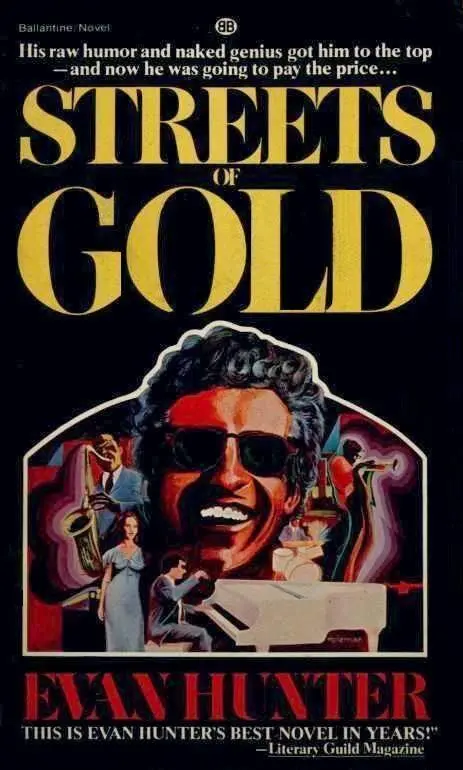
- Название:Streets of Gold
- Автор:
- Издательство:Ballantine Books
- Жанр:
- Год:1975
- Город:New York
- ISBN:978-0-345-24631-8
- Рейтинг книги:4 / 5. Голосов: 1
-
Избранное:Добавить в избранное
- Отзывы:
-
Ваша оценка:
Streets of Gold: краткое содержание, описание и аннотация
Предлагаем к чтению аннотацию, описание, краткое содержание или предисловие (зависит от того, что написал сам автор книги «Streets of Gold»). Если вы не нашли необходимую информацию о книге — напишите в комментариях, мы постараемся отыскать её.
Streets of Gold — читать онлайн бесплатно полную книгу (весь текст) целиком
Ниже представлен текст книги, разбитый по страницам. Система сохранения места последней прочитанной страницы, позволяет с удобством читать онлайн бесплатно книгу «Streets of Gold», без необходимости каждый раз заново искать на чём Вы остановились. Поставьте закладку, и сможете в любой момент перейти на страницу, на которой закончили чтение.
Интервал:
Закладка:
I hated what the boppers were doing. I hated their music on the few records I’d heard, and I hated it all over again hearing them in person. I cursed Kenny Clarke, who, Biff told me, was the first drummer to stop playing time, hated the klook-a-mop explosions that erupted unexpectedly from bass drum or snare like mortar shells in an undeclared war. I hated those flatted fifths the horn men were playing, though Biff told me he’d first heard them played on a piano as far back as 1940 (while I was still laboring over Chopin) by a man named Tadd Dameron, who was also one of the first to play in what Biff described as “the legato manner,” using his English accent, which I learned was both defensive and derisive. I think he hated bop as much as I did, but he was stuck with it, he recognized it as the wave of the future, and like my Uncle Nick, he wasn’t about to buck the system. I hated Gillespie and I hated Parker and I hated Powell and Wallington, Pettiford and Monk, and the whole damn gallery of men who were, it seemed to me, forcing me to change my path even before I’d firmly placed a foot upon it.
To me — I was eighteen and eager and excited and ambitious — these men were doing this deliberately, were trying to screw up my life, were out to get me personally. I wasn’t far from wrong. They were out to get Whitey, though he was known as Charley in those days. They were playing music they thought the white man could not steal, changing the names of songs so that when they played them with strangely revised charts, they would be unrecognizable to square Charley - “Ornithology” was “How High the Moon”; “A Dizzy Atmosphere” was “I Got Rhythm”; “Hot House” was “What Is This Thing Called Love?”; “Donna Lee” was “Back Home in Indiana.” The machine-gun chatter in the early stages of this war was an idiomatic cliché vocalized as “Bu-REE-bop,” or “Du-BEE-bop,” and probably deriving from Gillespie’s “Salt Peanuts,” a tune with a I, VI, II, V chord pattern and a Sears Roebuck bridge. Salt-PEA-nuts — the tonic, the octave, and the tonic again. The “Salt” was an eighth note on the second beat of the bar, followed by an eighth-note rest. The “PEA” was an eighth note on the upper tonic, and the “nuts” was an eighth note on the tonic below; beamed together they comprised the third beat of the bar. And there you were — “Ru-BEE-bop” or “Bu-REE-bop,” later shortened to “bebop” or “rebop” and finally to “bop” as the definitive label for the new jazz.
Freed from the need to express themselves in an archaic musical tongue, the boppers invented a shorthand verbal language as well, and this became the coinage of everyday communication. A word like “ax” was first used to describe a horn of any kind, but its scope rapidly expanded to include any instrument, even the guitar and piano, which are about as far removed from an actual ax as a giraffe is from a water buffalo. The word “gone” was initially an abbreviation of the expression “out of this world.” If you are out of this world, why, then you are literally gone, no? But it was also used in brief exchanges such as this:
“So I’ll see you Tuesday, man.”
“Gone.”
The “gone” meant “okay,” or “all right,” or “agreed,” and was frequently used interchangeably with the word “crazy,” which also expressed approval, and which was sometimes linked with the word “like.”
“Like three bills for the gig, cool?”
“Like crazy.”
“Like” was probably the most overworked word in the new jazz vocabulary. If, on the battlefield, soldiers (black and white) were using “fuck” in its numberless variations — “Pass the fuckin’ ammunition, you fuck, or fuck if I give a fuck what fuckin’ happens” — so were black musicians at home using “like” with every fucking breath.
“I was like walking along, when I dug this wigged-out chick, she like gassed me.”
“Like I’m short of gold, you got like a pad for me tonight?”
“Like, dig, man, you puttin’ me on?”
“Like I got eyes for like retiring like in Paris.”
“Like gone, man.”
“Like I like love you like.”
Like I like hated it, man.
I hated the music, which I thought was simplistic, crude, mysterious, irritating, architecturally inept, and utterly without warmth or feeling. I figured the only reason Bud Powell was playing such primitive stuff was because he had tiny hands, as Biff had pointed out, and couldn’t reach those resounding Tatum chords. Tatum had riches to squander; he threw gold coins into the air, rubies poured from his ears, he swallowed emeralds and belched black pearls. Bop seemed impoverished to me, and the boppers — for all their dexterity — made music I considered emotionless and cold. I know a lot of jazz players who assign colors to keys. B flat will become brown, F will be green, E pink — meaningless references for me. I think instead in terms of warmth or lack of it. D is my favorite key, but only because it represents the feel of sunshine, and not because I think of it as saffron or burnt umber. Keys, as a matter of fact, have never meant very much to me. The problem confronting me each time I sit at the piano is not what key I’m going to play in, but only what I’m going to do with the tune. If I’m going to bomb out in E flat, I’ll bomb out in G as well. As far as I was concerned, the hoppers were bombing out in all twelve keys, and if they were playing in any color at all, it was the opposite of black, which most of them were; the music they made was cold and white. Dead white. I listened to it, and I thought This can’t be it, this can’t be where it’s going, this has got to be a fad.
I hated them for systematically and maliciously (I thought) destroying a sound I had loved instantly and without reservation from the first minute I’d heard it; I hated them for their exclusivity, which I did not recognize as naked hostility until that day years later when Rex Butler put me down on Broadway; I hated, them because they caused me to long for acceptance into their inner circle, where they spoke a childlike code, easily cracked and therefore no code at all, and yet impossible to imitate without incurring derision from them. Actually, I was missing the point, and it took me a long time to realize that Charlie Parker had been right. He understood, intuitively, that jazz as it was being played had come as far as it could ever go. There was no longer any way to modify or refine the existing system; it had to be completely demolished. He had reevaluated the entire harmonic and rhythmic structure and decided — not consciously; none of these decisions are ever conscious — to return jazz to its purest form.
I did not know what to do. I had given up classical piano in favor of jazz, and had hardly registered as an alien before my adopted country exploded in revolution. I now had the choice of sticking with the Tatum style and perfecting it (eating cake, so to speak, while the rabble was clamoring at the palace gates), or learning to play a music I did not like or even understand. I could either go it alone, play solo piano if I chose — solo piano already had its head on the chopping block, and George Shearing would lop it off forever in 1947 — or I could learn to play with other musicians in small ensembles where the piano player was a part of the rhythm section and, except when taking a chorus, was expected to feed chords to horn players. I had no idea that running down a chart for a horn player could be excitingly heady stuff when the horn players were inventive geniuses like Parker or Gillespie. I did not realize that the bass line of the thirties had indeed been a prison, or that Powell and Wallington and many, many others were freeing the right hand from those cop-out pentatonic runs, more suited to the playing of bagpipes than the playing of piano. In bop, the concentration on the right-hand blowing line — the truly creative line, the invented melody line — was intense. The very system of using hollow shells in the bass demanded that the right hand be innovatively restless at all times, free to express ideas and feelings. And the left hand was no longer rigidly playing the rhythm, but was playing against the rhythm — and that was freedom, too. I didn’t realize this when I first told Biff I’d made up my mind. I only knew that I could either go it alone, or I could learn to play music with other men in... well, a family. If it happened that the family was black, and perhaps angry, that was something I would have to cope with. This was America.
Читать дальшеИнтервал:
Закладка:
Похожие книги на «Streets of Gold»
Представляем Вашему вниманию похожие книги на «Streets of Gold» списком для выбора. Мы отобрали схожую по названию и смыслу литературу в надежде предоставить читателям больше вариантов отыскать новые, интересные, ещё непрочитанные произведения.



Обсуждение, отзывы о книге «Streets of Gold» и просто собственные мнения читателей. Оставьте ваши комментарии, напишите, что Вы думаете о произведении, его смысле или главных героях. Укажите что конкретно понравилось, а что нет, и почему Вы так считаете.