Evan Hunter - Streets of Gold
Здесь есть возможность читать онлайн «Evan Hunter - Streets of Gold» весь текст электронной книги совершенно бесплатно (целиком полную версию без сокращений). В некоторых случаях можно слушать аудио, скачать через торрент в формате fb2 и присутствует краткое содержание. Город: New York, Год выпуска: 1975, ISBN: 1975, Издательство: Ballantine Books, Жанр: Современная проза, на английском языке. Описание произведения, (предисловие) а так же отзывы посетителей доступны на портале библиотеки ЛибКат.
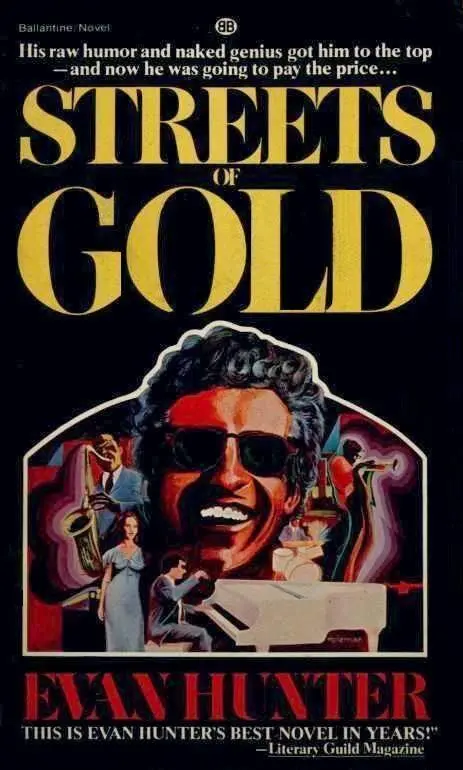
- Название:Streets of Gold
- Автор:
- Издательство:Ballantine Books
- Жанр:
- Год:1975
- Город:New York
- ISBN:978-0-345-24631-8
- Рейтинг книги:4 / 5. Голосов: 1
-
Избранное:Добавить в избранное
- Отзывы:
-
Ваша оценка:
Streets of Gold: краткое содержание, описание и аннотация
Предлагаем к чтению аннотацию, описание, краткое содержание или предисловие (зависит от того, что написал сам автор книги «Streets of Gold»). Если вы не нашли необходимую информацию о книге — напишите в комментариях, мы постараемся отыскать её.
Streets of Gold — читать онлайн бесплатно полную книгу (весь текст) целиком
Ниже представлен текст книги, разбитый по страницам. Система сохранения места последней прочитанной страницы, позволяет с удобством читать онлайн бесплатно книгу «Streets of Gold», без необходимости каждый раз заново искать на чём Вы остановились. Поставьте закладку, и сможете в любой момент перейти на страницу, на которой закончили чтение.
Интервал:
Закладка:
“He’s a liar,” my mother said.
“So okay, I’ll tell him to go drop dead, okay? What do you want me to tell him, Stella?”
“Who cares what you tell him? Who cares about him or what he does with his whore?”
“The kid’s sittin’ right here,” my Uncle Nick said. “You shouldn’t talk that way in front of the kid.”
“Why not? He should know what kind of bum his father is.”
“Okay, so I’ll tell Jimmy not to come home, okay? Is that what you want me to tell him? I’ll tell him whatever you want, Stella. I ain’t gonna buck the system, that’s for sure. You buck the system, you wind up with a busted head.”
“Tell him what you like.”
“Well, what kind of answer is that, Stella? Now listen to me, I’m gonna talk to you like you was my own sister, all right? He’s been at my house since last Wednesday, he goes to work in the morning, drives all the way here to the Bronx, and comes home for supper every night when Connie’s puttin’ the macaroni on the table. Now if he’s foolin’ around with a woman here in the Bronx, why’s he comin’ back to my house in Corona every night, would you please tell me that?”
“Because she’s married , why do you think?” my mother said. “ Married , you understand, Nick, or are you thickheaded like your brother? If I knew who she was, if la Madonna had only told me who she was, I’d go see her husband, he’d fix Jimmy’s onions, you can bet on that.”
“Stella, if you don’t know who this woman is supposed to be, how do you know she’s married?”
“You think I’m stupid?” my mother said.
“Stella, I think you ain’t listening to me,” Nick said. “Look, it’s two days till Easter, where you gonna be spending Easter Sunday?”
“At my father’s house.”
“Okay. You want me to tell Jimmy to come here Easter morning, pick up you and the kid and take you to Harlem? How’s that, Stella?”
“Who cares?” my mother said. “Tell him what you like.”
“Okay, I’ll tell him to pick you up Easter, okay?”
“Tell him what you like. Who cares?” my mother said.
My father came back to the house at ten o’clock on Easter morning. Nick had neglected to mention that the day after my father had left home, he’d withdrawn most of the money in my mother’s and his joint savings account. He was driving a new Dodge, and carrying armloads of gifts for my mother and me. (I forget what my presents were.) The trip to my grandfather’s house in Harlem was frosty with silence. When we got to the apartment on First Avenue, my grandfather clasped my father in his arms and said, “Jimmy, Buona Pasqua! Come! You have to help me bring some wine from the cellar.”
“I’ll help,” Pino said from the other room.
“No, Pino, sta qui ,” my grandfather said. “Jimmy and I can manage alone.”
I do not to this day know whether or not my father had an Irish whore on Pelham Parkway. I did not believe the Virgin Mary had accosted my mother on White Plains Avenue, of course, but I could find no reasonable explanation for a strange woman coming up to her with such information. I thought of a great many possibilities, but none of them made much sense. Was it conceivable, for example, that the woman in black had herself been my father’s doxy, and that she’d gone to my mother seeking revenge after a lovers’ quarrel? Or was she the sister of my father’s whore? Or her mother? Or was it all simply a case of mistaken identity? My father’s partner on the Pelham Parkway route was named Jimmy, too, and he also wore a mustache, and was about my father’s size, though a bit heftier. Was it he who’d been shtupping the lady every afternoon? Had the informer in black fingered the wrong fornicating mailman?
I began to check up on my father. I became the first blind detective in history. I would drop in unexpectedly whenever he was playing a wedding or a dance, using the excuse that I wanted to sit in and get some practice playing with bands. My father’s ( band — he then called it James Palmer’s Rhythm Kings — was square to the toes, and sitting in with them was total torment. But I wasn’t there to advance my musical career. I was Ignazio Di Palermo, Private Eye. Blind in both, I wouldn’t have recognized an Irish whore if I’d tripped over her vagina and stumbled into County Killarney. (Remind me to tell you the joke about George Washington’s horse sometime.) I never did get the goods on my father, nor did he ever once deviate from his story: The lady in the street was crazy, he did not know a whore on Pelham Parkway or anyplace else in the world, the receipt for the gold earrings with the sapphire chips had been given to him by the jeweler when he went to pick them up for a friend. Eventually, my mother forgave him. But to keep the matter in perspective, and to correct any misconceptions about the extent of her willingness to forget, she promptly stopped talking to my Uncle Nick, who had served as nothing more than an innocent go-between in the entire affair. Nick was a house painter. He died in 1953, when he suffered a cerebral hemorrhage after a fall from a ladder. My mother had not spoken to him since that Good Friday in 1944, and she did not go to his funeral.
Who says there never were any streets of gold in America? In 1944, I found one. I had learned from an issue of Down Beat that Biff Anderson was back in New York. I sought him out again. I told him I’d been trying to understand bop, and was hopelessly confused. He told me that was tough shit. I told him he was the one who’d advised me not to even try playing Tatum piano, that bop was the new thing, and that was what I should be learning. He said That’s right. So where am I supposed to learn it? I asked. Nobody’s teaching it, Biff, there aren’t any bop solos in Braille, there aren’t even any Tatum solos in Braille, what am I supposed to do? (I was using the little-blind-bastard ploy that hadn’t worked on my grandfather with Vesuvio; it didn’t work on Biff, either.)
“Look,” he said, “I don’t know you from a hole in the wall, I got enough problems of my own, I don’t need a blind man hanging around me all the time asking questions.”
“Biff,” I persisted, “if you saw me walking down Broadway with a cup full of pencils, you’d take pity on me, wouldn’t you?”
“Oh, sheeee-it,” he said.
“Biff, all I’m asking you to do is take me around a little, help me to understand the styles, okay? And then if I decide I want to play bop... which is what you advised me to do, right? am I right?”
“Yeah, yeali,” he said.
“Then all I want you to do is give me a lesson every now and then. Or even if I decide to play Tatum, okay? I just need some help, that’s all. I can’t take it off the records anymore, I’m not getting anywhere.”
“Where in hell you want to go, man?” he asked.
“I want to be the best jazz piano player who ever lived.”
“Oh, sheeee-it,” he said again.
“I can’t pay you much for the lessons, Biff...”
“Ain’t gonna be no lessons,” he said.
“Fifteen, twenty dollars a week maybe, that’s what I was paying the man who taught me classical music...”
“Man, you one hell of a pushy blind person, you know that?”
“I’ve got to be,” I said.
He was quiet for a long time.
Then he said, “I must be outa my fuckin’ mind.”
Fifty-second Street was pure gold. I very nearly suffered a cardiac seizure the first time Biff took me downtown and I learned (he had saved it as a surprise) that Tatum was playing at the Famous Door, with a bassist and a guitarist as his sidemen. We got there at ten, and I sat there in ecstasy till two in the morning, when Biff took me up to meet Tatum. The next night we went to hear Sidney Bechet, an old-time New Orleans soprano sax player, and the night after that Biff took me to hear Coleman Hawkins at the Onyx. Biff had played with Hawkins many years back, and he told me this man could shake down the Empire State Building with his horn. Man, he shook me to the roots. He was playing with two young musicians who had cut their chops on bop, a drummer named Max Roach, and a trumpet player named Howard McGhee. Biff asked me to pay particular attention to the drummer, who had learned from Klook Clarke (another new name to me), and I listened to him very carefully and did not like what I heard. The next night we went to the Downbeat and listened to Red Norvo on the vibraphone, and the night after that we caught Eddie Condon playing Chicago-style jazz, and Biff introduced me to him, and later told me he was the one who’d said, “The boppers flat their fifths; we drink ours.” For the next six months, or seven, or eight, Biff and I walked from door to door on the Street, and then taxied downtown or crosstown to every jazz joint he could find, listening to the main attractions and the intermission bands. For me, it was like rushing through an encapsulated chronology of jazz from its earliest beginnings to its then current form, all the giants and near-giants assembled, blowing for all they were worth in cabarets stinking of booze and smoke — Bobby Hackett, Don Byas, John Kirby, Pee Wee Russell and Bud Freeman and Zutty Singleton and, of course, the Bird — who was playing at the Three Deuces with a band that spelled Erroll Garner, who was the feature attraction.
Читать дальшеИнтервал:
Закладка:
Похожие книги на «Streets of Gold»
Представляем Вашему вниманию похожие книги на «Streets of Gold» списком для выбора. Мы отобрали схожую по названию и смыслу литературу в надежде предоставить читателям больше вариантов отыскать новые, интересные, ещё непрочитанные произведения.
Обсуждение, отзывы о книге «Streets of Gold» и просто собственные мнения читателей. Оставьте ваши комментарии, напишите, что Вы думаете о произведении, его смысле или главных героях. Укажите что конкретно понравилось, а что нет, и почему Вы так считаете.