Evan Hunter - Streets of Gold
Здесь есть возможность читать онлайн «Evan Hunter - Streets of Gold» весь текст электронной книги совершенно бесплатно (целиком полную версию без сокращений). В некоторых случаях можно слушать аудио, скачать через торрент в формате fb2 и присутствует краткое содержание. Город: New York, Год выпуска: 1975, ISBN: 1975, Издательство: Ballantine Books, Жанр: Современная проза, на английском языке. Описание произведения, (предисловие) а так же отзывы посетителей доступны на портале библиотеки ЛибКат.
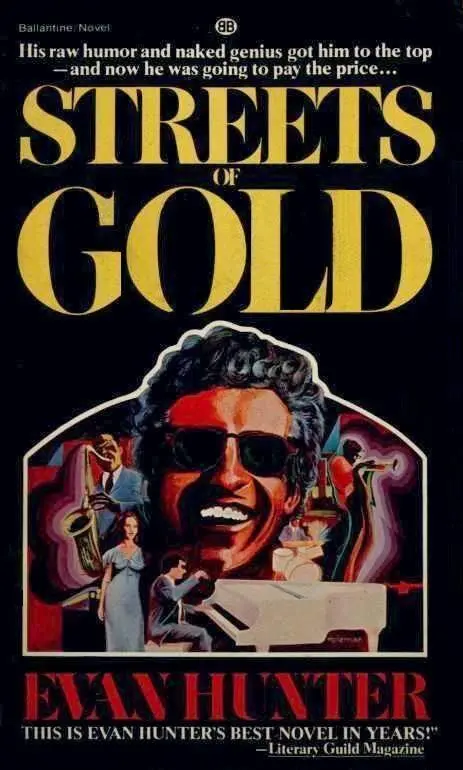
- Название:Streets of Gold
- Автор:
- Издательство:Ballantine Books
- Жанр:
- Год:1975
- Город:New York
- ISBN:978-0-345-24631-8
- Рейтинг книги:4 / 5. Голосов: 1
-
Избранное:Добавить в избранное
- Отзывы:
-
Ваша оценка:
Streets of Gold: краткое содержание, описание и аннотация
Предлагаем к чтению аннотацию, описание, краткое содержание или предисловие (зависит от того, что написал сам автор книги «Streets of Gold»). Если вы не нашли необходимую информацию о книге — напишите в комментариях, мы постараемся отыскать её.
Streets of Gold — читать онлайн бесплатно полную книгу (весь текст) целиком
Ниже представлен текст книги, разбитый по страницам. Система сохранения места последней прочитанной страницы, позволяет с удобством читать онлайн бесплатно книгу «Streets of Gold», без необходимости каждый раз заново искать на чём Вы остановились. Поставьте закладку, и сможете в любой момент перейти на страницу, на которой закончили чтение.
Интервал:
Закладка:
I made the American choice.
Rebecca.
I suppose we have to get to Rebecca sooner or later.
The last time I saw her was when I went back to the Talmadge house to pick up the personal belongings I’d left behind, all of which had been clearly detailed in our separation agreement. When I wrote Rebecca trying to set a time and a date, she wrote back saying she didn’t know why I felt I still needed all that “small assorted junk.” The small assorted junk included two pieces of sculpture we’d bought in Venice, and a complete set of the Encyclopaedia Britannica . Rebecca would not let me take the Britannica . She said I’d given it to the family as a gift, and she intended to keep it. I did not argue the point. When I left the house in Connecticut for the last time, I took with me the sculpture and the outdoor furniture and my own extensive record collection, including the jazz I’d first listened to in my brother’s room — small assorted junk. I also took with me a Braille edition of The Well-Tempered Clavier , which Rebecca had bought for me in London and given to me as a birthday present years ago.
That was the last time I saw Rebecca.
The first time I saw her was in July of 1945. Franklin Roosevelt was dead, and the war in Europe was over, but everyone was saying that the end was still nowhere in sight. An invasion of Japan was expected, and we all knew it would be bloody and costly, but by God we would finish the job in the Pacific the way we had in Europe, all of us out there doing our part — the tobacco-spitting kid from the Ozarks alongside the wisecracking kid from the Bronx and the snooty rich kid from Boston and the divinity student from Duluth and even the handsome sun-bronzed kid who’d tried to dodge the draft because he was making it with four blond starlets in a Malibu beach house, but who’d ended up realizing the fight was his , too, he was part of the family, and the family was out there struggling for survival. For me, the war had ended the day they killed Tony. I still believed in the myth, of course; I had to if I was to make any sense at all of my brother’s death. But victory was a foregone conclusion; America always emerged triumphantly. Even when Roosevelt died, I knew we would pull ourselves together and get on with this distasteful job that needed finishing. In those days, Americans were good workers, possibly because we’d come through the Depression years longing for work, and were now grateful for any job that came our way, even if it happened to be war. Today... don’t ask. If I played piano the way the man who installed our Talmadge kitchen cabinets did his job, people would throw rotten eggs and tomatoes at me. Rebecca later said that the man who’d installed our cabinets was to blame for the divorce, since his shabby work caused a connubial fight that lasted for a week. Rebecca dear, men who install kitchen cabinets, however, shoddily, are not responsible for divorce actions.
Biff had been busy teaching me every chart he knew, which he said I had to learn — “That’s the nexus, man, the nexus.” His method of teaching was... well... not quite the same as Passaro’s. Very often, Biff would give me the chart for a tune, and I would discover that some of the chords were different from the ones on the sheet music. He would tell me to never mind the sheet music, this is the right chord. And when I complained that it couldn’t be the right chord, he would say, “This’s the chord we play , man. This’s the chord that sounds right.”
A great many jazz musicians are very superstitious people, and Biff was one of them. Erroll Garner, for example, refuses to learn to read music because he thinks it’ll fuck up the way he’s playing. (Mary Lou Williams told me he can read, but Erroll insists he can’t and won’t learn, besides.) I once got into a discussion with George Shearing about his sound, and the “locked hands” or “block chord” architecture of it, which had as its forerunner the Glenn Miller saxophone section — a clarinet on top of the four saxophones normally found in a big band. I was telling George this meant that the melody could be played in two separate voices an octave apart, and I was about to go into a further technical exploration of it, when I detected (we’re both blind, and such detection wasn’t easy) that he was becoming a bit agitated, and finally slightly angry, or maybe just frightened. He didn’t want to know about it. His block system had only been one of the major shaping forces in the history of jazz piano, emulated by every young piano player in the country (including me at one time), but he didn’t want his style dissected. He was an articulate man, and he didn’t quite put it in these words, but what he was saying was, “Man, don’t bug me. I just blow, that’s all.”
Biff just blew, that was all. He had his own Rube Goldberg system of working with harmony and rhythm, and he explained chords to me the way he’d learned them. “Play me a C-diminished ninth,” he’d say, and I’d play it, and he’d say, “That ain’t no C-diminished ninth, I don’t know what that is, man.” I’d played a C-diminished ninth, all right, but what Biff had wanted me to play was a C-dominant chord with a flatted ninth. (Similarly, in Biff’s argot, a half-diminished became “a minor flat five.”) He taught me all the things he knew, hundreds of charts and tricks, milking the minor, moving voices; he gave me gratuitous advice: “Don’t play in B for no horn players, that’s a bum key for them, five sharps in it”; he told me stories about jazz men: “There was this one night with Philly Joe Jones, he turned the whole band around with his drumming. Did it as a joke. Got them so fucked up, they lost the meter”; he laid down the law: “Don’t you never lose the meter, man. You play them chords in their proper order, and you hold them for how long you’re supposed to, and that’s it , man”; issued warnings and proclamations: “Don’t you never mess with dope, you hear me? Lots of cats, they go listen to Bird, they go home and try to play like him, and they can’t do it, and they figure they got to go shoot dope the way he does. That ain’t the answer, dope ain’t what makes Bird play like he does. I don’t mind drinkin’, that goes together, booze and piano does. But you ever shoot a needle in your arm, I’ll personally come bust your ass, Iggie, you hear me? Blind or not, I’ll kick your ass all over the block I ever hear you’re messin’ with dope.”
The week before I met Rebecca, Biff had taken me up to Harlem with him. He didn’t live in Harlem anymore, but he went up there for a haircut every Wednesday. I don’t want to get into a dissection of that. All I know is that Biff lived on Canal Street, in a big loft that used to be a hat factory, and there were hundreds of barbershops in the area, including some barber colleges on the Bowery, but Biff went uptown to Harlem for his haircut every Wednesday. I was with him that Wednesday because he wanted me to meet a drummer who was putting together a trio and looking for a piano player. Biff figured I was about ready to get out there on my own; the only way I’d ever really learn to play ensemble piano was to start playing with a band. The guy he introduced me to must have been under a hot towel when we came into the barbershop. Biff told him I was a good man, told him I’d been getting down all the bop shit, knew hundreds of charts, and if he hadn’t yet hired a piano man for the gig on Staten Island, I was the man Biff was recommending for the job. The guy’s name was Herbie Cooper. He kept mumbling all the while Biff talked. Finally Biff said, “So what do you say, man?”
Читать дальшеИнтервал:
Закладка:
Похожие книги на «Streets of Gold»
Представляем Вашему вниманию похожие книги на «Streets of Gold» списком для выбора. Мы отобрали схожую по названию и смыслу литературу в надежде предоставить читателям больше вариантов отыскать новые, интересные, ещё непрочитанные произведения.


Обсуждение, отзывы о книге «Streets of Gold» и просто собственные мнения читателей. Оставьте ваши комментарии, напишите, что Вы думаете о произведении, его смысле или главных героях. Укажите что конкретно понравилось, а что нет, и почему Вы так считаете.