Evan Hunter - Streets of Gold
Здесь есть возможность читать онлайн «Evan Hunter - Streets of Gold» весь текст электронной книги совершенно бесплатно (целиком полную версию без сокращений). В некоторых случаях можно слушать аудио, скачать через торрент в формате fb2 и присутствует краткое содержание. Город: New York, Год выпуска: 1975, ISBN: 1975, Издательство: Ballantine Books, Жанр: Современная проза, на английском языке. Описание произведения, (предисловие) а так же отзывы посетителей доступны на портале библиотеки ЛибКат.
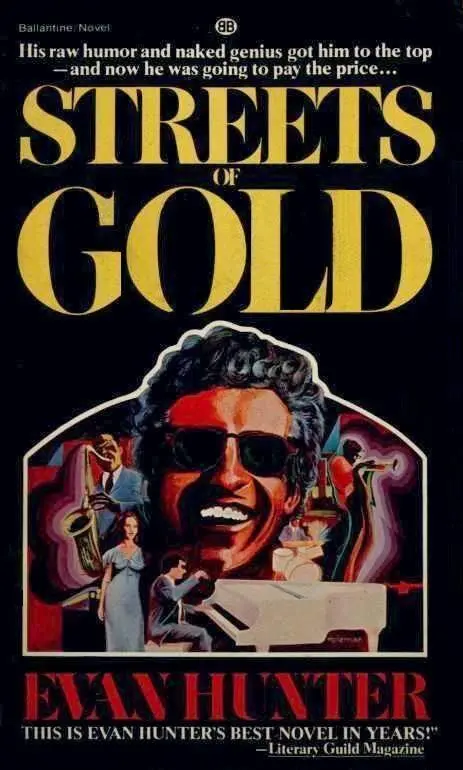
- Название:Streets of Gold
- Автор:
- Издательство:Ballantine Books
- Жанр:
- Год:1975
- Город:New York
- ISBN:978-0-345-24631-8
- Рейтинг книги:4 / 5. Голосов: 1
-
Избранное:Добавить в избранное
- Отзывы:
-
Ваша оценка:
Streets of Gold: краткое содержание, описание и аннотация
Предлагаем к чтению аннотацию, описание, краткое содержание или предисловие (зависит от того, что написал сам автор книги «Streets of Gold»). Если вы не нашли необходимую информацию о книге — напишите в комментариях, мы постараемся отыскать её.
Streets of Gold — читать онлайн бесплатно полную книгу (весь текст) целиком
Ниже представлен текст книги, разбитый по страницам. Система сохранения места последней прочитанной страницы, позволяет с удобством читать онлайн бесплатно книгу «Streets of Gold», без необходимости каждый раз заново искать на чём Вы остановились. Поставьте закладку, и сможете в любой момент перейти на страницу, на которой закончили чтение.
Интервал:
Закладка:
“Green,” she said.
“My mother’s eyes are green.”
“What color are yours?”
“Blue.”
“Blue,” she said. “Well, good night,” she said.
“Good night,” I said.
I called the following night, a Thursday. I started calling at six o’clock, before heading crosstown to Harlem where Herbie was waiting to take me to Staten Island again. I knew Rebecca lived in the Bronx, and I knew that her friend, Shirley Ackerman, lived across the hall. I did not know Shirley Ackerman’s father’s first name (nor even the name of Lincoln’s mother’s doctor’s dog). I asked my mother to read me all the Ackerman phone numbers listed in the Bronx directory. There were two columns of them. Patiently, she recited the numbers as I punched them out with my stylus. Then I carried the phone and the list into the bathroom, and closed the door on the telephone cord, and began dialing. Blind people, if you are interested, invented the digital system of dialing long before the telephone company did. That’s because we count the holes in the dial when we’re telephoning anyone. The first hole is just the number 1, but the second hole is the number 2 and also the letters ABC. The third hole is 3 and DEF and the fourth hole is 4 and GHI and a partridge in a pear tree. When dialing the prefix OL 4, therefore, I automatically translated it to 654. That was the prefix for the twelfth number I dialed. There was a Shirley Ackerman at only one of the numbers I’d dialed previously, but she did not know a Rebecca across the hall. My second Shirley Ackerman answered the telephone, and when I asked if she would run across the hall to get Rebecca for me, she said, “Who’s this?”
“A friend from school,” I said.
“From Barnard?” she asked, surprised. Barnard was an all-girls’ school.
“Columbia,” I said, recovering quite nimbly, I thought.
“What’s your name?” she asked.
“Just tell her it’s the guy who helped her with her English homework that time.”
“Well, don’t you have a name?” Shirley asked.
“Yes, but she doesn’t know it, it wouldn’t mean anything to her. Just tell her what I said.”
“Well,” Shirley said dubiously, but she put down the phone and went to call Rebecca across the hall. I thought I’d been pretty clever. It seemed to me that at one time or another Rebecca must have accepted English-homework assistance from one male student or another.
The first thing she said when she picked up the phone was, “I told you not to call.”
“What are you doing tonight?” I asked.
“I’m seeing Marvin.”
“How about tomorrow night?”
“I’m seeing Marvin tomorrow night, too, and every night till we get married.”
“What are you doing the night after you get married?” I said.
“What do you want, Iggie?” she asked.
“I want to see you.”
“Why?”
“Why the hell not?” I said.
“I love Marvin.”
“That’s a good reason,” I said.
“Okay?”
“I didn’t realize it was that serious.”
“It is,” she said.
“Okay. Look, lots of luck, huh? Forgive me for calling. I honestly didn’t realize...”
“That’s all right,” she said.
“Well, so long then.”
“So long,” she said.
I hung up, and immediately dialed Susan Koenig’s number. Her brother answered the phone.
“Who’s this?” he said, before even saying “Hello.”
“Iggie,” I said. “Who’s this ?”
“Franklin,” he said.
“Benjamin or Roosevelt?” I asked.
“What are you, a wise guy?” he asked, and hung up.
I tried again just before I left for Harlem, and this time I was lucky enough to avoid his surveillance system. I told Susan I still thought of her fiercely and passionately (this was already more than a year after Fodderwing had returned from the»Pacific), and I suggested in the most delicate language I could muster that it was neither psychologically sound nor genetically safe for a girl to be fucking her own brother.
Susan said, “I don’t know what you’re talking about,” and hung up.
On Saturday night, the band concluded its Staten Island engagement. I told Herbie how happy I’d been, and expressed the hope that I’d fulfilled his expectations.
“You was adequate, man,” he said magnanimously.
The meeting between Biff and my grandfather takes place in a club in Greenwich Village, where Biff is playing a one-night stand. He is late arriving, and the owner of the place is in an uproar. Biff placates the boss, stops briefly at our table to be introduced, and then excuses himself, saying he has to go to the men’s room. The moment he is gone, my grandfather whispers, “Ignazio?”
“Yes, Grandpa?”
“This man is a nigger , did you know that?”
“Yes, Grandpa.”
“Eh!” he says, or something that sounds like “Eh!” an explosion of breath that translates into English as “Okay, you know it; I just wanted to make sure you knew it.”
As sidemen that night, Biff is using a drummer, a bass player, and two horn men — one on trumpet, the other on sax — the usual instrumentation for a bop combo. The set they play is strictly Parker-Gillespie, all the stuff those two have been laying down, some of the tunes not even named yet, the charts picked up by emulating musicians who put them into the jazz lexicon and only later identify them as “Epistrophy” or “Swingmatism” or “A Night in Tunisia.” Biff is in trouble almost from go. He tries desperately to control his trained left hand, but it keeps trying to play time — fleshed-out tenths leap unexpectedly from his fingers, a brief swing bass oom-pahs over the riding ching-ching-ching-ching of the drummer’s top cymbals, tenths walk precisely in meter with the bass fiddle. He pulls himself back suddenly, you can feel the effort, and he begins playing shells again, using only two fingers of his left hand, and he tries to get a rhythmic line into his right hand, but the right is trained as well, it responds automatically, filling spaces where he feels something is needed, a florid little run sprinkling into that arid bop desert like an impossible rain squall. There is something hysterical about the way he plays, and something bitter, too. The marvelous counterpoint I’d listened to on my brother’s records is all but gone. Biff keeps squelching his left and forcing his right into strange new patterns, and it is like listening to half a piano player. The people are responding strangely, I can hear their constant chatter all through the set. They are there to hear Biff Anderson, yes, but in their minds jazz is jazz and they expect Biff to play the jazz they are starting to hear everywhere around them, even though they know this is not the kind of jazz upon which he built his reputation. It is quite an odd demand — somewhat like going to see a Clark Gable movie and expecting him to play Andy Hardy.
Biff comes over to the table after the set, and sits down on my right, so that I am between him and my grandfather. He asks my grandfather if he’d care for something to drink, and my grandfather orders a glass of red wine, and Biff tells the waiter he’d like a bourbon and water, and I fill in the lag before the drinks come by asking Biff a lot of questions about the sidemen. When the drinks arrive, my grandfather says, “Salute” and drinks, and makes an odd sound that tells me this is not the sort of red wine he is used to making and drinking. Abruptly, he says, “So what about my grandson?”
“You got some grandson here, Mr. Di Lorenzo,” Biff says.
“Is he a good piano player?”
“Very good. An’ gettin’ better all the time.”
Читать дальшеИнтервал:
Закладка:
Похожие книги на «Streets of Gold»
Представляем Вашему вниманию похожие книги на «Streets of Gold» списком для выбора. Мы отобрали схожую по названию и смыслу литературу в надежде предоставить читателям больше вариантов отыскать новые, интересные, ещё непрочитанные произведения.






Обсуждение, отзывы о книге «Streets of Gold» и просто собственные мнения читателей. Оставьте ваши комментарии, напишите, что Вы думаете о произведении, его смысле или главных героях. Укажите что конкретно понравилось, а что нет, и почему Вы так считаете.