Evan Hunter - Streets of Gold
Здесь есть возможность читать онлайн «Evan Hunter - Streets of Gold» весь текст электронной книги совершенно бесплатно (целиком полную версию без сокращений). В некоторых случаях можно слушать аудио, скачать через торрент в формате fb2 и присутствует краткое содержание. Город: New York, Год выпуска: 1975, ISBN: 1975, Издательство: Ballantine Books, Жанр: Современная проза, на английском языке. Описание произведения, (предисловие) а так же отзывы посетителей доступны на портале библиотеки ЛибКат.
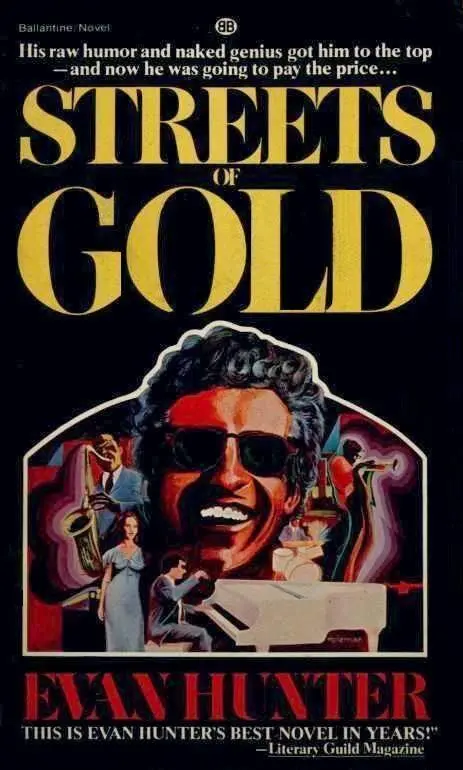
- Название:Streets of Gold
- Автор:
- Издательство:Ballantine Books
- Жанр:
- Год:1975
- Город:New York
- ISBN:978-0-345-24631-8
- Рейтинг книги:4 / 5. Голосов: 1
-
Избранное:Добавить в избранное
- Отзывы:
-
Ваша оценка:
Streets of Gold: краткое содержание, описание и аннотация
Предлагаем к чтению аннотацию, описание, краткое содержание или предисловие (зависит от того, что написал сам автор книги «Streets of Gold»). Если вы не нашли необходимую информацию о книге — напишите в комментариях, мы постараемся отыскать её.
Streets of Gold — читать онлайн бесплатно полную книгу (весь текст) целиком
Ниже представлен текст книги, разбитый по страницам. Система сохранения места последней прочитанной страницы, позволяет с удобством читать онлайн бесплатно книгу «Streets of Gold», без необходимости каждый раз заново искать на чём Вы остановились. Поставьте закладку, и сможете в любой момент перейти на страницу, на которой закончили чтение.
Интервал:
Закладка:
“What you played,” he says. “That was jazz?”
“That was jazz,” Biff says.
“I don’t like it,” my grandfather says.
Biff begins laughing. “You ain’t alone.”
“Do you like it?”
“Well, that’s a difficult question to answer,” Biff says. “It’s changin’ right now. It’s in the mist of change, you dig? If you mean do I like playin’ piano, yes, I love it. It’s what I’ve been doin’ all my life, and I guess it’s what I’ll keep on doin’.” Biff laughs again. “That is, if they let me.”
“Who?” my grandfather says.
“The people who’re changin’ it all.”
“What people?”
“Mainly Parker, Powell, and Gillespie. Klook. Them.”
“Why don’t you go see them?” my grandfather asks. I think he feels these men are politicians like Marcantonio, people you can go to with complaints or requests for favors. I don’t think he quite understands that they are musicians, and that the revolution in jazz is not being legislated.
“I’ve seen them,” Biff says.
“You told them?”
“Told them what?”
“That you don’t like it?”
“No. No, I didn’t tell ’em that, Mr. Di Lorenzo.”
“Why not?”
“Well, it don’t matter to them what I like or don’t like. They’re playin’ what they feel.”
“Do you play what you feel?”
“I try. It’s... well, it’s like learning a new Ianguage, that’s all. You got to put your feelings into new words.”
“Ah,” my grandfather says. This he understands. He has been trying to learn a new language for forty-four years now. “Are you teaching this language to Ignazio?”
“Yes, sir.”
“How can you teach it if you don’t understand it?”
“Oh, I understand it, all right. I just don’t quite feel it yet.”
“Ah,” my grandfather says, and strikes a match. “You want a see-gah?” he asks Biff.
“I don’t smoke,” Biff says.
“Tell me some more things.”
“What do you want to know?”
“Is this where you play jazz? In bars?”
“Mostly.”
“This is where Ignazio will play jazz?”
“In better places than this, I hope. This is a toilet, Mr. Di Lorenzo.”
“Yes,” my grandfather agrees. “But even better places, they’ll still be bars, eh?”
“Bars, clubs, cabarets, yes. That’s mostly where jazz is played.”
“Mm,” my grandfather says. “You drink a lot?”
“Enough.”
“Mm,” my grandfather says.
“Booze and piano go together,” Biff says.
“Mm,” my grandfather says. “Why?”
“Because there’s always a drink on top of the piano.”
“The girls here,” my grandfather says, and pauses. “ Mi sembrano puttane , you understand me?”
“No.”
“He says the girls look like prostitutes.”
“Some of them are,” Biff says.
“Mm,” my grandfather says. “Where do you play in these bars? In New York?”
“All over. All over the country. Or at least I used to. I even played in Paris and Stockholm.”
“Paris, eh? Paris.”
“France,” Biff says.
“But now you play only in New York, eh?”
“I can’t get many gigs other places.”
“Jobs,” I explain to my grandfather.
“Mm, jobs. Why not?”
“Because it doesn’t last that long.”
“What doesn’t?”
“A career in jazz.”
“ How long?”
“Five, six years. Seven the most. I’m just hangin’ on now, Mr. Di Lorenzo. I was on the way down long before this new stuff came in. I’m talkin’ about big money. I can still earn a living, more or less, but I don’t make big money no more.”
“What do you call big money? If you play jazz, what’s big money?”
“Well, I was pullin’ down three, four bills a week in the thirties, an’ that’s when people were starvin’, and I’m not nowhere near the piano player Tatum or Wilson is. I guess Art is still makin’... what? a thousand a week? But I ain’t sure how long that’s gonna last for him, not with this new jazz we’ve been tellin’ you about. An’ that’s just playin’ club dates; he makes money on his records, too, and other stuff.” I hear Biff lifting his glass. He drinks, I hear him swallow, he puts the glass back on the table and says, “Mr. Di Lorenzo, I get the feeling you don’ want no bullshit where it concerns your grandson’s prospects...”
“That’s right, no bullshit.”
“So, okay, I’ll lay it right on the line. I already told you he’s a good musician. I don’t know where he’s goin’ yet, but lots of young kids comin’ up today don’t know where they’re at, either; this bop ain’t so easy as you think. You hear Bird play, you want to go out an’ hang yourself, I’m not kiddin’. He’s that good, he’s that brilliant, you just want to go kill yourself. Instead, you try to do on your instrument whatever he’s doin’ on his saxophone, an’ that’s where it is today, and Iggie - if he keeps up with this — will have to do Parker on the piano, I s’pose, same way everybody else is doin’ Parker on whatever instrument they play. That’s where it’s at now; I can’t tell you how long it’ll last, but even when it’s gone, I know for sure it’ll have changed everything for keeps. What I’m sayin’ is I think Iggie’s got the chops, the hands, Mr. Di Lorenzo, and he’s got real feeling for what he plays, and I think he’s got a good head, too, but that don’t mean it’ll be easy for him.
“It won’t be easy ’cause first of all he’s blind. I know Iggie good enough to talk about his bein’ blind without fear of offendin’ him; I wouldn’t hurt him for anything in the world. But he’s blind, Mr. Di Lorenzo, and he’s gonna run into a lot of the same things colored musicians are up against. Not ’cause he’s colored, but ’cause he’s blind. He can’t read regular music, he can only read Braille, and that means he won’t be able to get jobs that are bread-an’-butter jobs to good paper men — men who can read music good. I mean, even if by some miracle some Broadway producer decided to hire Iggie to play for a big musical, and wanted to have Iggie’s part written out in Braille, even if that happened, why, Mr. Di Lorenzo, it would just be too much trouble for everyone concerned, they just wouldn’t be able to cope with a blind man in an orchestra pit, you understand me?”
“I understand you,” my grandfather says, and quickly covers my hand with his own.
“So let’s count that out as a possibility. Iggie ain’t gonna be called in by no contractor who needs a piano player to fill a chair on a big-band record date, and ain’t no radio station gonna call him up to do studio work, an’ he’s not about to get a rush call from the guy runnin’ Carousel , just forget them as possibilities, okay? That means he’ll have to make it either as a solo piano player or with a small group, and I think he already knows solo piano is on its last legs; where jazz is at today is in the small group. He’s got to work hard, and get his bag of tricks together, and start himself a group makin’ the right sound in the right time and in the right place. An’ he’ll start makin’ some records with that group, and if they catch on, he’ll have it made. He gets a couple of hit records, he can count on some good club dates followin’ them, and some real gold playin’ and makin’ more records that’ll bring in royalties, and so on, it’ll keep mush-roomin’ for maybe five or six years, he can be pullin’ down, oh, say fifty thousand, seventy-five thousand a year while he’s on top. If he doesn’t just blow that gold, he can make himself some good investments so that when things begin to taper, when the records stop sellin’ because maybe another sound has come in, or another style, or another piano player comes up with the right thing in the right time an’ place, why, then Iggie’ll have enough to tide him over while he ain’t makin’ as much gold but is still playin’ here and there because people still know his name. He’s got to make it first, you understand. Lots of guys never make it.
Читать дальшеИнтервал:
Закладка:
Похожие книги на «Streets of Gold»
Представляем Вашему вниманию похожие книги на «Streets of Gold» списком для выбора. Мы отобрали схожую по названию и смыслу литературу в надежде предоставить читателям больше вариантов отыскать новые, интересные, ещё непрочитанные произведения.

Обсуждение, отзывы о книге «Streets of Gold» и просто собственные мнения читателей. Оставьте ваши комментарии, напишите, что Вы думаете о произведении, его смысле или главных героях. Укажите что конкретно понравилось, а что нет, и почему Вы так считаете.