Evan Hunter - Streets of Gold
Здесь есть возможность читать онлайн «Evan Hunter - Streets of Gold» весь текст электронной книги совершенно бесплатно (целиком полную версию без сокращений). В некоторых случаях можно слушать аудио, скачать через торрент в формате fb2 и присутствует краткое содержание. Город: New York, Год выпуска: 1975, ISBN: 1975, Издательство: Ballantine Books, Жанр: Современная проза, на английском языке. Описание произведения, (предисловие) а так же отзывы посетителей доступны на портале библиотеки ЛибКат.
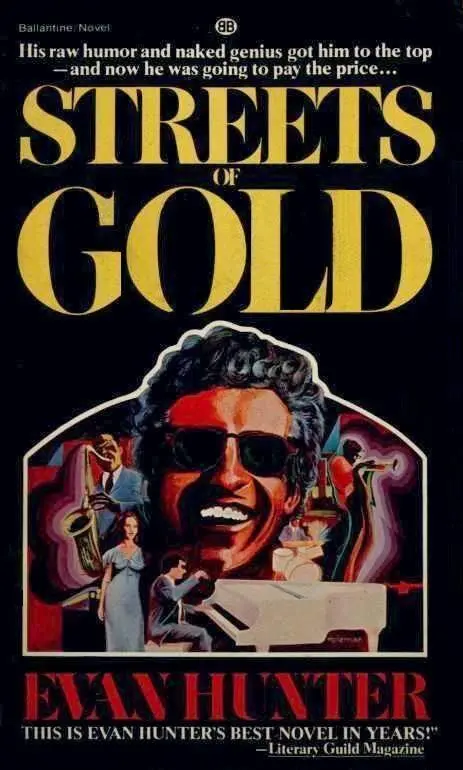
- Название:Streets of Gold
- Автор:
- Издательство:Ballantine Books
- Жанр:
- Год:1975
- Город:New York
- ISBN:978-0-345-24631-8
- Рейтинг книги:4 / 5. Голосов: 1
-
Избранное:Добавить в избранное
- Отзывы:
-
Ваша оценка:
Streets of Gold: краткое содержание, описание и аннотация
Предлагаем к чтению аннотацию, описание, краткое содержание или предисловие (зависит от того, что написал сам автор книги «Streets of Gold»). Если вы не нашли необходимую информацию о книге — напишите в комментариях, мы постараемся отыскать её.
Streets of Gold — читать онлайн бесплатно полную книгу (весь текст) целиком
Ниже представлен текст книги, разбитый по страницам. Система сохранения места последней прочитанной страницы, позволяет с удобством читать онлайн бесплатно книгу «Streets of Gold», без необходимости каждый раз заново искать на чём Вы остановились. Поставьте закладку, и сможете в любой момент перейти на страницу, на которой закончили чтение.
Интервал:
Закладка:
“I didn’t figure it was nothin’ at first,” the girl said. “He was ony complainin’ his neck felt stiff, tha’s all. I figured it was bad shit.”
“What? What do you mean?”
“Lots of bad shit runnin’ roun’ the city.” She was silent for a moment. She must have been staring at me, she must have been trying to look through my dark glasses and see into my eyes, read what was in my eyes as though I were sighted, trying to fathom my confusion. “Listen,” she said, “I thought you an’ Biff was friends.”
“We are.”
“An’ you don’t know?”
“Don’t know what , for Christ’s sake?”
“That he’s a junkie?”
“No,” I said. I was not answering her question. I was denying the information she had just given me. “No,” I said again.
“Hooked clear through the bag an’ back again,” she said.
“I don’t believe you.”
“Come down, man, he been a addict for ten years now.”
“Then... then... what...?” There was a sudden sharp movement on the mattress; his body lurched under my hand.
“Oh, Jesus!” the girl said.
“Where’s the telephone?” I said.
“Ain’t none here,” she said. “I called fum a booth downstairs.”
“We’ve got to get an ambulance,” I said.
“What for , man? One thing we don’t need on Christmas is any heat about dope.”
“Where’s that phone booth?” I said. “Don’t leave him alone, you hear me? Just stay with him while...”
“Cool it, man,” she said softly. “I’ll go make the call.”
He died that night. He died of asphyxia or exhaustion or a combination of both. Medical bullshit. I listened to medical bullshit from an intern in the charity ward of a hospital built twenty years before my grandfather first came to .these shores. Biff died in spasm induced by the tetanus bacillus that had infected a subcutaneous abscess on his left arm, undoubtedly caused by repeated insertions of a hypodermic needle. He’d been a dead man a week or two before I’d arrived at the loft that Christmas Day; that was the incubation period, the intern told me, that was how long it had taken for the exotoxin to launch its fatal attack on the central nervous system. He died with his jaws locked shut. He died in a room as black as the color of his skin. (Light, it had something to do with light, they did not want light in the room.) The nurses tiptoed quietly past the door, not because a man was dying inside, but only because any sudden noise (it had something to do with noise) might set off another racking spasm. The spasms were killing him. He was being shaken to death and choked to death, that poor lovely son of a bitch.
I left the hospital at ten minutes past one on the morning after Christmas. That was five minutes after they’d pronounced Biff dead. A thin drizzle was falling. I stood outside the main entrance with the girl. She didn’t say anything for a long time. Then she sighed, and said, “Well, that’s that, man,” and began to weep. She did not want to go back to the loft. I took her to Harlem in a taxi, and then I found a pay phone in a bar where bad jazz musicians were trying to play Charlie Parker, and I called my grandfather’s house. He answered the telephone before it rang twice. I told him not to worry, I was okay. I went to the bar, and sat down, and began drinking, and got drunk for the first time in my life. When the black bartender asked me what I was doing up in Harlem, I said, “I don’t know. What are you doing up in Harlem?” and he laughed.
That’s what happened that Christmas Day.
I made it all up.
I like to think, even now, that I made it all up.
In 1946, I began playing at a place called Auntie’s on Macdougal Street in New York’s Greenwich Village. The “auntie” who ran the joint was a crazy old Frenchwoman, named Madeleine. She paid me and my sidemen $350 a week for playing six nights a week, from 10 P.M. to two in the morning. I gave the bass man and the drummer a bill apiece, and kept $150 for myself as leader. My bass player was black, my drummer was white. The odd sets were played by a piano man who was black; his name was Oz Rodriguez. Oz was in his late fifties, a gifted musician steeped in Waller and Hines. He played solo piano the way I’d first heard it on my brother’s records, spelling us during our fifteen-minute intermissions and doubling as an accompanist whenever anybody wanted to sing a song. Madeleine was always wanting to sing a song. I sometimes think she opened the club only so she’d get to do her world-famous imitation of Piaf as often as she liked. She used to bug poor Oz out of his mind. Once she came to me and asked if I’d accompany her on “La Vie en Rose.” I told her I wasn’t an accompanist, I was leader of the house band. She told me she could get another house band any time she wanted. I said she was free to do so, if that was her desire, but the boys and I had built at least something of a following since we’d begun playing at Auntie’s and I’d hate to have to move over to the new club that had opened two blocks south of Sheridan Square, and take good steady drinking clientele to another place. “Ike,” she said, “tu es vraiment un bâtard aveugle.”
I had adopted the “Ike” the moment I got the steady gig at Auntie’s. The name came to me out of the blue. I went into the kitchen one night, and said to my mother, “How do you like Blind Ike?”
She said, “What?”
“For a name,” I said.
“What do you mean for a name?”
“For the trio. The Blind Ike Trio.”
“Ike?” she said. “What’s that?”
“Instead of Iggie,” I said.
“What’s the matter with Iggie?”
“Nothing, I just think Blind Ike sounds better. There are lots of blind piano players, you know. George Shearing is blind, you know.”
“Does he call himself Blind Ike?”
“Well, no, but...”
“Then why do you want to call yourself Blind Ike? Your name is Iggie. What’s the matter with that name?”
“Nothing, Mom. I’m thinking of what sounds better, that’s all.”
“Iggie sounds fine to me.”
“Well, I’m going to tell Madeleine to put it on the poster outside the club. The Blind Ike Trio. Okay?”
“If you decided already, why are you asking me?”
“Because if you ever come down to Macdougal Street, I want you to know who I am.”
“I know who you are,” she said. “You’re Iggie, that’s who you are.”
(But today she calls me Ike, the same as everyone else.)
I can’t remember what kind of piano I was playing back in 1946. I was searching for a style, and stealing from everything I heard. There was a lot to hear. I’d listen to it, and try it for a while, and then abandon it when I heard something I liked better. Jazz musicians are notorious thieves. I’m not talking about the fact that throughout the history of jazz the white man has packaged and commercialized the innovations of the black man. That’s not theft. That’s American free enterprise. I’m talking about a lick that’ll suddenly pop up in a horn solo, deliberately or unconsciously swiped from something the musician heard the night before at another club, or on a record, or hummed from behind the door of a pay toilet. I listened a lot, and stole a lot. Or, to put it more delicately, I was “influenced” a lot. By Nat Cole, Garner, Powell (reluctantly, because I still thought he was a crude pianist), Hampton Hawes, Herbie Hancock, Joe Albany, Lennie Tristano, Mary Lou Williams, Clarence Profit, Monk, Oscar Peterson — the only man, incidentally, who ever had the motor skills to play Charlie Parker on the piano, a consummate musician with more technical facility than any of us. I listened to whoever was making records or appearing in person in New York City, and invariably tried to copy what they were doing. The sidemen in the trio — Stu Holman on bass and Cappy Kaplan on drums — were my accomplices in crime. We stole outrageously, casing joints all over the city, busting open a style the way we might a bank vault, plundering what was inside, throwing away the wrappers around the bills, spending all the loot, and then searching for another safe to crack. We were serving our apprenticeship in the only way we could. None of us, you see, were true innovators. But in America, you don’t have to be.
Читать дальшеИнтервал:
Закладка:
Похожие книги на «Streets of Gold»
Представляем Вашему вниманию похожие книги на «Streets of Gold» списком для выбора. Мы отобрали схожую по названию и смыслу литературу в надежде предоставить читателям больше вариантов отыскать новые, интересные, ещё непрочитанные произведения.

Обсуждение, отзывы о книге «Streets of Gold» и просто собственные мнения читателей. Оставьте ваши комментарии, напишите, что Вы думаете о произведении, его смысле или главных героях. Укажите что конкретно понравилось, а что нет, и почему Вы так считаете.