Evan Hunter - Streets of Gold
Здесь есть возможность читать онлайн «Evan Hunter - Streets of Gold» весь текст электронной книги совершенно бесплатно (целиком полную версию без сокращений). В некоторых случаях можно слушать аудио, скачать через торрент в формате fb2 и присутствует краткое содержание. Город: New York, Год выпуска: 1975, ISBN: 1975, Издательство: Ballantine Books, Жанр: Современная проза, на английском языке. Описание произведения, (предисловие) а так же отзывы посетителей доступны на портале библиотеки ЛибКат.
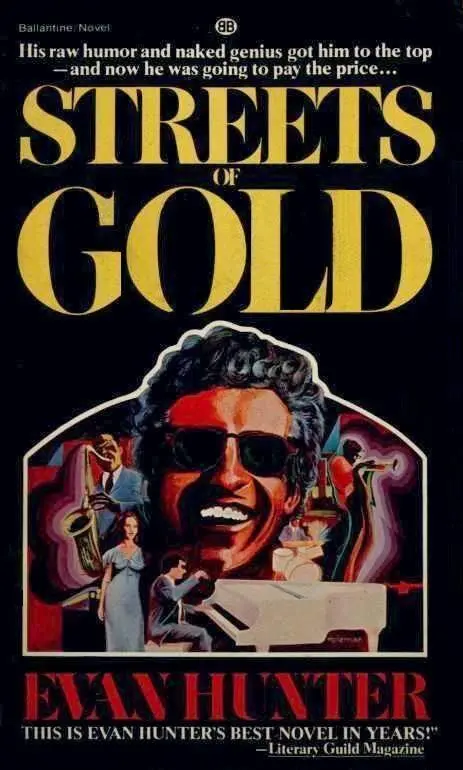
- Название:Streets of Gold
- Автор:
- Издательство:Ballantine Books
- Жанр:
- Год:1975
- Город:New York
- ISBN:978-0-345-24631-8
- Рейтинг книги:4 / 5. Голосов: 1
-
Избранное:Добавить в избранное
- Отзывы:
-
Ваша оценка:
Streets of Gold: краткое содержание, описание и аннотация
Предлагаем к чтению аннотацию, описание, краткое содержание или предисловие (зависит от того, что написал сам автор книги «Streets of Gold»). Если вы не нашли необходимую информацию о книге — напишите в комментариях, мы постараемся отыскать её.
Streets of Gold — читать онлайн бесплатно полную книгу (весь текст) целиком
Ниже представлен текст книги, разбитый по страницам. Система сохранения места последней прочитанной страницы, позволяет с удобством читать онлайн бесплатно книгу «Streets of Gold», без необходимости каждый раз заново искать на чём Вы остановились. Поставьте закладку, и сможете в любой момент перейти на страницу, на которой закончили чтение.
Интервал:
Закладка:
“Well, you ain’t a F-sharp piano player, that’s for sure,” Sam said. “But you know what you can do with that left hand of yours, don’t you?”
“You can chop it off and shove it clean up your ass,” the trumpet player said. “Let’s get Biff.”
They were moving off the bandstand. In a moment, and without another word to me, they were gone. I sat at the piano alone, baffled.
“What’s going on here?” a voice asked. “Who the hell are you? Who’s that band? Where’s my piano player?”
The voice belonged to a fat man. I could tell. I could also tell he was Jewish. I know it’s un-American to identify ethnic groups by vocal inflection or intonation, but I can tell if a man’s black, Italian, Irish, Jewish, or what ever simply by hearing his voice. And so can you. And if you tell me otherwise, I’ll call you a liar. (And besides, what the hell’s so un-American about it?) I was stunned. Some black bastard horn player had just told me to shove my precious left hand up my ass, and I didn’t know why.
“You!” the fat man said. “Get away from that piano. Where’s Biff?”
“Cool it, Mr. Gottlieb,” Biff’s voice said. “I’m right here; the boy’s a friend of mine.”
“Do you know ‘Deep in the Heart of Texas’?” Gottlieb said. “The bartender wants ‘Deep in the Heart of Texas.’ ”
“Beyond my ken,” Biff said, in what sounded like an English accent.
“What?” Gottlieb said, startled.
“The tune. Unknown to me,” Biff said.
“What?”
“Advise your barkeep to compile a more serious list of requests,” Biff said in the same stuffy English cadences, and then immediately and surprisingly fell into an aggravated black dialect, dripping watermelon, pone, and chitlings. “You jes’ ast you man to keep de booze comin’, an’ let me — an’ mah frens who was kine enough to come see me heah — worry ’bout de music, huh? Kid, you want to git off dat stool so’s we kin lay some jazz on dese mothahs?”
“What?” Gottlieb said.
“I’ll talk to you later,” Biff said as I climbed off the stool and off the bandstand.
My uncle Luke had drunk too much. His head was on the table, touching my elbow, and I could hear him snoring loudly as Biff talked to me. On my right, the girl with the five-and-dime perfume sat silent and motionless, her presence detectable only by her scent and the sound of her breathing. The trumpet player had left around midnight. The bass player and the drummer had followed him at about one. We were alone in the place now, except for the bartender, who was washing glasses and lining them up on the shelves, and Gottlieb, who had tallied his register and was putting chairs up on tables, preparatory to sweeping out the joint. As he passed our table, he said, “This ain’t a hotel, Mr. Jazz,” and then moved on, muttering.
“Cheap sheenie bastard,” Biff said. “He’s got his bartender watering my drinks. You okay, Poots?” he asked the girl. The girl did not answer. She must have nodded assent, though, the motion of her head and neck unleashing a fresh wave of scent. Biff said, “Fine, that’s fine, you jus’ stick aroun’ a short while longer. Now, you,” he said. “You want to know what’s wrong with how you play piano?”
“Yes,” I said.
“You’re lucky Dickie’s a gentle soul. Dickie. The drummer. Otherwise he’da done what Jo Jones done to Bird in Kansas City when he got the band all turned around. He throwed his cymbal on the floor, and that was that, man, end of the whole fuckin’ set. ’Scuse me, Poots.”
“Well, they ended the set, too,” I said. I still didn’t know that Bird was someone’s name. This was the second time Biff had used it tonight, and each time I’d thought he meant bird with a lower-case b ; the reference was mystifying. For that matter, I didn’t know who Jo Jones was, either. But I figured if he’d thrown a cymbal on the floor, he had to be a drummer, whereas all I could think about the use of the word “bird” was that it was a black jazz expression. (Come to think of it, it was .) “And I’ll tell you something, Mr. Anderson, your bass player pissed me off right from the start. Excuse me, miss. Making cracks about F-sharp piano players.”
“Well, le’s say he ain’ ’zackly de mos’ tac’ful of souls,” Biff said in his watermelon accent, and then immediately added in his normal speaking voice, “But he’s a damn fine musician, and he knows where jazz is today, and that’s what he was trying to convey to you.”
“I’m no damn F-sharp piano player,” I said.
“He didn’t know that. Anyway, that ain’t what got him or the other boys riled.”
“Then what?”
“Your left hand.”
“I’ve got a good left hand,” I said.
“Sure,” Biff said. “If you want to play alone, you’ve got a good left hand, and I’m speakin’ comparative. You still need lots of work, even if all you want to play is solo piano.”
“That’s what I want to play.”
“Then don’t go sittin’ in with no groups. Because if you play that way with a group, you’re lucky they don’t throw the piano at you, no less the cymbals.”
“Mr. Anderson,” I said, “I don’t know what you’re talking about.”
“I’m talking about that bass,” he said.
“That’s a Tatum bass,” I said. “That’s what you your self played. That was Tatum right down the line.”
“Correct,” Biff said.
“So?”
“Maybe you didn’t notice, but I was playin’ alone . Kid, a rhythm section won’t tolerate that bass nowadays. Not after Bird.”
“What do you mean, bird ? What’s that?”
“Parker. Charlie Parker. Bird.”
“Is he a piano player?”
“He plays alto saxophone.”
“Well... what about him?” I said. “What’s he got to do with playing piano?”
“He’s got everything to do with everything,” Biff said. “You tell me you want to play Tatum piano, I tell you Tatum’s on the way out, if not already dead and gone. You tell me you want to learn all those Tatum runs, I tell you there’s no room for that kind of bullshit in bop. You know why Sam...”
“In what , did you say?”
“Bop, that’s the stuff Parker’s laying down. And Fats Navarro. And Bud Powell. Now there’s the piano player you ought to be listening to, Powell; he’s the one you ought to be pickin’ up on, not Art Tatum. You want to know why the boys shot you down, it’s ’cause you put them in prison, man, you put them in that old-style bass prison, and they can’t play that way no more. These guys’re cuttin’ their chops on bop. Even I’m too old-fashioned for them, but we’re good friends, and they allow me to get by with open tenths and some shells. Sam wants to walk the bass line himself, he don’t want to be trapped by no rhythm the piano player’s layin’ down, he don’t even want to be trapped by the drummer no more. Didn’t you hear what Dickie was doing behind you? You didn’t hear no four/four on the bass drum, did you? That was on the cymbals; he saved the big drum for klook-mop, dropping them bombs every now and then, but none of that heavy one, two, three, four, no, man . Which is why they told you to stick your left hand up your ass, ’scuse me, Poots, to lose it, man. They wanted you to play shells in the left hand, that’s all, and not, that pounding Tatum rhythm, uh-uh. You dig what I’m saying?”
“What’s a shell? What do you mean, they wanted me to play shells?”
“Shells, man. You know what a C-minor chord is?”
“C, E flat, G, and B flat,” I said.
Читать дальшеИнтервал:
Закладка:
Похожие книги на «Streets of Gold»
Представляем Вашему вниманию похожие книги на «Streets of Gold» списком для выбора. Мы отобрали схожую по названию и смыслу литературу в надежде предоставить читателям больше вариантов отыскать новые, интересные, ещё непрочитанные произведения.


Обсуждение, отзывы о книге «Streets of Gold» и просто собственные мнения читателей. Оставьте ваши комментарии, напишите, что Вы думаете о произведении, его смысле или главных героях. Укажите что конкретно понравилось, а что нет, и почему Вы так считаете.