Evan Hunter - Streets of Gold
Здесь есть возможность читать онлайн «Evan Hunter - Streets of Gold» весь текст электронной книги совершенно бесплатно (целиком полную версию без сокращений). В некоторых случаях можно слушать аудио, скачать через торрент в формате fb2 и присутствует краткое содержание. Город: New York, Год выпуска: 1975, ISBN: 1975, Издательство: Ballantine Books, Жанр: Современная проза, на английском языке. Описание произведения, (предисловие) а так же отзывы посетителей доступны на портале библиотеки ЛибКат.
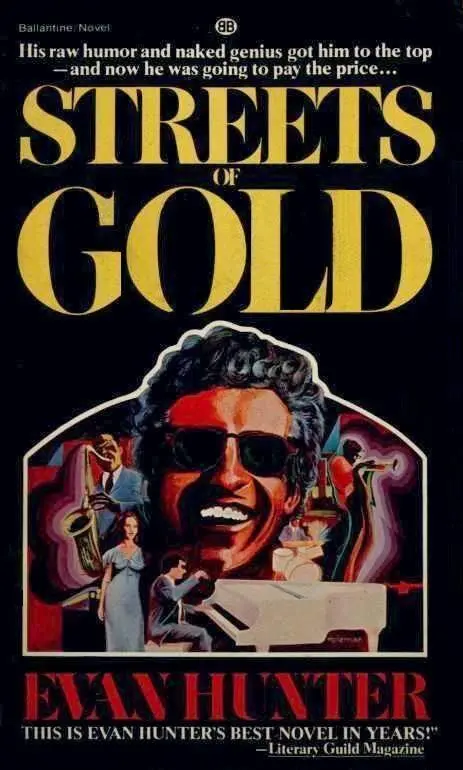
- Название:Streets of Gold
- Автор:
- Издательство:Ballantine Books
- Жанр:
- Год:1975
- Город:New York
- ISBN:978-0-345-24631-8
- Рейтинг книги:4 / 5. Голосов: 1
-
Избранное:Добавить в избранное
- Отзывы:
-
Ваша оценка:
Streets of Gold: краткое содержание, описание и аннотация
Предлагаем к чтению аннотацию, описание, краткое содержание или предисловие (зависит от того, что написал сам автор книги «Streets of Gold»). Если вы не нашли необходимую информацию о книге — напишите в комментариях, мы постараемся отыскать её.
Streets of Gold — читать онлайн бесплатно полную книгу (весь текст) целиком
Ниже представлен текст книги, разбитый по страницам. Система сохранения места последней прочитанной страницы, позволяет с удобством читать онлайн бесплатно книгу «Streets of Gold», без необходимости каждый раз заново искать на чём Вы остановились. Поставьте закладку, и сможете в любой момент перейти на страницу, на которой закончили чтение.
Интервал:
Закладка:
Ready?
Ah- one twothreefour...
SUSAN spent six hours with/ME, who soon learned that/SUSAN was not a virgin, that her/BED had been shared with her brother, who, like/ME, had desired her, but, unlike/ME, had been humping her for years./DECEMBER was my turn, that AFTERNOON apartment/... HOT radiators clanging, COLD wind rattling the windows,/AFTERNOON waning, EVENING on the way. Oh, that/AFTERNOON! Coming four times and, in the EVENING, once again in/SUSAN’s mouth, BEDDED still, she asked that I let MYSELF out, lying there/LIMP, still wearing dark glasses, as dusk shadowed the rumpled BED.
SUSiphANy SU SU whispering/ME, and oh, andering, MEandering, black-eyed/SUSAN flat -boy-ant, optimum/BED! a dead hollow vesper, a con-spir-a-see/ME-eyed poinciana, eyed,/ o sole ME-eyed poin-/DEE-CEM-BER, all white, and A-F-T-ERNOON all all all un-ending./HOT musky HOT mustard, COLD stinking COLD thurible,/AFTER-sun and NOON sinking, E,V,E,NING fuck and tongue, an/AFTER-taste, but NOON gone, AFTER-NOON screaming, screening EVEN-ING/SUSAN, SUSANitary seas, BEDAZZled by moonlight and I... I... coconut-fronded, MYcamel-SELFconsciousness slinkily slumbering/LiMPingly stuttering, DUSKily darkening, deepening daisies and violets in BEDS.
SUSAN six hours with/ME all astonished, for/SUSAN’s no virgin, her/BED was her brother’s!/ME she fucked royally,/ME she taught brotherwise, all through/DECEMBER, or all AFTERNOON at least./HOT dizzy licks, COLD chops but warm cockles,/AFTERNOON heat begat cool EVENINg’s expertise./AFTERNOON practice for EVENINg’s fel-ay-she oh/SUSAN! oh Christ! how she BEDDED and wedded and urged that I be MYSELF,/LiMPly suggested she’d best be alone now, DUSK softly shrugging and hugging her naked and leaving her lying in shades on her BED.
The bar was on Fordham Road, just off Jerome Avenue.
“It’s full of niggers,” my Uncle Luke said. “Let’s get out of here.”
This was February of 1944, and you could hardly walk through any street in New York without stumbling upon a place offering live jazz. I had asked Luke to take me to this particular bar because Biff Anderson was playing here this weekend. There were eight Biff Anderson records in my brother’s collection, two of them with him backing the blues singers Viola McCoy and Clara Smith, four of them made when he’d been playing with Lionel Howard’s Musical Aces, the remaining two featuring him on solo piano. His early style seemed to be premised on those of James P. Johnson and Fats Waller. Waller, I had already learned, was the man who had most influenced Tatum. And Tatum was where I wanted to be.
I was not surprised that the place was full of black people. I had begun subscribing to Down Beat and Metronome , which my father read aloud to me, and I knew what color most of the musicians were; not because they were identified by race, but only because there were pictures of them in those jazz journals. My father would say, “This Tatum is a nigger, did you know that?” (He also told me Tatum was blind, which was of far greater interest to me, and which confirmed my belief that I could one day play like him.) Or “Look at this Jimmie Lunceford,” he would say. “I hate nigger bands. They repeat themselves all the time.” I knew Biff Anderson was black, and I expected him to have a large black audience. But my Uncle Luke must have been shaken by it; he immediately asked the bartender for a double gin on the rocks.
“How about your friend here?” the bartender asked. He was white.
“I’ll have a beer,” I said.
“Let me see your draft card,” he said, and then realized I was blind, and silently considered whether or not blind people were supposed to register for the draft, and then decided to skip the whole baffling question, and simply repeated. “Double gin on the rocks, one beer.” We had to register for the draft the same as anyone else, of course, and — at least according to a joke then current — even blind people were being called up, so long as their Seeing Eye dogs had twenty-twenty vision. I didn’t have a draft card because I wasn’t yet eighteen. I’d have skipped the beer if the bartender had raised the slightest fuss; I was there to hear Biff Anderson play, and that was all.
The bar was a toilet. I’ve played many of them. It did not occur to me at the time that if someone of Biff’s stature was playing a toilet in the Bronx, he must have fallen upon hard times. Nor did I even recognize the place as a toilet. I had never been inside a bar before, and the sounds and the smells were creating the surroundings for me. Biff must have been taking a break when we came in. The jukebox was on, and Bing Crosby was singing “Sunday, Monday, or Always.” Behind the bar, the grain of which was raised and then worn smooth again, I could hear the clink of ice and glasses, whiskey being poured, the faint hiss of draft beer being drawn. There was a lot of echoing laughter in the room, mingled with the sound of voices I’d heard for years on “Amos ’n’ Andy.” The smells were beer and booze and perfume, the occasional whiff of someone who’d forgotten to bathe that month, the overpowering stench of urine from the men’s room near the far end of the bar — though that was not what identified this particular dump as a toilet. To jazz musicians, a toilet is a place you play when you’re coming up or heading’ down. I played a lot of them coming up, and I played a few of them on the way down, too. That’s America. Easy come, easy go.
“Lots of dinges here tonight,” the bartender whispered as he put down our glasses. “What’re you guys doin’ here?”
“My nephew’s a piano player,” Luke said. “He wants to hear this guy.”
“ He’s a dinge, too,” the bartender said. “That’s why we got so many of them here tonight. I never seen so many dinges in my life. I used to tenn bar in a dump on Lenox Avenue, and even there I never seen so many dinges. You hole a spot check right this minute, you gonna find six hundred switchblades here. Don’t look crooked at nobody’s girl, you lend up with a slit throat. Not you, kid,” he said to me. “You’re blind, you got nothin’ to worry about. You play the piano, huh?”
“Yeah,” I said.
“So whattya wanna lissen to this guy for? He stinks, you ask my opinion. I requested him last night for ‘Deep Inna Hearta Texas,’ he tells me he don’t know the song. ‘Deep Inna Hearta Texas,’ huh? Anybody knows that song.”
“It’s not the kind of song he’d play,” I said.
“You’re tellin’ me ?” the bartender said. “He don’t know it, how could he play it? I don’t recognize half the things he plays, anyway. I think he makes ’em up, whattya think of that?”
“He probably does,” I said, and smiled.
“He sings when he plays,” the bartender said. “Not the words, you unnerstan’ me? He goes like uh-uh-uh under his breath. I think he’s got a screw loose, whattya think of that?”
“He’s humming the chord chart,” I said. “He does that on his records, too.”
“He makes records, this bum?”
“He made a lot of them,” I said. “He’s one of the best jazz pianists in the world.”
“Sure, and he don’t know ‘Deep Inna Hearta Texas,’ ” the bartender said.
“There’s got to be four hundred niggers in this place,” Luke said.
“You better lower your voice, pal,” the bartender advised. “Less you want all four hunnerd of ’em cuttin’ off your balls and hangin’ ’em from the chandelier.”
“There ain’t no chandelier,” Luke said.
“Be a wise guy,” the bartender said. “I tole the boss why did he hire a dinge to come play here? He said it was good for business. Sure. So next week this bum goes back to Harlem and we’re stuck with a nigger trade. And he can’t even play ‘Deep Inna Hearta Texas.’ Can you play ‘Deep Inna Hearta Texas’?” he asked me.
Читать дальшеИнтервал:
Закладка:
Похожие книги на «Streets of Gold»
Представляем Вашему вниманию похожие книги на «Streets of Gold» списком для выбора. Мы отобрали схожую по названию и смыслу литературу в надежде предоставить читателям больше вариантов отыскать новые, интересные, ещё непрочитанные произведения.



Обсуждение, отзывы о книге «Streets of Gold» и просто собственные мнения читателей. Оставьте ваши комментарии, напишите, что Вы думаете о произведении, его смысле или главных героях. Укажите что конкретно понравилось, а что нет, и почему Вы так считаете.