Evan Hunter - Streets of Gold
Здесь есть возможность читать онлайн «Evan Hunter - Streets of Gold» весь текст электронной книги совершенно бесплатно (целиком полную версию без сокращений). В некоторых случаях можно слушать аудио, скачать через торрент в формате fb2 и присутствует краткое содержание. Город: New York, Год выпуска: 1975, ISBN: 1975, Издательство: Ballantine Books, Жанр: Современная проза, на английском языке. Описание произведения, (предисловие) а так же отзывы посетителей доступны на портале библиотеки ЛибКат.
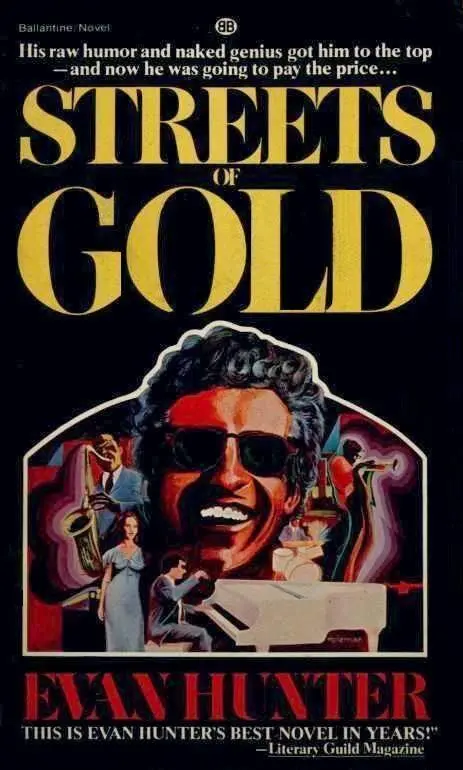
- Название:Streets of Gold
- Автор:
- Издательство:Ballantine Books
- Жанр:
- Год:1975
- Город:New York
- ISBN:978-0-345-24631-8
- Рейтинг книги:4 / 5. Голосов: 1
-
Избранное:Добавить в избранное
- Отзывы:
-
Ваша оценка:
Streets of Gold: краткое содержание, описание и аннотация
Предлагаем к чтению аннотацию, описание, краткое содержание или предисловие (зависит от того, что написал сам автор книги «Streets of Gold»). Если вы не нашли необходимую информацию о книге — напишите в комментариях, мы постараемся отыскать её.
Streets of Gold — читать онлайн бесплатно полную книгу (весь текст) целиком
Ниже представлен текст книги, разбитый по страницам. Система сохранения места последней прочитанной страницы, позволяет с удобством читать онлайн бесплатно книгу «Streets of Gold», без необходимости каждый раз заново искать на чём Вы остановились. Поставьте закладку, и сможете в любой момент перейти на страницу, на которой закончили чтение.
Интервал:
Закладка:
“Right. But when Powell plays a C-minor, all he hits are the C and the B flat. With his pinkie and his thumb, you dig? He leaves out the insides, he just gives you the shell. He feeds those shells to the horn players, and they blow pure and fast and hard, without that fuckin’ pounding rhythm and those ornate chords and runs going on behind them all the time, and lockin’ them in, ’scuse me, Poots. Piano players just can’t play that way no more.”
“ Tatum does,” I said. “And so does Wilson.”
“A dying breed,” Biff said in his English accent, “virtually obsolete. Look , man, I was with Marian McPartland the first time she heard Bud play, and she said to me, ‘Man, that is some spooky right hand there,’ and she wasn’t shittin’. That right hand is spooky, the things he does with that right hand. He plays those fuckin’ shells with his left — the root and seventh, or the root and third — because he’s got tiny hands, you see, he couldn’t reach those Tatum tenths if he stood on his fuckin’ head, ’scuse me, Poots. Some of the time he augments the shell by pickin’ up a ninth with the right hand, but mostly the right is playin’ a horn solo, you dig? He’s doin’ Charlie Parker on the piano. There are three voices dig? Two notes in the shell, and the running line in the right hand, and that’s it. Tatum runs? Forget ’em, man! They’re what a piano player does when he can’t think of nothin’ new, he just throws in all those rehearsed runs that’re already in his fingers. That ain’t jazz, man. That’s I don’t know what it is, but it ain’t jazz no more.”
“You people going to pay rent on that table?” Gottlieb said.
“What’re you thinking, kid?” Biff asked. “I can’t tell what you’re thinking behind them shades.”
“I just don’t understand what you’re saying.”
“You don’t, huh? Well, here it is in a nutshell, kid. The rhythm ain’t in the left hand no more — it’s passed over to the right. The left hand is almost standin’ still these days. And if you want to keep on playin’ all that frantic shit, then you better play it all by yourself, ’cause there ain’t no band gonna tolerate it. That’s it in a nutshell.”
“I still want to play like Tatum,” I said.
“You’ll be followin’ a coffin up Bourbon Street,” Biff said. “Look, what the hell do I care what you play? I’m just tryin’ to tell you if you’re startin’ now , for Christ’s sake, don’t start with somethin’, already dead . Go to the Street, man, Fifty-second Street, dig what the cats are doin’. If you don’t like it, then, man, that’s up to you. But I’m tellin’ you, sure as this sweet li’l thing is sittin’ here beside me, Tatum and Wilson are dead and the Bird is king, and jazz ain’t never gonna be the same again.” He suddenly burst out laughing. “Man, the cats goan drum me clear out of the tribe. They got strong hostility, them boppers.”
“I want to hear them play,” I said.
“Get your uncle to take you down the Street. Diz an’ Oscar — Pettiford, Oscar Pettiford — got a fine group at the Onyx, George Wallington on piano. Go listen to them.”
“Will you take me there, Mr. Anderson?”
“Me? I don’t know you from a hole in the wall,” Biff said.
“Oh, take the fuckin’ kid,” Poots said.
Well, he didn’t take me. He didn’t take me because, as it happened, he was leaving for California in a week to play a gig out there, and if things went well for him, he would stay there through the winter and spring, and probably wouldn’t be back in New York till June or July. When I asked him if he’d take me to the Street when he got back, he told me again that he didn’t know me from a hole in the wall, and said I should get my uncle to take me. Uncle Luke was still asleep, and snoring very loudly at that point. I told Biff my uncle had other things to do, and besides, he couldn’t teach me to play the kind of piano I wanted to play. Biff said Now hold it just one minute, kid, who said anything about teaching you piano? I never taught anybody in my life, and I ain’t about to start now. I don’t know you from a hole in the wall, go down the Street, get yourself some bop records, it’s been nice talkin’ to you.
My mother would not allow me to go down to Fifty-second Street, either alone or accompanied by Luke. She said she wanted me to maintain my good grades at Santa Lucia’s, especially since I’d be graduating in June, and besides, I was doing enough gallivanting, what with running off on mysterious errands every time the phone rang. The telephone calls were from Susan Koenig, of course, and they would notify me that her mother would be gone for the evening or the afternoon, whereupon I would hop the trolley to Mount Vernon and spend a few blissful hours in bed with her. Or up against the sink. Or on the kitchen table. All that ended in April when her brother — whose obnoxious name was Franklin — was inconsiderate enough to get himself shot in the foot by a Japanese sniper, thereby earning himself a Purple Heart and managing somehow to finagle a boat ticket to the States at a time when nobody, but nobody , was being sent home for minor wounds. In April, too, a week or so before Easter, the Virgin Mary came down to visit my mother and precipitated a family crisis that was more immediate to me than jazz, or the war, or the fact that Susan seemed to prefer her brother’s brand of houghmagandy to mine.
She appeared to my mother on 218th Street and White Plains Avenue at three o’clock in the afternoon. There is nothing particularly noteworthy about that corner, and God alone knows why Mary chose it for her return to Earth. My mother had been out marketing, and was loaded down with shopping bags as she wended her gentle way homeward that afternoon. The Virgin was wearing black. Black topcoat and black stockings, black shoes, and a small black hat. She approached my mother and said, “Stella Di Palermo?”
“Yes?” my mother answered, puzzled. She had never seen this woman before. We had been living in the Bronx for seven years, and my mother knew most of the neighborhood ladies, but this woman was a stranger to her.
“I’m telling you this for your own good,” the woman said. “Your husband Jimmy is in love with a woman on Pelham Parkway. He goes to see her almost every day, after work.”
“Who are you?” my mother asked.
“Never mind,” the woman said. “God bless you, Stella,” and walked off.
My mother stood there watching her as she disappeared. She was forty-one years old, young Stella, and a strange lady in black had just told her that her beloved husband was enamored of a woman on Pelham Parkway, which was exactly where my father delivered mail. My mother immediately concluded that the woman in black was the Virgin Mary. Why this association should even have occurred to a person who hadn’t been inside a church for twenty-one years is beyond me, but again, I have no desire to probe the convoluted mental processes of anyone who happens to be my mother. Maybe Easter had something to do with it. Maybe the religious identification was triggered by the fact that my mother had seen a miniature replica of the crucifixion in the window of the butcher shop an instant before she was confronted by the lady in black. It doesn’t matter. My mother gets these fixed ideas. If Charlie Shoe was a hophead rape artist, then the lady in black was the Virgin Mary, and that was that. And that , believe me, was more than enough. As fate would have it, my father was late getting home from work that afternoon, and this naturally confirmed everything the Virgin Mary had whispered to my mother in the street. I was not as fortunate as my father; I got home from school at my usual time and found a raving lunatic in the kitchen.
Читать дальшеИнтервал:
Закладка:
Похожие книги на «Streets of Gold»
Представляем Вашему вниманию похожие книги на «Streets of Gold» списком для выбора. Мы отобрали схожую по названию и смыслу литературу в надежде предоставить читателям больше вариантов отыскать новые, интересные, ещё непрочитанные произведения.



Обсуждение, отзывы о книге «Streets of Gold» и просто собственные мнения читателей. Оставьте ваши комментарии, напишите, что Вы думаете о произведении, его смысле или главных героях. Укажите что конкретно понравилось, а что нет, и почему Вы так считаете.