Evan Hunter - Streets of Gold
Здесь есть возможность читать онлайн «Evan Hunter - Streets of Gold» весь текст электронной книги совершенно бесплатно (целиком полную версию без сокращений). В некоторых случаях можно слушать аудио, скачать через торрент в формате fb2 и присутствует краткое содержание. Город: New York, Год выпуска: 1975, ISBN: 1975, Издательство: Ballantine Books, Жанр: Современная проза, на английском языке. Описание произведения, (предисловие) а так же отзывы посетителей доступны на портале библиотеки ЛибКат.
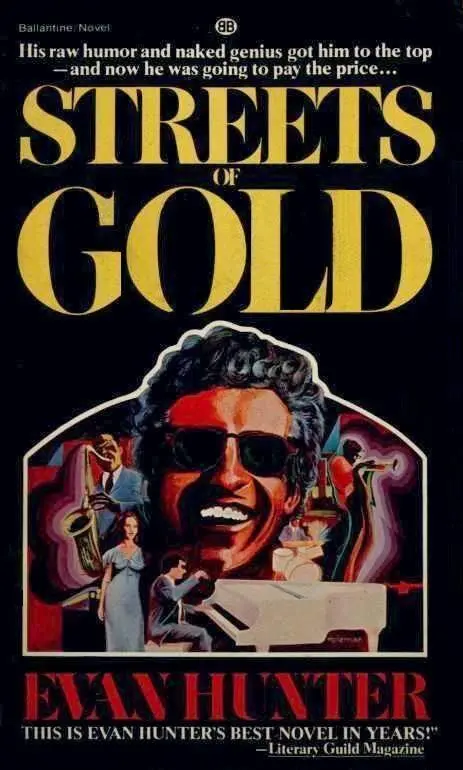
- Название:Streets of Gold
- Автор:
- Издательство:Ballantine Books
- Жанр:
- Год:1975
- Город:New York
- ISBN:978-0-345-24631-8
- Рейтинг книги:4 / 5. Голосов: 1
-
Избранное:Добавить в избранное
- Отзывы:
-
Ваша оценка:
Streets of Gold: краткое содержание, описание и аннотация
Предлагаем к чтению аннотацию, описание, краткое содержание или предисловие (зависит от того, что написал сам автор книги «Streets of Gold»). Если вы не нашли необходимую информацию о книге — напишите в комментариях, мы постараемся отыскать её.
Streets of Gold — читать онлайн бесплатно полную книгу (весь текст) целиком
Ниже представлен текст книги, разбитый по страницам. Система сохранения места последней прочитанной страницы, позволяет с удобством читать онлайн бесплатно книгу «Streets of Gold», без необходимости каждый раз заново искать на чём Вы остановились. Поставьте закладку, и сможете в любой момент перейти на страницу, на которой закончили чтение.
Интервал:
Закладка:
Inspiring me with tales of Great Musicians He Had Known, firing my ambition (“You will win all the prizes, you will perform in Carnegie Hall!”), he pushed me into the Beethoven C-Minor because he honestly believed I would win all the awards. Then, as now, there were prestigious young musicians’ prizes being offered all over the country — Eastern Seaboard, West Coast, and points between. Like a farmer who had fattened a hog, Passaro was anxious to exhibit his livestock and cop a blue ribbon, and push he did, oh, how he pushed! And I, in turn, missing my brother tremendously, fearful he would be sent overseas at any moment, accepted each new Passaro prod gratefully, and stilled my anxieties by spending hours at the keyboard. “That’s nice, Iggie,” my mother would say. “Play that part again.” I played that part again. And again. And again, and again, and again. And the months passed painlessly.
I can never truly understand motivation. Cause and effect have always been mysteries to me, except at the piano. I still don’t know whether the Rachmaninoff concert had anything at all to do with my later decision to move into jazz. Passaro obtained the tickets three months in advance, and had shpieled nothing but Rachmaninoff, Rachmaninoff, Rachmaninoff all through August, September, and October. I don’t know whether it rained for twelve days and twelve nights in June of 1901, when my grandfather was digging his subway, but I do know what the weather was like on November 7, 1942, because I vas dere, Sharlie. It was cloudy but mild most of the day. In fact, the temperature was hovering in the low fifties when we entered the concert hall which (Passaro kept telling me) would one day resound with cheers for me , Ignazio Di Palermo, supreme virtuoso. The hall was packed. I am blind, and I do not like crowds. Passaro guided me through the throng, his hand firm on my elbow. This annoyed me. He should have known better than to be shoving me through the goddamn crowd. Our seats were in the balcony, we took the elevator up, there were excited voices everywhere around me, people bumping into me. Passaro’s guiding fingers pushed at my elbow, we found our row, “Excuse me, excuse me,” Passaro said, pulling me behind him now as we moved past knees and more knees, searching for our seats.
“There are chairs on the stage,” Passaro whispered to me. “Wooden chairs. There must be more than a hundred of them. Folding chairs, Iggie. Every seat in the house is filled. Oh, Iggie, can you feel this? Can you feel the excitement?”
There was indeed a hum in the air, an almost tangible sense of expectation, tinglingly electric. Passaro read to me from the program. Rachmaninoff was to play his own transcriptions of the Prelude, Gavotte, and Gigue from Bact’s Partita in G Major, followed by Beethoven’s Opus 31, Number 2, and then a Chopin program, including the C-Minor Polonaise (I remembered the first time I had ever heard it, when Passaro reached across me on that January day in 1935, and I remembered him asking if I thought I could play it in three months’ time), and then Rachmaninoff’s own Etudes-Tableaux (“You yourself will compose one day,” Passaro whispered to me), and finally a selection of Liszt pieces. The audience fell silent all at once, the absence of sound shocking after the incessant hum that had preceded it. “Here he comes,” Passaro whispered into my ear, and then, with the precision of a single pistol shot, the audience broke into applause. “He’s crossing to the piano,” Passaro whispered. “He’s sitting,” and the applause stopped as abruptly as it had begun, its brief thunder replaced by a stillness now laden with the agony of anticipation.
Rachmaninoff began playing.
The concert was disappointing for both of us, on different levels and in different ways. All the way back to Tremont Avenue, Passaro could not stop talking about how badly Rachmaninoff had played.
“Ah, yes, it is all there still, of course, he is a master, he is a giant, there is no one today who understands the mechanics of the keyboard the way he does, nessuno , and he is sixty-nine years old, remember! Did you hear the way he handled the pianissimi — a whisper, a caress, a touch of balmy air. And the fortissimi! Did you hear, Iggie? He does not pound, he is strong, there is force and power, but he does not pound, do you understand now why I tell you ‘Don’t pound,’ eh?
“But what? Is that Bach he played, or is it Rachmaninoff? How dare he add counterpoint to the Prelude? A giant, yes, but what was Bach, a midget? There is a style to Bach that cannot be tampered with, I don’t care about pianistic effectiveness, is this a circus sideshow? This is Bach , and he does not need contrapuntal embroidery, nor does he need what Rachmaninoff did with the Gavotte, those harmonies and figurations, what were those? Those were unforgivable lapses of taste. Beethoven, all right, I can understand. He has never played a Beethoven sonata well in his life. Good phrasing, enormous charm, but no feeling , and what is Beethoven if not feeling? The Adagio movement, especially, did you hear it? Why, why, why did he play it allegretto? He made it sound like a Field nocturne; what is the matter with that man?
“Speed, speed, all was speed, he was running a foot race. Even the Chopin was played too rapidly, although, yes, I hope you noticed the way he played the F-Sharp Nocturne, did you hear those lovely, lovely details, yes, that was good, that was magnificent, that is the Rachmaninoff I took you to hear. But the Polonaise? Too fast. And the F-Minor Ballade? Why did he choose to turn its beautiful theme into a sickening little waltz, and then accentuate it on the off beat when it entered again later, in the bass? The Scherzo? Too fast. Chopin did not intend it to be played so fast, that was not his meaning. The Liszt, of course, well, what can one say about Rachmaninoff’s Liszt? His Liszt has always been magic, and today, yes, I suppose, yes, perhaps. Perhaps there and in the Chopin nocturne, you heard the real Rachmaninoff. But the rest? Ah, forgive me, Iggie, eh? I wanted more for you. I wanted you to hear more.”
As for me, I’d heard more than enough.
In fact, I didn’t know what Passaro was talking about. I had been overwhelmed by Rachmaninoff’s mastery of the instrument, his dazzling speed, the brilliance of the tones he coaxed, whipped, snapped, teased, demanded from the piano, the soaring giddiness of his invention, the breadth and depth of his interpretations. Stunned and speechless, I’d sat through the entire performance scarcely breathing for fear he would somehow miss the trapeze, falter in the midst of his aerial keyboard acrobatics and tumble to the sawdust below.
When we left Carnegie Hall, I was crushed.
For despite Passaro’s wild promises of prizes to be won and accolades to follow, I knew for certain on that dismal November day that I would never in a million years be able to play the way that man up there on the concert stage had played.
On the sixth day of July in the year 1943, four days before General Patton’s Seventh Army invaded the island of Sicily, my brother Tony wrote a letter to my grandfather. It was a very brief letter, and it was written entirely in Italian, which Tony had tried to learn at Evander Childs High School.
Caro Nonno,
Non posso rivelare esattamente dove son’io adesso, ma basta il dire che in breve tempo io vedero tutt’i posti che tu hai avuto descrivuto quand’ero piccolo. Non poss’ aspettare! Scusi, per piacere, il mio ltaliano misero! Ti voglio bene.
Il suo nipote,
AntonioRoughly translated, my brother had written:
Dear Grandpa,
Читать дальшеИнтервал:
Закладка:
Похожие книги на «Streets of Gold»
Представляем Вашему вниманию похожие книги на «Streets of Gold» списком для выбора. Мы отобрали схожую по названию и смыслу литературу в надежде предоставить читателям больше вариантов отыскать новые, интересные, ещё непрочитанные произведения.
Обсуждение, отзывы о книге «Streets of Gold» и просто собственные мнения читателей. Оставьте ваши комментарии, напишите, что Вы думаете о произведении, его смысле или главных героях. Укажите что конкретно понравилось, а что нет, и почему Вы так считаете.