Evan Hunter - Streets of Gold
Здесь есть возможность читать онлайн «Evan Hunter - Streets of Gold» весь текст электронной книги совершенно бесплатно (целиком полную версию без сокращений). В некоторых случаях можно слушать аудио, скачать через торрент в формате fb2 и присутствует краткое содержание. Город: New York, Год выпуска: 1975, ISBN: 1975, Издательство: Ballantine Books, Жанр: Современная проза, на английском языке. Описание произведения, (предисловие) а так же отзывы посетителей доступны на портале библиотеки ЛибКат.
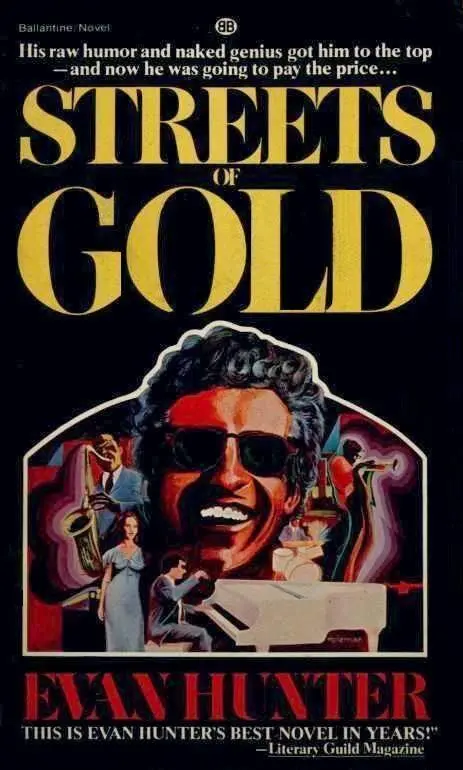
- Название:Streets of Gold
- Автор:
- Издательство:Ballantine Books
- Жанр:
- Год:1975
- Город:New York
- ISBN:978-0-345-24631-8
- Рейтинг книги:4 / 5. Голосов: 1
-
Избранное:Добавить в избранное
- Отзывы:
-
Ваша оценка:
Streets of Gold: краткое содержание, описание и аннотация
Предлагаем к чтению аннотацию, описание, краткое содержание или предисловие (зависит от того, что написал сам автор книги «Streets of Gold»). Если вы не нашли необходимую информацию о книге — напишите в комментариях, мы постараемся отыскать её.
Streets of Gold — читать онлайн бесплатно полную книгу (весь текст) целиком
Ниже представлен текст книги, разбитый по страницам. Система сохранения места последней прочитанной страницы, позволяет с удобством читать онлайн бесплатно книгу «Streets of Gold», без необходимости каждый раз заново искать на чём Вы остановились. Поставьте закладку, и сможете в любой момент перейти на страницу, на которой закончили чтение.
Интервал:
Закладка:
I can’t reveal exactly where I am at the moment, but suffice it to say that in a short while I’ll be seeing all the places you described when I was little. I can’t wait! Please excuse my miserable Italian. I love you.
Your grandson,
TonyMy grandmother called the day they received the letter. I answered the telephone, and she told me first that they’d heard from Tony, and then she read the letter to me in Italian, and then translated it. She told me his Italian wasn’t really too bad, and she wondered why he had apologized for it. Then she asked me how the piano was coming along, and finally told me to put my mother on. That was on July 12, six days after my brother had mailed the letter. We later figured it had been posted from North Africa, where Patton’s invasion force was massed for the strike at what Winston Churchill called the “soft underbelly” of Europe.
Eight days later, on the twentieth, my brother was killed in the vicinity of Porto Empedocle, on the western coast of Sicily. The War Department telegram arrived on the twenty-first, and a letter from Tony’s lieutenant, a man named Arthur G. Rowles, arrived two weeks later. There wasn’t much Rowles could say. He wrote that my brother had fought bravely and well. He reported that he had been killed by an Italian soldier who, in the midst of what appeared to be a headlong, disorganized retreat, had suddenly whirled, raised his rifle, and fired blindly and erratically at the advancing squad. Only one of his bullets struck home, the one that killed Tony — “instantly and mercifully, he did not suffer,” the lieutenant wrote. Why the Italian had not surrendered, as his comrades were doing everywhere around him, was a mystery to the lieutenant. He wrote, too, that a heavy artillery attack, German or American, began almost the moment my brother fell to the ground. The man who had slain him threw his rifle down and began running up the road to Porto Empedocle as it erupted in blossoms of earth and boulders and hot flying shrapnel. He was still running, still on his feet, apparently unscathed, as he disappeared into the dust.
We did not tell my grandfather that an Italian had killed Tony.
I went into his room.
It was raining. The rain lashed the room’s single window, which opened on a potholed driveway that ran steeply from the street to the small porch outside the kitchen. We usually came in through the kitchen door, Tony and I.
I sat on his bed.
I listened to the rain in the gutters and the drainpipes and against the windowpanes. There was undirected anger in my grief. I was angry at General Patton, who had sent my brother into combat. I was angry at my grandfather, who had refused to let Tony fly, and angry at my mother, who had steadfastly upheld his greaseball decision. And I was angry at Tony, for letting himself get killed. What the hell was the matter with him, getting killed like that? And I began to cry again.
I played his records because I was angry and grief-stricken. I played them in defiance of his privacy and his secrecy, played them in a futile attempt to find him again, to share with him something he had loved, to make his records and therefore himself an ineradicable part of me . I found them on the shelves above the record player my parents had given him for his thirteenth birthday. I selected one at random, put it on the turntable, and turned the volume control up full. When my mother heard the music blaring, she came into the room.
“Iggie?” she said. Her voice was tremulous. She had not stopped crying since the telegram arrived. “What are you doing, baby?” she asked, and sat beside me, and gently passed her hand over my forehead, brushing back my hair.
“Listening,” I said.
I listened all that night. There were 347 records in his collection. He had taken very good care of them, but he had also played them often and they were badly worn. The sound sputtered and crackled from the speaker, the needle caught in tired grooves and endlessly repeated notes or full measures, skipped over hairline cracks, skimmed the shellacked surfaces of the 78s. I had heard some of the tunes before, on the radio. But the others, the ones I had not heard...
You can believe this or not. I have known jazz musicians for the better part of my life, I have played with them and rapped with them, and suffered with them, and I can tell you that my experience was not unique. Anyway, I don’t care what you think; this is the way it happened. I could not read the labels on the records, and to me the ten-inch disks all felt the same. I recognized some of the tunes, but I did not know who was playing them. I kept pulling the records from the shelves and removing them from their protective sleeves and putting them on the turntable haphazardly, mixing swing with ragtime with boogie-woogie with Dixieland with barrelhouse with stride with blues, big bands and small ensembles, vocalists and soloists, a hopeless melange of chronology and style.
I called my mother into the room. It was three o’clock in the morning. She had been lying awake, I realized, because she came to me instantly.
“Who’s this?” I asked, and handed her the record I had just heard.
“Just a minute,” she said. “Let me put on a light.”
I heard the click of the floor lamp alongside Tony’s bed.
“Let me see,” my mother said, and took the record from my hand. “Art Tatum,” she said. She pronounced his name “Tattum.”
“Are there any more of his?” I asked.
“What?”
“On the shelf.”
“Iggie, it’s late. Can’t you...?”
“Mom, please . Are there any more records by him?”
“Just a minute,” she said. I heard her rummaging around. “Iggie, I need my glasses,” she said.
I waited. When she came back, she said, “Tony loved these records.”
“Yes,” I said.
“Do you like them, Iggie?”
“Yes,” I said.
“Tch,” she said, and in that single meeting of tongue with gum ridge, she came to terms with my brother’s death. The click that resonated into the silence of Tony’s room was desolate and forlorn; it echoed a Neapolitan acceptance of the inevitability of fate. As she looked through the records on his shelves, she spoke to me and to herself in disconnected phrases and sentences separated by long silences and the crackle of the stiff paper sleeves on my brother’s records. “Uncle Dominick used to take him to Yankee Stadium,” or “Seven pounds, six ounces; a very big baby,” or “Always good to you,” or “Do you remember when he sat on Pino’s cigar?” or “Loved that girl so much,” or “Lou Gehrig, it was,” or as she searched, “Tattum, Tattum,” and finally, “He died for America, Igg.”
She handed me the records she had found.
“Can you listen to them in the morning?” she asked. “Your father has to go to work. You’re keeping him up, Iggie.”
“I’ll play them very low,” I said.
“Did you love him, Igg?”
“I loved him,” I said.
“He’s dead.”
“Yes, Mama.”
“He’s dead,” she said, and went out of the room.
I listened to Tatum.
And first I thought That’s it . That’s how I want to play.
And then I thought I can do that. I can play that.
I listened again. I played the records again and again. And I became more and more convinced that I could do it, I could actually do it. I sat trembling with discovery, each brimming chord, each gliding arpeggio absorbed by my very skin, penetrating, vibrating within me as though some secret unborn self were augmenting the sound, the music threatening to explode from my dead eyes and my shaking hands, lift off the top of my skull, flow ceilingward in a dizzying fireworks display of sharps and flats and triplets and thirty-second notes. I must have made my decision at once, long before I’d heard all the Tatum records, long before I’d run them through the machine a second, third, and fourth time; I probably had made the decision even before I’d called my mother into the room to identify this man who was playing piano as I’d never heard it played before. It was that sudden, it was that simple, I make no apologies. It happened that way. I heard jazz for the first time in my life, played by a giant, on my instrument, and I v knew at once that this was the way the piano was meant to be played, and this was the way I was going to play it from that moment on.
Читать дальшеИнтервал:
Закладка:
Похожие книги на «Streets of Gold»
Представляем Вашему вниманию похожие книги на «Streets of Gold» списком для выбора. Мы отобрали схожую по названию и смыслу литературу в надежде предоставить читателям больше вариантов отыскать новые, интересные, ещё непрочитанные произведения.
Обсуждение, отзывы о книге «Streets of Gold» и просто собственные мнения читателей. Оставьте ваши комментарии, напишите, что Вы думаете о произведении, его смысле или главных героях. Укажите что конкретно понравилось, а что нет, и почему Вы так считаете.