Evan Hunter - Streets of Gold
Здесь есть возможность читать онлайн «Evan Hunter - Streets of Gold» весь текст электронной книги совершенно бесплатно (целиком полную версию без сокращений). В некоторых случаях можно слушать аудио, скачать через торрент в формате fb2 и присутствует краткое содержание. Город: New York, Год выпуска: 1975, ISBN: 1975, Издательство: Ballantine Books, Жанр: Современная проза, на английском языке. Описание произведения, (предисловие) а так же отзывы посетителей доступны на портале библиотеки ЛибКат.
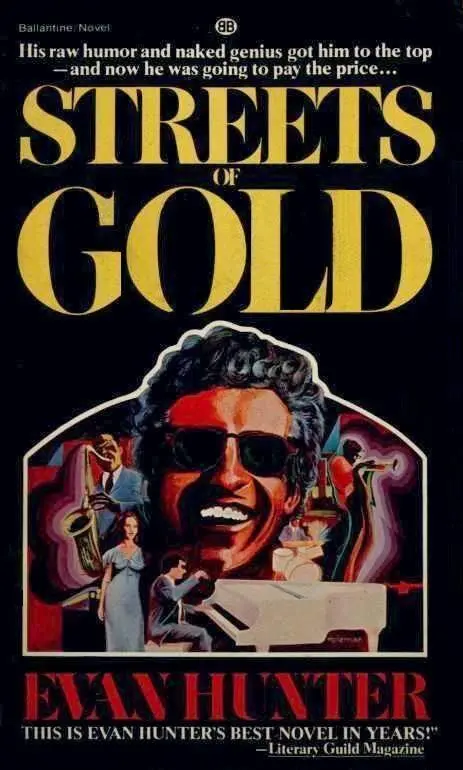
- Название:Streets of Gold
- Автор:
- Издательство:Ballantine Books
- Жанр:
- Год:1975
- Город:New York
- ISBN:978-0-345-24631-8
- Рейтинг книги:4 / 5. Голосов: 1
-
Избранное:Добавить в избранное
- Отзывы:
-
Ваша оценка:
Streets of Gold: краткое содержание, описание и аннотация
Предлагаем к чтению аннотацию, описание, краткое содержание или предисловие (зависит от того, что написал сам автор книги «Streets of Gold»). Если вы не нашли необходимую информацию о книге — напишите в комментариях, мы постараемся отыскать её.
Streets of Gold — читать онлайн бесплатно полную книгу (весь текст) целиком
Ниже представлен текст книги, разбитый по страницам. Система сохранения места последней прочитанной страницы, позволяет с удобством читать онлайн бесплатно книгу «Streets of Gold», без необходимости каждый раз заново искать на чём Вы остановились. Поставьте закладку, и сможете в любой момент перейти на страницу, на которой закончили чтение.
Интервал:
Закладка:
My mother adored Michelle Dulac — naturally.
“Bonjour, Michelle,” she would say. “Comment allez-vous aujourd’hui?”
“Très bien, merci, et vous, Madame Di Palermo?”
“Comme ci, comme ça,” my mother would reply, beaming, and then, because Michelle and I were on our way to the movies, she would add, “Vite, vite, nous manquerons le match de football!”
At the movies, Michelle and I sat in the children’s section and watched ( she watched, I listened to) six cartoons, two chapters, a newsreel, and two feature films starring the motion picture families of the various studios, and these blended in my mind to become one big movie family which in turn became a part of our family, the great American family that seemed to be proliferating wildly and uncontrollably and excitingly, the democratic experiment on the very edge of proving itself valid and enduring, the impurities burning off in the crucible of hard times easing, the residual mettle hardening into something glowing and impervious.
In the evenings, or on long summer afternoons when I’d finished my practicing or my homework, I went over to Michelle’s and she read to me aloud from her vast collection of comic books, introducing a whole new batch of families to add to those already surrounding me, comforting me, nourishing me. None of the neighborhood kids considered our relationship serious, possibly because a blind person isn’t expected to have a “girl friend” in the accepted sense, especially when he’s only eleven and the girl is three months younger. (Tony knew better.) Too, since I couldn’t play football or baseball or handball except with the kids at Santa Lucia’s (and those athletic contests were full-scale riots, believe me), the other kids on the block thought it perfectly reasonable for me to have a girl for a fast friend, and readily accepted the fact that blind Iggie spent a lot of time on the floppy old couch in the Dulac living room, the windows behind us open to the sounds of the street and the shouts of the other children, Michelle reading aloud the ballooned dialogue of the comic book heroes and heroines, and describing the action in the drawings.
Outside, we heard the bells of the Good Humor truck, and the voices of the women calling to each other in English or Italian.
The first girl I ever kissed was Michelle Dulac.
I kissed her on a January day in 1940, after two years and nine months of movies and comic books. She had a collection as high as the ceiling. It occurs to me that if she still owns it, it must be worth a fortune. But why would she still own it? Superman and the brood he spawned died with the rest of the family, even though their mummified corpses are still around.
The first breast I ever touched was Michelle Dulac’s.
I touched it in the back seat of her father’s Pontiac coming home from Orchard Beach on the Fourth of July that same year. We were both thirteen, we were both wearing damp bathing suits. Michelle said she was a little chilly, and draped a blanket over us, covering us to our chins. In the front seat, Mr. and Mrs. Dulac were talking to each other in French. The rain that had forced us to leave the beach was drumming on the roof of the automobile. The blanket was sandy. My hand hovered an inch above Michelle’s right breast for perhaps twenty minutes, the fingers spread and suspended between the blanket and the top of her bathing suit, the entire hand paralyzed. When I finally mustered the courage to touch her (would she scream?), I attacked her hapless budding tit with a ferocity I normally reserved for the third movement of Bact’s Italian Concerto. Mixing styles and techniques, I played arpeggios up and down that tiny perfect slope, tapped two-fingered trills on the scant nipple, shifted to the bass clef and executed a pianistically perfect series of descending triplets from her left collarbone to her left breast, and then attempted a swift, smooth glissando to her belly button. She grabbed my wrist.
“Careful,” she murmured, and her father up front said, “What, Michelle?” and she said, “Truck up ahead,” and he said, “I see it,” and still clutching my wrist, she brought my hand back up to her breasts again. We were both panting when we pulled up in front of her house on 217th Street.
“Are we home already?” Michelle asked breathlessly.
“Home sweet home,” her father said.
Under the blanket, Michelle was frantically retying the straps of her bathing suit, which she had loosened to allow me greater finger dexterity, musical genius that I was. I was meanwhile trying to figure how I could get out of the automobile without exposing the grotesque bulge in my trunks.
“It’s still raining,” her mother said. “Why don’t you kids stay in the car till it stops? Or shall I get you an umbrella?”
“No, we’ll stay in the car,” Michelle said.
We stayed in the car, or the equivalent of the car, for the next thirteen months. I felt her up constantly. Every chance I got, I felt her up. I felt her up in her living room and in her kitchen and once in her bedroom when her parents were away for the evening. I felt her up riding behind her on the rack of her bicycle, and I felt her up in Bronx Park under the trees and sitting on benches and lying on the grass; I felt her up incessantly. I felt her up in the Loews Post and the Laconia and the Melba and the Wakefield, and I felt her up on the Grand Concourse in the Loews Paradise, and in Mount Vernon at both the Embassy and the Biltmore, while the voices of my vast American family flooded warmly and approvingly from the theater speakers. I felt her up against the schoolyard fence and against the clapboard shingles of Mr. Locchi’s house while my mother entertained the ladies of her sewing club upstairs, and I felt her up in more driveways and behind more hedges than anyone on the block or in the entire Bronx even knew existed. From July of 1940, when I was still thirteen, to the day she moved away in the fall of 1941, when I was almost fifteen, I deliriously stroked, squeezed, kneaded, patted, probed, and poked those perfect pubescent peaks as they metamorphosed with her own advancing adolescence into beautiful, bountiful, bouncing, bursting... I get carried away even now.
“Je t’aime, je t’adore, qu’est-ce que tu veux encore?” Michelle would ask in metered breathlessness, but each time I demonstrated what more I desired, each time my hand wandered down to the hem of her skirt, her own hand would dart out with all the terrible swiftness of The Flash, and her fingers would grip my wrist with the viselike strength of Sheena of the Jungle. “No, baby,” she would say, “not now.” Not now meant never. Only once did I manage to steal my hand onto the soft silken secret of her panties, and then for just an electric instant before those swift descending fingers closed again upon my wrist and snatched my hand away.
In August of 1941, her father took a job teaching at a Queens high school. We said our good-byes one early September midnight, locked in embrace on the lawn behind the house of an old ginzo we called “The Paintbrush” because of his walrus mustache, the crickets and katydids racketing in the bushes, my hands desperately clutching those prized departing possessions.
“I love you,” she whispered. “I’ll always love you, Iggie.”
“Oh, and I love you, Michelle. Oh, God , how I love you.”
She moved out of my life forever the very next day.
She remains the most beautiful woman I have ever known.
My brother Tony was seventeen years old when the Japanese bombed Pearl Harbor. He immediately asked my mother for permission to enlist in the Air Corps. My mother talked it over with my father, and then my grandfather, and then got back to Tony with an unequivocal “No.”
Читать дальшеИнтервал:
Закладка:
Похожие книги на «Streets of Gold»
Представляем Вашему вниманию похожие книги на «Streets of Gold» списком для выбора. Мы отобрали схожую по названию и смыслу литературу в надежде предоставить читателям больше вариантов отыскать новые, интересные, ещё непрочитанные произведения.


Обсуждение, отзывы о книге «Streets of Gold» и просто собственные мнения читателей. Оставьте ваши комментарии, напишите, что Вы думаете о произведении, его смысле или главных героях. Укажите что конкретно понравилось, а что нет, и почему Вы так считаете.