Evan Hunter - Streets of Gold
Здесь есть возможность читать онлайн «Evan Hunter - Streets of Gold» весь текст электронной книги совершенно бесплатно (целиком полную версию без сокращений). В некоторых случаях можно слушать аудио, скачать через торрент в формате fb2 и присутствует краткое содержание. Город: New York, Год выпуска: 1975, ISBN: 1975, Издательство: Ballantine Books, Жанр: Современная проза, на английском языке. Описание произведения, (предисловие) а так же отзывы посетителей доступны на портале библиотеки ЛибКат.
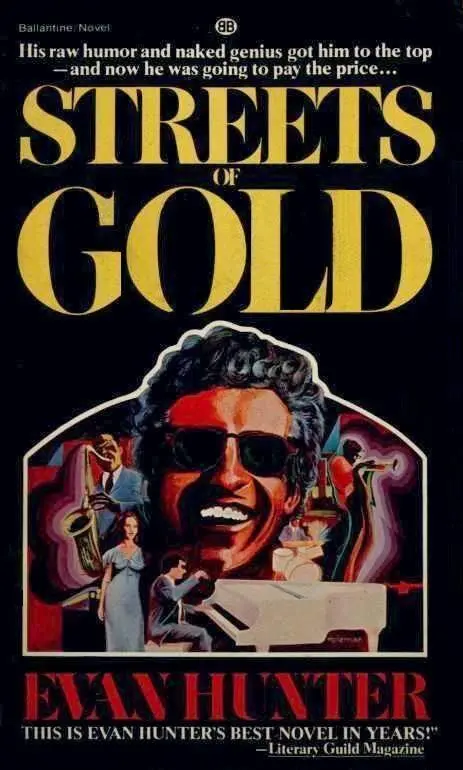
- Название:Streets of Gold
- Автор:
- Издательство:Ballantine Books
- Жанр:
- Год:1975
- Город:New York
- ISBN:978-0-345-24631-8
- Рейтинг книги:4 / 5. Голосов: 1
-
Избранное:Добавить в избранное
- Отзывы:
-
Ваша оценка:
Streets of Gold: краткое содержание, описание и аннотация
Предлагаем к чтению аннотацию, описание, краткое содержание или предисловие (зависит от того, что написал сам автор книги «Streets of Gold»). Если вы не нашли необходимую информацию о книге — напишите в комментариях, мы постараемся отыскать её.
Streets of Gold — читать онлайн бесплатно полную книгу (весь текст) целиком
Ниже представлен текст книги, разбитый по страницам. Система сохранения места последней прочитанной страницы, позволяет с удобством читать онлайн бесплатно книгу «Streets of Gold», без необходимости каждый раз заново искать на чём Вы остановились. Поставьте закладку, и сможете в любой момент перейти на страницу, на которой закончили чтение.
Интервал:
Закладка:
“If you’d like to leave a small deposit with me now, you can talk it over with your hubby, and then if you decide against it, I’ll return the money.”
“How much of a deposit?” my mother asked.
“Whatever you like,” Mrs. Locchi said. “Five dollars? I’ll tell you the truth, the woman who wants the apartment is German. I prefer an Italian family. You’re Italian, aren’t you?”
“I was born here,” my mother said, bridling.
“Oh, me, too ,” Mrs. Locchi said, never once realizing how close she had come to blowing the deal.
Santa Lucia’s was indeed within walking distance, and after Tony had taken me there once or twice, I learned the route by heart, and got there and back without mishap every weekday morning and afternoon. There was one wide avenue, and also three side streets to cross before I got to the school. I sometimes had to wait a long time, especially in the winter, for someone to help me across the streets, but that didn’t bother me. I just busied myself playing piano inside my head, my books and my cane tucked under my arms, my hands nestled in the pockets of my mackinaw, my fingers moving against the felt linings. There were lots of pieces to play in my pockets. I had been playing piano for five years by then, the last almost-three of them under Passaro’s tutelage, and I was firmly convinced that I was a prodigy for whom nothing was too difficult. Preludes and fugues from The Well-Tempered Clavier ? Duck soup for eleven-year-old Ignazio Di Palermo. A Chopin etude, a Mozart sonata, a Debussy prelude, a Ravel pavanne, I had them all in my pockets and under my fingers. I was hot stuff.
Santa Lucia’s was a lot different from the Blind School in New York. At Santa Lucia’s, all the kids were either blind or only partially sighted, and this created a sense of unity that had been totally lacking in Manhattan, where fourteen of us were isolated from the sighted community and made to feel (though not through any fault of Miss Goodbody, bless her heart) like outcasts. There’s a certain similarity between being blind and being black, and I first felt its full impact in the forties, when I began playing jazz. It was then that I realized how dumb those kids on Park Avenue had been. They’d never once understood they were only beating up another nigger. My thinking has changed since the forties. Forget being blind; I now realize we’re all niggers. But back in 1937, during my first week at Santa Lucia’s, conditioned as I was by the Blind School, I tried some of the boastful cruelty that had proved so effective against the little blind bastards in Manhattan.
Fortified by Passaro’s promises, I immediately told my classmates that I was studying to be a concert pianist, and that pretty soon I’d be playing at Carnegie Hall. (You think I’m blind, don’t you? Heh-heh. You’re the ones who are blind. I’m going to play at Carnegie Hall.) The kids told me they thought that was great. Puzzled, I told them I was a musical genius , for Christ’s sake! So the kids asked our teacher if they could hear me play sometime, and Sister Margarita arranged for me to give a recital in the school auditorium. After the recital, all the kids came up and told me I was marvelous, and asked how long it had taken to learn to play that way, and one kid — a girl named Susan Koenig, who had the voice of an angel — held my hand in her own and gently patted it, and said she had never heard anything so beautiful in her life. I had played Beethoven’s “Moonlight” Sonata (which I announced as “ Sonata Quasi Una Fantasia,” to make it sound even more impressive), and I was about to tell her that whereas perhaps I had made a few errors in the exceedingly difficult (in fact, ball-breaking, even to pianists who’ve been playing for half a lifetime) presto agitato movement, I had nonetheless tried it in public, even though I was still working on it — when one of the nuns came over. She introduced herself as Sister Monique and said she had never been able to overcome the first movement’s doubling effect in the right-hand octave, and that somehow the triplets always overwhelmed the melody, and she would be grateful to me if one day I showed her how I’d managed to achieve just the proper touch. I was a trifle flabbergasted. What was this place, anyway — a family?
Well, not quite. But pretty close to one. Santa Lucia’s had been started in 1906 in a four-room apartment in the West Farms section of the Bronx. The man who’d founded it had been blind himself, a devout Catholic who chose to name it after Santa Lucia of Syracuse, the patron saint of anyone afflicted with ophthalmia and other diseases of the eye. There are patron saints for everything and everyone, of course, but Lucy’s story is sort of interesting if you’ve got a minute. Apparently some young swain was so stricken by her gorgeous’ peepers that he told her he was unable to sleep at night, and unable to concentrate on what he was doing during the day. Taking her cue from Christ himself (“If thine eye offend thee, pluck it out”), Lucy did just that, and sent both beautiful orbs to the young man, together with a message that read (according to usually well-informed sources), “Now you have what you desired, so leave me in peace!” The man became a Christian on the spot; Lord knows what he’d been before. And God, ever merciful, later returned Lucy’s eyes and her vision to her while she was at prayer.
In the early days, Santa Lucia’s had accepted only “legally blind children of the Catholic faith,” and had taught them through the sixth grade. But after the death of the founder in 1928, the trustees moved the school to its present location and expanded not only its physical plant but its restrictive entrance requirements as well. When I started there, it was still being administered by nuns, but it was fully accredited by the Regents of the State of New York, and it accepted any legally blind boy or girl over three years of age, regardless of race, creed, or color. That was nice. It fit perfectly into what I thought America was supposed to be. Santa Lucia’s, too, had recently become a six-six school, which meant that once I had completed my elementary-school education (I entered the sixth grade in September of 1937), I could continue my secondary education there for the next six years, without having to look around for another school. I loved Santa Lucia’s, but it took me four months to get my father to come to school and meet the nuns who were teaching me. When he finally did come, he stood silently by my side, and held my hand, and let them do all the talking. His hand was sweating.
For me, everything was beginning to fall into place, and everything seemed right. “If you think this is something, you shoulda seen Mamaroneck ,” Tony said, but to me the Bronx was perfect. I loved the school, I loved the new neighborhood, and I especially loved a little girl across the street, with whom I went to the movies every Saturday, after my piano lesson. Her name was Michelle Dulac, and her father taught French at the junior high school. Tony would take me to my piano lesson, the ride to Passaro’s consuming a half hour of my brother’s burning time, and then he would wait impatiently in the other room while I played Chopin for the next hour, and then he would hurry me home again on the Third Avenue El, impatiently tapping his feet, scarcely able to speak. When we got back to the house at one or a little bit after, he would bolt down a sandwich and swallow a glass of milk in a long single gulp and dash out of the house again, running for the elevated station on 219th Street and White Plains Avenue. His destination? The fair Letitia, whose loss he mourned for a full eight months, his record collection growing in direct proportion to his grief. He never got to play his records for her anymore, because my grandmother took Saturdays off from the tailor shop, and the front room of her house was no longer as sacrosanct as it had been on those long Friday afternoons of yore. But neither did he play them for me . (To an Italian, even a third-generation American Italian, a vow is a vow.) My parents had given him a record player for his birthday-in June, and now that he had his own room, he would go in there and lock the door, and all I heard through the thick wooden panels were the forbidden muffled sounds of the pounding drums and the screaming trumpets and the moaning saxophones, and occasionally the sound of a thirteen-year-old crying.
Читать дальшеИнтервал:
Закладка:
Похожие книги на «Streets of Gold»
Представляем Вашему вниманию похожие книги на «Streets of Gold» списком для выбора. Мы отобрали схожую по названию и смыслу литературу в надежде предоставить читателям больше вариантов отыскать новые, интересные, ещё непрочитанные произведения.


Обсуждение, отзывы о книге «Streets of Gold» и просто собственные мнения читателей. Оставьте ваши комментарии, напишите, что Вы думаете о произведении, его смысле или главных героях. Укажите что конкретно понравилось, а что нет, и почему Вы так считаете.